

Pet Store Inventory Management Guide 2026
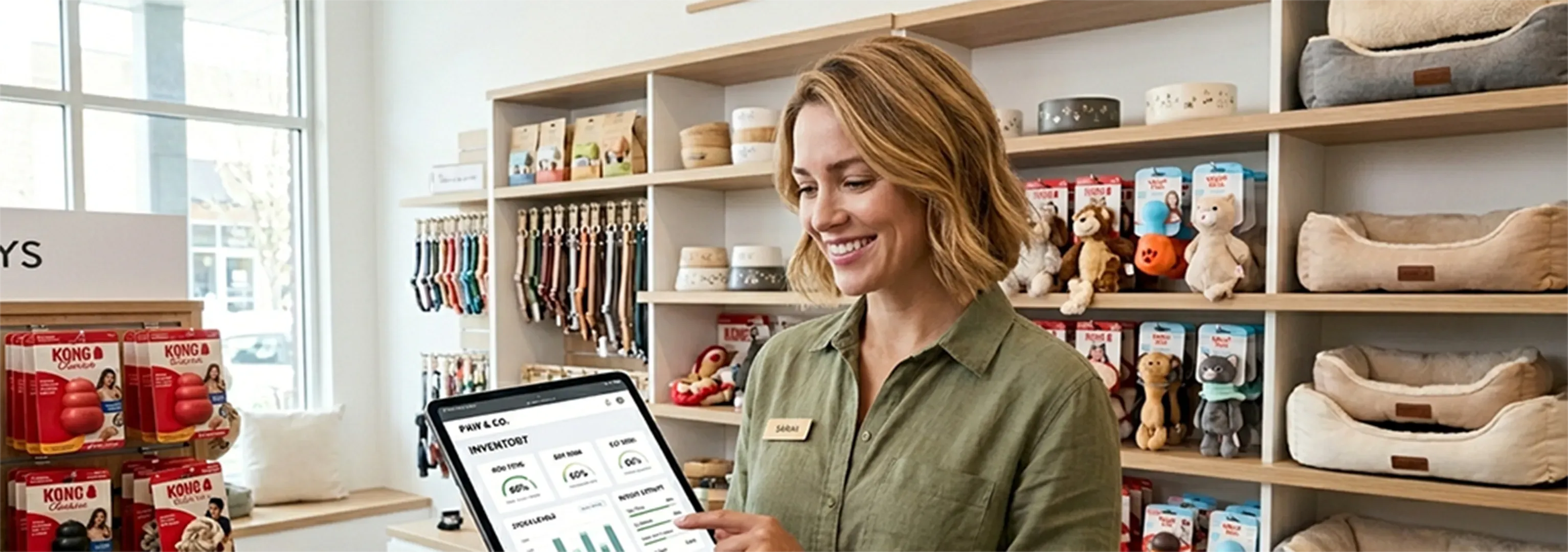
Introduction: Why Inventory Is Your Pet Business’s #1 Profit Lever
Running a successful pet business in 2026—whether a brick-and-mortar boutique, mobile groomer, ecommerce shop, vet clinic retail section, dog training facility, pet rescue, or subscription box brand—requires far more than cute products and loyal customers. It demands data-driven inventory management that turns stock from a static asset into a dynamic profit system.
The U.S. pet supplies, live animals, and OTC medicine category reached $33.3 billion in 2024 and is projected to hit $34.3 billion in 2025, according to the American Pet Products Association (APPA). Globally, categories like dog harnesses, collars, leashes, toys, grooming tools, and cat accessories generate tens of billions in annual spending, creating massive opportunities for small and mid-sized pet businesses.
But here’s the harsh reality: 65% of retail inventory records are inaccurate (per a peer-reviewed study of 370,000 retail inventory records), meaning most pet business owners make critical buying, restocking, and pricing decisions based on flawed data. This leads to three universal pain points:
- Too much inventory = frozen cash flow
- Too little inventory = lost sales and frustrated customers
- Wrong products = dead stock and wasted shelf space
This guide is built for small B and large C pet businesses—groomers, trainers, vet clinics, pet rescues, ecommerce sellers, marketplace resellers, new store owners, breeders, and pet boutiques—who need practical, science-backed inventory strategies. We’ll cover how to calculate ideal stock levels, identify consistent bestsellers, eliminate overstock, choose the right software, and source smarter with global wholesale partners like Petfairs. Every strategy includes real formulas, industry data, and actionable steps you can implement today.
Chapter 1: How Much Inventory Should Your Pet Business Carry? (Data-Driven Answers)
The #1 question from new and growing pet business owners is: “How much inventory do I actually need to carry?” There’s no one-size-fits-all number, but successful pet retailers rely on three core frameworks to eliminate guesswork: reorder points, inventory turnover, and ABC analysis.
1.1 The Reorder Point Formula: Never Run Out of Bestsellers
The reorder point (ROP) is the exact stock level at which you must place a new order to avoid stockouts. It’s the foundation of reliable inventory control.
Reorder Point Formula:
Reorder Point = (Average Daily Unit Sales × Lead Time in Days) + Safety Stock
Real-World Example for Pet Businesses
Suppose you sell 3 step-in dog harnesses per day, your supplier (like Petfairs) has a 14-day lead time, and you keep 20 units as safety stock for demand spikes:
ROP = (3 × 14) + 20 = 62 units
When your inventory position (on-hand + on-order − allocated) hits 62 units, you reorder. This ensures you never run out of high-demand items like no-pull harnesses for pitbulls, dog leashes with loops, or summer dog harnesses—products your customers expect to find in stock.
1.2 Inventory Turnover: Speed > Quantity
Inventory turnover measures how quickly you sell and replace stock. It’s the single best metric to assess inventory health.
Inventory Turnover Formula:
Inventory Turnover = Cost of Goods Sold (COGS) ÷ Average Inventory Value
Days Inventory Outstanding (DIO) Formula:
DIO = (Average Inventory ÷ COGS) × 365 ≈ 365 ÷ Turnover
Pet Business Benchmarks (2026)
Business Type | Ideal Turnover | Ideal DIO |
Physical Pet Store | 6–8x/year | 45–60 days |
Ecommerce Seller | 8–12x/year | 30–45 days |
Grooming Salon Retail | 4–6x/year | 60–90 days |
Pet Trainer/Daycare | 3–5x/year | 70–120 days |
1.3 ABC Inventory Strategy: Focus on the 80/20 Rule
The Pareto Principle applies perfectly to pet retail: ~20% of your SKUs drive ~80% of sales. ABC analysis segments your inventory into three categories to prioritize resources:
Category | SKU Percentage | Sales Percentage | Management Focus | Key Pet Products |
A-Items | 10–20% | 50–70% | Highest service level, frequent restocks, cycle counts weekly | No-pull harnesses for pitbulls, step-in dog harnesses, hands-free dog leashes, durable chew toys |
B-Items | ~20% | ~20% | Moderate service level, restock every 2–4 weeks | Camo cat collars, unusual cat collars, banana dog toys, small dog name tags |
C-Items | 50%+ | 10–30% | Low service level, minimal stock, infrequent restocks | Bougie dog collars, leopard print dog leashes, niche novelty toys |
1.4 Open-to-Buy (OTB): Your Cash Flow Safety Net
OTB is a budgeting tool that prevents overbuying by answering: “How much inventory can I afford this month?”
OTB Formula:
OTB = (Planned Sales + Planned Markdowns + Planned Ending Inventory) − (Planned Beginning Inventory + On-Order Inventory)
Even small pet businesses can use a simple OTB spreadsheet to control spending. For example, if your planned monthly sales are $5,000, you have $1,000 in on-order stock, and you want $2,000 in ending inventory, your OTB is $4,000—no impulse buys allowed.
Chapter 2: 2026’s Best-Selling Pet Products (Non-Food) That Drive Consistent Sales
Many pet business owners make a fatal mistake: chasing viral trends instead of stocking repeat-purchase essentials. Customers don’t change buying habits quickly—your inventory should focus on products with stable demand, predictable reorder cycles, and high customer loyalty.
Below are the highest-performing non-food pet supplies categories for 2026, backed by retailer data and consumer search trends.
2.1 Dog Essentials (Highest Volume, Most Repeat Purchases)
Dogs represent the largest segment of pet supply spending, with daily-use items leading sales.
Top SKUs include:
- Harnesses: No-pull harnesses for pitbulls, step-in dog harnesses, summer dog harnesses, terrain dog harnesses, pink small dog harnesses, peach dog harnesses, batman dog harnesses, spider harness belts
- Leashes: Dog leashes with loops, hands-free running leashes, long leashes, retractable pink dog leashes, hands-free leashes for two dogs, leopard print dog leashes, beach dog leashes, short dog leads
- Collars: Moon dog collars, brown dog collars, star dog collars, black dog collars, Broncos dog collars
- Waste & Travel: Dog poop bags with handles, cute poop bag holders, dog travel mats
- Toys: Flying dog toys, banana dog toys, chew toys for poodles, toys for dogs with bad teeth, durable rubber toys, nylon dog toys, canvas dog toys, pull-along toys, juicy stick dog toys, wooden dog bite toys, tiny dog toys, blue and yellow dog toys
- Accessories: Polka dot dog bowls, small dog name tags, pink dog coats
2.2 Cat Accessories (Fastest-Growing Segment)
Cat ownership is rising globally, driving demand for specialized, stylish accessories:
- Collars: Camo cat collars, unusual cat collars, cat collar accessories
- Harnesses: Cat harness sizes (critical for cat safety and outdoor adventures)
- Toys: Cat puppets, interactive cat toys (complementary to your dog toy inventory)
2.3 What Defines a “True Bestseller” (Not a Trend)
A real bestseller has three non-negotiable traits:
- Repeat purchases: Customers buy it monthly/quarterly (e.g., poop bags, chew toys)
- Stable demand: Sales don’t drop off after a viral moment
- Predictable reorder cycles: You can plan stock 3–6 months in advance
Pro Tip: For groomers, trainers, and vet clinics, attach retail sales to services—e.g., sell slicker brushes and nail clippers after grooming appointments, or no-pull harnesses after training sessions. These high-attachment items become instant A-items.
2.4 Exotic Pet Supplies (Niche, Low Competition)
Don’t overlook small animals, birds, reptiles, and fish. These categories have less competition and loyal customer bases. Stock breadth (variety) over depth (quantity)—use Petfairs’ low MOQ to test exotic pet supplies without overstocking.
Chapter 3: How to Eliminate Overstock (The Silent Killer of Pet Businesses)
Overstock is the #1 cause of cash flow problems for pet businesses. Inventory = frozen money, and dead stock costs you storage space, capital, and mental stress. A 2026 Reddit survey of pet retailers found 78% struggle with: “Too much of what doesn’t sell, too little of what does.”
3.1 Why Overstock Happens (And How to Fix It)
Cause | Solution |
Buying based on emotion/trends | Use OTB and sales data for all purchases |
Ordering to meet supplier MOQs | Use low-MOQ wholesalers like Petfairs |
Ignoring turnover/DIO metrics | Set DIO thresholds (e.g., >90 days = clearance) |
Too many slow SKUs | Cull 10–15% of C-items quarterly |
3.2 The Overstock Action Plan (Step-by-Step)
- Identify slow movers: Run a report for SKUs with DIO > 90 days
- Classify by ABC: A-items? Fix inventory accuracy; C-items? Clearance immediately
- Liquidate strategically: Bundle with A-items, discount incrementally, or donate for tax write-offs
- Prevent recurrence: Cut reorder quantities for slow sellers and use OTB to cap spending
3.3 Seasonal Inventory Strategy
Seasonal items (e.g., summer dog harnesses, pink dog coats) are high-risk if overstocked. Follow this rule:
- Order limited batches: Use Petfairs’ low MOQ to test seasonal products
- Mark down early: Discount 30 days before the season ends
- Don’t reorder: Never restock seasonal items after the peak
Golden Rule: Depth kills more pet businesses than lack of variety. Stock fewer styles of fast-moving items (e.g., 3 best-selling harnesses instead of 10) and keep quantities lean.
Chapter 4: Inventory Software for Pet Businesses (2026 Comparison Guide)
Excel spreadsheets no longer cut it for 2026 pet businesses. Inaccurate inventory records cost you sales, and manual tracking wastes hours weekly. The right software automates reorders, tracks sales, and syncs multi-channel inventory.
4.1 Must-Have Features for Pet Businesses
- Real-time stock tracking
- Low-stock alerts for A-items
- Barcode scanning
- Sales analytics (turnover, GMROI)
- Multi-channel sync (store + ecommerce + marketplaces)
- Purchase order management
4.2 Top Software Platforms (2026 Comparison)
Software | Pricing (USD/mo) | Best For | Key Pet Business Features |
Shopify | $39–$399 + $89/location | Omnichannel sellers (online + store) | POS Pro, inventory alerts, shipping labels |
Square | $0–$89/location | Small brick-and-mortar, groomers | Simple inventory, barcode printing, COGS reports |
Lightspeed | $89–$289 | Mid-sized stores, multi-location | Advanced forecasting, landed costs |
Zoho Inventory | $29–$249 | Ecommerce sellers, distributors | Multi-warehouse, shipping tools |
Cin7 | $349+ | Scaling multi-channel businesses | Global inventory, PO management |
4.3 Cycle Counting: Fix Inventory Accuracy
Since 65% of inventory records are inaccurate, cycle counting is non-negotiable.
- A-items: Count weekly
- B-items: Count monthly
- C-items: Count quarterly
This eliminates “phantom inventory” (system says in-stock, shelf says empty) and keeps your data reliable.
Chapter 5: Source Smarter, Not Harder: How Petfairs Empowers Global Pet Businesses
Inventory management isn’t just about control—it’s about smart sourcing. For small B and large C pet businesses, the biggest sourcing pain points are high MOQs, limited product selection, slow shipping, and unreliable suppliers. Petfairs solves all these problems with a global wholesale platform built exclusively for pet businesses.
5.1 What Is Petfairs?
Petfairs is a global online pet supply wholesale platform designed for small and mid-sized pet businesses. We connect you directly to verified manufacturers, offering low MOQs, fast global shipping, and a full catalog of non-food pet supplies—including all the top-selling SKUs we’ve covered in this guide.
5.2 Petfairs’ Core Benefits for Your Business
- Ultra-Low MOQs: Start with just 1 carton per SKU—test new products like cute poop bag holders, dog travel mats, or pink small dog harnesses without overstocking
- Global Shipping: Deliver to most countries worldwide, with fast options for U.S., Europe, and Asia
- Full Product Range: Dogs, cats, and exotic pet supplies—all your A, B, and C-items in one place
- Factory-Direct Pricing: Cut out middlemen to boost margins
- Quality Assurance: Every order is inspected before shipping
- Ideal for Your Customers: Perfect for groomers, trainers, vet clinics, rescues, ecommerce sellers, and new store owners
5.3 How Petfairs Fits Into Your Inventory Strategy
- A-items: Restock fast-moving essentials (no-pull harnesses, hands-free leashes) with frequent small orders
- B-items: Test mid-tier products (camo cat collars, banana dog toys) with low MOQs
- C-items: Add niche products (unusual cat collars, bougie dog collars) without cash risk
- New Products: Launch trending items safely before scaling up
Petfairs turns your inventory strategy from reactive to proactive—you’ll always have the right products, at the right time, in the right quantity.
Chapter 6: 2026 Inventory Action Plan (Implement Today)
Follow this 7-step plan to transform your pet business’s inventory and profits:
- Run ABC analysis on all SKUs; prioritize A-items
- Calculate ROP and safety stock for every A-item
- Set OTB budgets monthly to control spending
- Cull slow SKUs (DIO > 90 days) immediately
- Adopt inventory software to automate tracking
- Cycle count A-items weekly to fix accuracy
- Source with Petfairs to lower MOQs and expand selection
Chapter 7:
FAQ (Answering Real Pet Business Owner Questions)
Q1: How do I calculate reorder points for pet supplies?
Use the formula: ROP = (Average Daily Sales × Lead Time) + Safety Stock. For example, 3 daily sales of step-in dog harnesses + 14-day lead time + 20 safety stock = 62 ROP.
Q2: What’s a good inventory turnover for a small pet store?
6–8 turns per year (45–60 days DIO) is ideal for physical stores; 8–12 turns for ecommerce.
Q3: How much starting inventory do I need for a new pet shop?
It depends on store size, but focus 50–70% of your budget on A-items (harnesses, leashes, toys) and use low-MOQ sourcing to test other products.
Q4: How do I prevent “full shelves but missing bestsellers”?
Use ABC analysis to prioritize A-items, set strict OTB budgets, and cycle count weekly to fix inventory inaccuracies.
Q5: What’s the difference between safety stock and reorder point?
Safety stock is your buffer for demand spikes; reorder point is the level to place a new order (includes safety stock).
Q6: How does Petfairs help small pet businesses?
Low MOQs (1 carton), global shipping, factory-direct pricing, and a full catalog of pet supplies—no overstock, no high upfront costs.
Final Thoughts: Inventory = Your Pet Business’s Future
In 2026, the most successful pet businesses won’t be those with the cutest products—they’ll be those with the best inventory systems. Every decision you make about stock directly impacts your cash flow, profits, and ability to grow.
By using reorder points, ABC analysis, OTB budgeting, and smart sourcing with Petfairs, you’ll eliminate guesswork, reduce overstock, and stock the products your customers actually want. Whether you’re a mobile groomer, ecommerce seller, vet clinic, or new pet store owner, this guide gives you the tools to build a predictable, scalable, and profitable pet business.
Remember: Inventory isn’t a storage problem—it’s a cash flow decision. Master it, and you’ll master your pet business.



 Popular Blogs