
What 53 Million U.S. Cat Households Are Buying in 2026
The Short Answer: Cat Spending in 2026 Is Moving Toward Better Care, Convenience and Enrichment
America's cat market is no longer built around only three staples: cat food, litter and a few inexpensive toys.
The American Pet Products Association's 2026 State of the Industry data shows that 53 million U.S. households owned a cat in 2025, representing 39% of American households. Cat ownership increased 5% year over year, with APPA identifying Gen Z and Millennials as important drivers of that growth. Products also remained the largest expense category for cat owners.
At the same time, NielsenIQ says cat products are outperforming other pet species across omnichannel retail. Cat parents are expanding feeding routines, buying more treats and accessories, and showing stronger interest in premium, convenient and enrichment-focused products.
For pet boutiques, online pet sellers, social-commerce merchants, subscription-box operators, grooming businesses, veterinary retail counters and new pet stores, the opportunity is therefore not simply to carry more cat SKUs.
The better opportunity is to understand which everyday problems cat owners are now willing to pay to solve.
Those problems include hydration, indoor boredom, litter odor, multi-cat management, feeding convenience, wellness, travel and the desire to give cats a more interesting life indoors.
U.S. Cat Ownership Is Growing Faster Than the Old “Dog-First” Retail Assumption Suggests
Dogs still have the larger household footprint in the United States, so it would be inaccurate to say that cats have overtaken dogs.
APPA reports that dogs were present in about 53% of U.S. households in 2025, compared with 39% for cats. APPA's July 2026 Dog Report puts the dog-owning household count at approximately 71 million, versus 53 million cat-owning households.
What is changing is the direction of growth.
U.S. Pet Household Comparison
| Metric | Cats | Dogs |
| U.S. households | 53 million | 71 million |
| Share of U.S. households | 39% | 53% |
| Latest APPA reference period | 2025 | 2025 |
| Current growth signal | Ownership and spending rising | Ownership growing, spending moderating |
| Important younger-generation influence | Gen Z and Millennials | Broad multi-generational base Source: APPA 2026 State of the Industry and 2026 Dog Report. This distinction matters for retailers. The dog category remains enormous, but cat retail is gaining momentum at a time when many mature pet categories are becoming more selective. NIQ expects total U.S. pet care to reach about $95.3 billion in 2026 in the categories it tracks and describes the strongest upside as concentrated around cat ownership, premium food and wellness-related products. That makes cat inventory particularly interesting for smaller retailers that cannot afford to compete with major chains by carrying thousands of undifferentiated SKUs. |
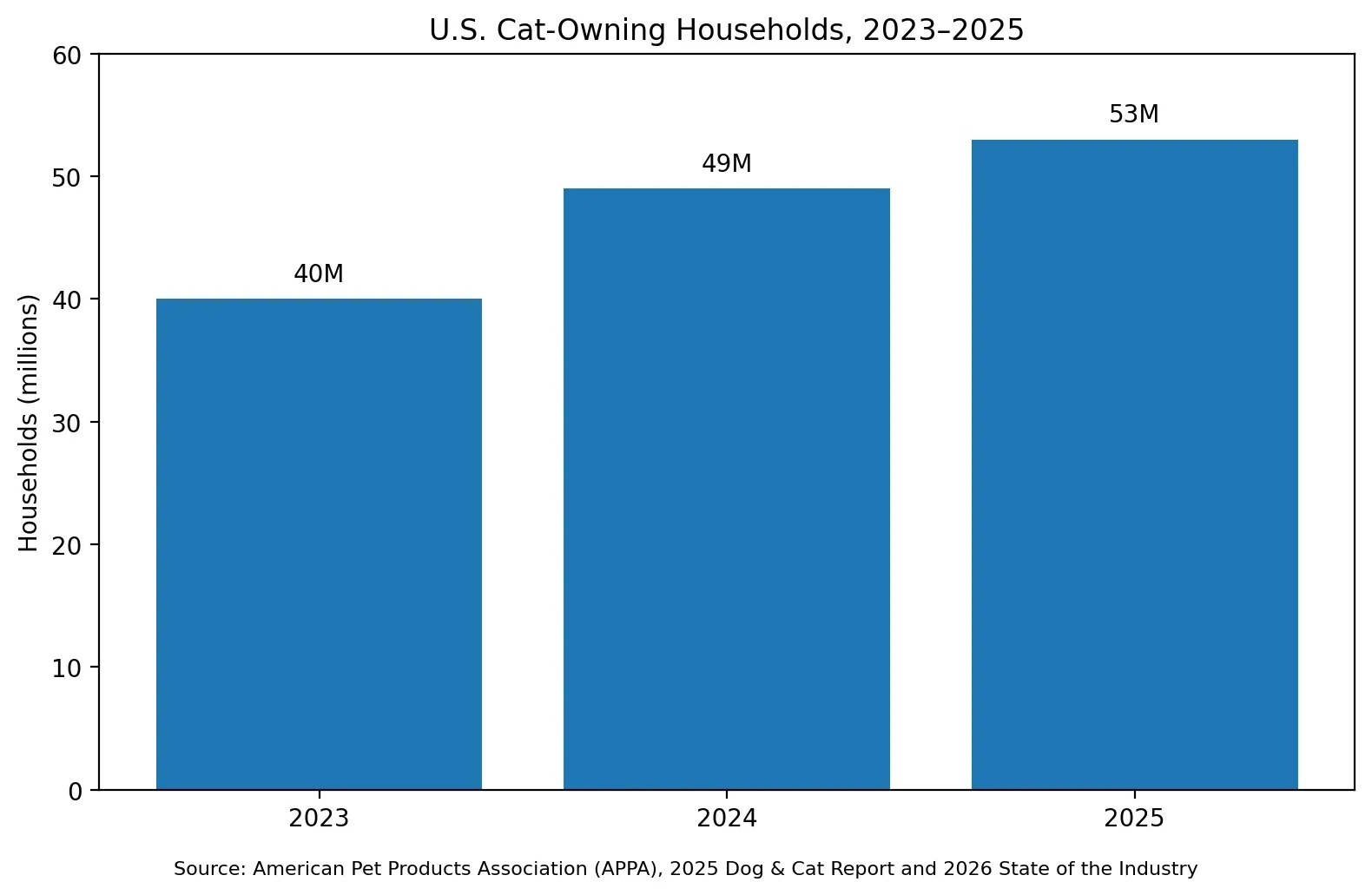
Chart: U.S. Cat-Owning Households Grew From 40 Million to 53 Million
The speed of recent cat household expansion becomes more obvious when the latest APPA reports are compared.
| Year | U.S. Cat-Owning Households | Dogs |
| 2023 | 40 million | 71 million |
| 2024 | 49 million | 53% |
| 2025 | 53 million | 2025 |
| Current growth signal | Ownership and spending rising | Ownership growing, spending moderating |
| Important younger-generation influence | Gen Z and Millennials | Broad multi-generational base APPA reported 49 million cat households in its 2025 Dog & Cat Report, up from 40 million in 2023. Its 2026 State of the Industry data subsequently raised the figure to 53 million for 2025. Suggested chart placement: Insert “U.S. Cat-Owning Households, 2023–2025” here. This is an important distinction for inventory planning. A growing household base does not automatically mean every cat category will grow equally. It means more households are entering the market, while existing owners are simultaneously changing what they consider normal cat care. The second shift may matter even more than the first. |
Why Cats Fit the Lifestyle Conversation Around Gen Z
My view is that the rise of cats among younger owners is not difficult to understand.
Compared with many dogs, a healthy adult cat may fit more easily into the routine of an apartment-based professional who works full time, lives alone or has limited access to outdoor space. Cats do not normally require scheduled outdoor walks several times a day, and indoor infrastructure such as litter boxes, climbing furniture, feeders and enrichment toys can support more of their daily routine inside the home.
That does not mean cats are maintenance-free.
Cats still require exercise, interaction, environmental stimulation, clean litter facilities, nutrition, veterinary care and daily observation.
What changes is the form of the work.
A dog owner's routine may involve walking, outdoor exercise and training outside the home. A cat owner's routine is more likely to create demand for products that bring those functions inside the home.
That difference helps explain the commercial importance of cat trees, scratchers, puzzle feeders, tunnels, window perches, fountains and automated litter products.
APPA's latest data supports the generational side of this interpretation: cat ownership and spending rose in 2025 with growth propelled by Gen Z and Millennials.
Younger shoppers are also particularly digital in how they discover products. Earlier APPA research found that 69% of Gen Z cat owners and 70% of Millennial cat owners said brand name was important when buying pet products, while younger generations were more likely to use visual platforms such as YouTube and TikTok for product discovery.
For social-commerce pet sellers, that combination is powerful.
A product has to solve a problem, but it also has to be visually understandable within seconds.
Premium Feeding Is Becoming Normal, but Value Still Matters
The first major buying shift is in feeding.
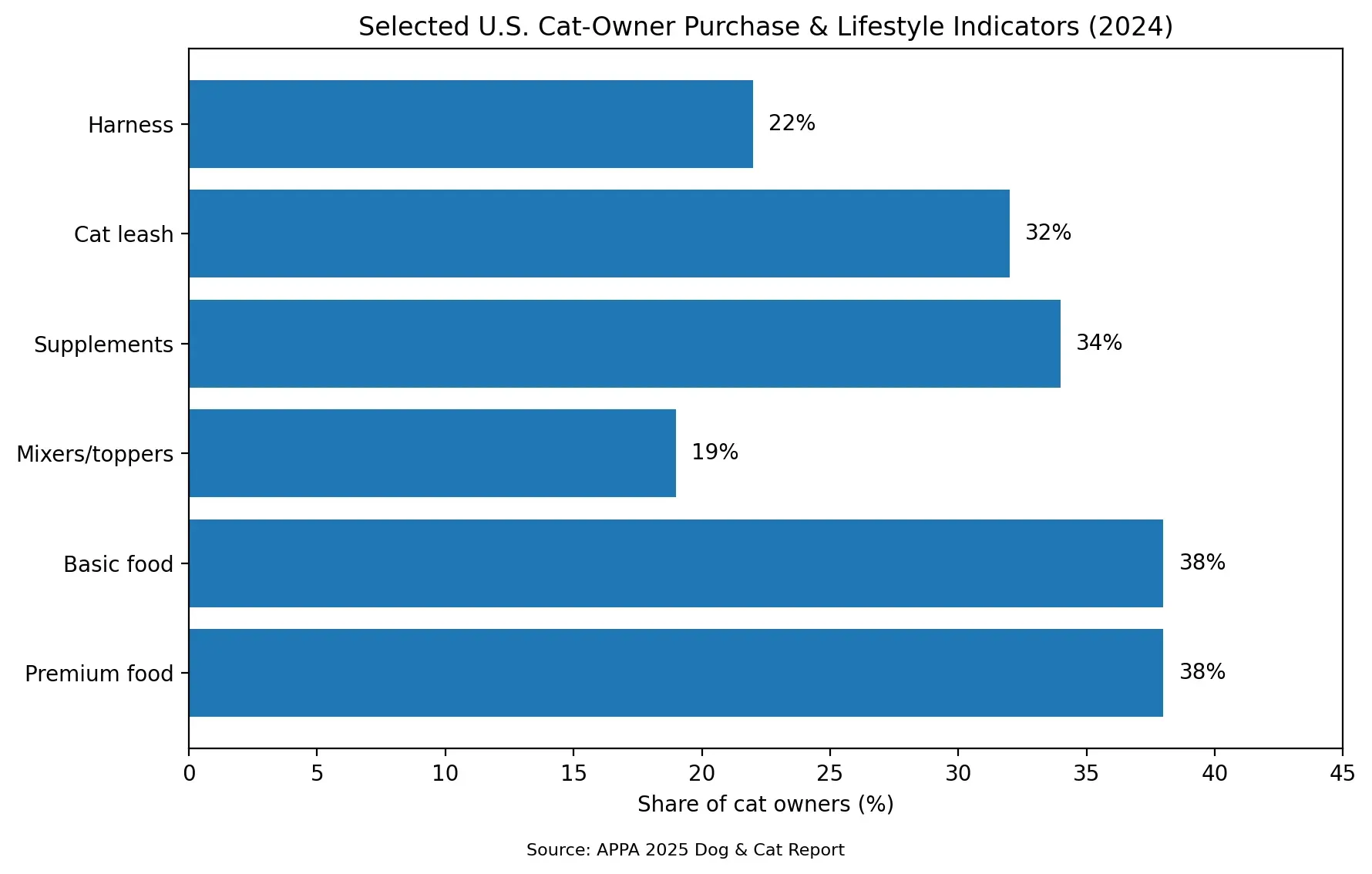
APPA found that 38% of cat owners purchased premium food in 2024, up 9% from the previous year. At the same time, 38% purchased basic food, with basic-food purchasing declining 7% year over year.
The key lesson is not that every customer suddenly wants the most expensive cat food.
It is that cat parents are becoming more deliberate about where quality matters.
NIQ describes a similar 2026 pattern across pet care: consumers are protecting essentials while becoming more selective, price-conscious and value-oriented. Premium products still perform well when they offer a benefit that shoppers can understand and trust.
Premium Does Not Mean Unlimited Spending
| Consumer Signal | What It Means for Retailers |
| 38% bought premium cat food | Quality positioning has a large addressable audience |
| 38% bought basic food | Value remains equally important |
| 22% of pet owners spent less in 2025 | Price sensitivity cannot be ignored |
| About half reported unchanged pet spending | Essentials remain resilient |
| Premium cat tiers outperform value/moderate segments in NIQ data | Premium works when benefits are clear |
| Dry-food routine | Feeding and hydration bundles |
| Independent play | Ball tracks and selected interactive toys Sources: APPA and NIQ. For smaller retailers, that argues against an assortment made entirely of either bargain products or luxury products. A more practical shelf strategy is good / better / best. The same principle applies beyond food to bowls, feeders, litter accessories, grooming tools and beds. |
Cat Meals Are Becoming More Customized
One of the most interesting APPA numbers is not about traditional cat food.
It is about mixers and toppers.
In 2024, 19% of U.S. cat owners purchased mixers or toppers, representing a 138% increase from 2018.
NIQ's 2026 research adds another layer: cat parents use an average of 2.2 food types per week, while 26% use three or more food types.
That suggests the old model of one bag of dry food sitting beside one bowl no longer describes the entire market.
A modern feeding routine may include dry food, wet food, treats, toppers and functional diets.
That increases demand not only for consumables but for the products surrounding feeding:
- slow feeders;
- stainless-steel bowls;
- elevated bowls;
- feeding mats;
- portion-control tools;
- automatic feeders;
- storage containers;
- travel bowls.
For a retailer, feeding accessories are especially useful because they can be attached to a repeat-purchase category without competing directly with major food brands.
Hydration Is Turning Water Into a Product Category
Water used to be treated as almost invisible in pet retail.
Put out a bowl, fill it, done.
Cat health research shows why that assumption is changing.
Cornell University's Feline Health Center notes that cats need approximately four ounces of water per five pounds of lean body weight per day. Wet food can contain up to 80% water, while cats eating dry diets depend more heavily on drinking water. Cornell also notes that some cats may drink more when offered a water fountain, although preferences differ between cats.
That turns hydration into a retail problem with several possible solutions.
Hydration-Related Retail Opportunities
| Owner Need | Product Opportunity |
| Fresh water availability | Bowls and water dispensers |
| Preference for moving water | Cat fountains |
| Multi‑cat access | Multiple water stations |
| Easy cleaning | Stainless or removable components |
| Travel | Portable bowls and bottles |
| Dry‑food routine | Feeding and hydration bundles The important E-E-A-T point is not to tell consumers that a fountain prevents disease. That would overstate the evidence. A credible retailer should instead explain that adequate hydration is important, and fountains are one option that some cats prefer. |
Indoor Enrichment May Be the Biggest Non-Food Opportunity
For working cat owners, the real problem is rarely “I need another cute mouse toy.”
The real problem is:
What does my cat do for eight hours while I am working?
A July 2026 discussion in Reddit's indoor-cat community captures the problem well. A full-time worker with two cats asked for enrichment that would remain useful without adding another daily maintenance task. Suggestions centered on cat trees near windows, hammocks, treat puzzles and simple toys that could remain available during the day.
Another recent CatAdvice discussion asked specifically for automatic or independent-play toys for periods when the owner could not provide active play.
These conversations are anecdotal, not population statistics, but they reveal the language behind the purchase.
Consumers are not necessarily searching for “cat enrichment.”
They are thinking:
- my cat is bored while I work;
- my apartment is small;
- I cannot play every hour;
- my cat wakes me up at night;
- my cat scratches furniture;
- my cat needs something to climb;
- I want a toy that does not require constant supervision.
That search intent is valuable for SEO and merchandising.
Enrichment Products by Natural Cat Behavior
| Cat Behavior | Retail Category |
| Climbing | Cat trees, shelves, towers |
| Scratching | Vertical and horizontal scratchers |
| Hunting | Wand, chase and motion toys |
| Foraging | Puzzle feeders and treat toys |
| Hiding | Tunnels, caves and covered beds |
| Observing | Window hammocks and perches |
| Independent play | Ball tracks and selected interactive toys A small retailer does not need twenty versions of the same plush mouse. It needs products that represent different behaviors. |
Multi-Cat Homes Change the Size of the Basket
Cat household growth is only one part of the story.
The number of cats inside those households is also changing.
APPA found that single-cat households declined from 64% in 2018 to 58% in 2024. Households with two cats increased, while households with three or more cats increased 36% compared with 2018.
That can dramatically change household product requirements.
One cat may use one primary feeding area.
Three cats can create issues around food competition, water access, sleeping territory, vertical space and litter-box availability.
AAHA/AAFP feline guidelines recommend, as a rule of thumb, one litter box per cat plus one additional box, with boxes placed in accessible locations, especially in multi-cat homes.
The implication for retailers is simple:
Multi-cat ownership creates demand through duplication, not only premiumization.
Example: How Needs Change From One Cat to Three Cats
| Category | One-Cat Household | Three-Cat Household |
| Litter boxes | Basic setup | Multiple boxes recommended |
| Water access | One primary station may work | Multiple access points may reduce conflict |
| Feeding | Simple bowl setup | Separate or controlled feeding may help |
| Beds | One or two sleeping areas | More territory and resting options |
| Scratchers | Single location | Multiple locations become useful |
| Toys | Basic rotation | Greater variety can reduce competition This is a particularly strong opportunity for physical pet stores and online sellers that can merchandise multi-cat solutions rather than individual products. |
Litter Buyers Want Less Odor, Less Dust and Less Work
Cat litter is an essential category, but consumers judge it through several competing priorities.
Small-home owners want odor control.
Some buyers prioritize low dust.
Others care about tracking.
Multi-cat homes care about clumping performance and frequency of cleaning.
Recent Reddit conversations show how these priorities overlap. One 2026 apartment resident with two cats described daily or twice-daily scooping while still struggling with odor in a one-bedroom home.
That explains why the litter category extends far beyond litter itself.
Retail opportunities include:
- litter boxes;
- litter mats;
- scoops;
- waste-bag systems;
- odor-control accessories;
- storage products;
- cleaning tools;
- automatic litter boxes.
The winning merchandising message should start with the problem.
“Low tracking.”
“Easy to clean.”
“Designed for multi-cat households.”
“Helps contain scattered litter.”
Those claims are easier for shoppers to understand than vague language such as “premium cat bathroom solution.”
Automatic Litter Boxes Show Both the Opportunity and the Risk of Smart Pet Products
Automation is clearly attracting interest.
NIQ specifically identifies automated litter boxes as one of the products contributing to growth in cat accessories.
But smart products also reveal a lesson that every retailer should understand:
Convenience does not automatically create trust.
In recent Reddit discussions, shoppers repeatedly asked whether automatic litter boxes were safe, whether they were worth their high price, and whether they could be trusted around kittens.
Another 2026 discussion included both long-term users who reported positive experiences and owners who preferred manual boxes because they wanted maximum control and easier monitoring of waste.
For a small seller, this means the product page cannot stop at:
“App controlled.”
“Automatic cleaning.”
“Smart sensor.”
Customers also want to know:
- minimum cat weight;
- safety mechanism;
- cleaning process;
- waste-bin capacity;
- replacement-part availability;
- warranty;
- noise;
- what happens if power fails.
For smart cat products, the real premium feature may be confidence.
Wellness Is Moving Into Everyday Cat Care
APPA reports that 34% of cat owners gave their cats vitamins or supplements in 2024, a 70% increase compared with 2018.
Among cat supplement users, multivitamins, prebiotics/probiotics and digestion-related supplements were among the most popular types.
This reflects a broader change in pet ownership.
Consumers increasingly think about wellness before a problem becomes severe.
For retailers, however, wellness must be handled carefully.
A toy, grooming item, bowl or supplement should not be marketed with unsupported disease-treatment claims.
Cornell explicitly advises that supplements can be harmful in some circumstances and should not be given without veterinary approval.
That distinction matters especially for veterinary clinics with retail counters.
A trusted retailer should sell supportive products with accurate claims, not turn ordinary merchandise into medical promises.
Cat Lifestyle Products Are Expanding Beyond the Home
One of the biggest misconceptions about cat owners is that cats never leave the house except for veterinary appointments.
APPA's 2025 report suggests that behavior is changing.
In 2024:
- 48% of cat owners reported using some type of training method;
- 32% owned a cat leash;
- 22% owned a harness;
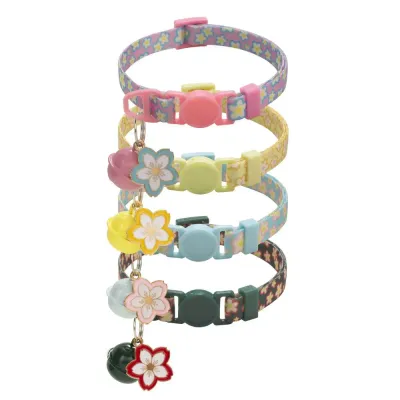
- 27% owned a non-flea collar.
Leash ownership was up 52% from 2018, while harness ownership increased 69%.
That creates a new group of categories for cat retailers:
cat harnesses, lightweight leashes, collars, carriers, portable bowls and travel accessories.
It does not mean every cat should be walked outdoors.
It means enough owners are experimenting with training and shared experiences that these products have moved beyond an ultra-niche audience.
For boutiques and social-commerce sellers, this is particularly attractive because harnesses and carriers are highly visual and easier to demonstrate in short-form video than many commodity products.
Younger Cat Owners Are Shopping Across Channels
Pet retail is not an “online versus physical store” battle anymore.
It is an omnichannel market.
APPA research found that nearly 80% of pet-care dollars were spent by omnichannel shoppers, while 57% of buyers shopped both in-store and online. Only about 3.35% were online-only in the referenced research.
NIQ says online growth continues to outpace in-store pet care performance in 2026.
This creates an interesting opportunity for smaller businesses.
A pet boutique does not have to beat Amazon at being Amazon.
A grooming salon does not have to become a giant ecommerce site.
A social seller does not need 10,000 products.
Smaller pet businesses can compete through selection, trust, explanation and relevance.
Different Sellers Need Different Cat Assortments
| Business Type | Strong Cat Categories |
| Pet boutique | Harnesses, toys, beds, design-led feeding products |
| Online pet seller | Broad accessories, replenishable products, bundles |
| Social-commerce seller | Demonstrable toys, fountains, grooming and lifestyle products |
| Subscription-box seller | Toys, treats, seasonal accessories, novelty items |
| Groomer or salon | Grooming tools, calming accessories, carriers |
| Veterinary retail counter | Feeding, recovery, grooming and veterinarian-aligned wellness products |
| Boarding/daycare operator | Bowls, beds, litter accessories, enrichment |
| New pet store | Essentials plus a controlled mix of high-interest trend products The important point is not to sell every category to every customer. Assortment should match the business model. |
Subscription Selling Is Moving Beyond Pet Food
Subscription sellers should pay special attention to non-food categories.
NIQ reported in 2026 that 40% of pet-care dollars in its measured market came from subscription sales, while some of the fastest-growing subscription categories included toys, collars and leashes, feeding accessories and grooming products.
That matters because consumables are not the only products capable of generating repeat orders.
A cat subscription box can rotate:
- toys;
- scratchers;
- grooming accessories;
- seasonal products;
- feeding accessories;
- replacement components;
- themed products.
The best recurring assortment offers novelty without becoming useless clutter.
Cat Owners Are Buying “Experiences,” Not Only Objects
Pet humanization has been discussed for years, but cat purchasing behavior now gives the idea more concrete meaning.
APPA found that 21% of cat owners hosted holiday or birthday parties for their cats in 2024, while 34% purchased pet-themed merchandise.
This is why events such as International Cat Day, Halloween and Christmas can matter to retailers even when the products are not essential.
A themed collar, costume, toy or birthday item sells something different from a food bowl.
It sells participation.
For pet boutiques and social-commerce sellers, seasonal cat products can therefore work best when they are merchandised as part of a story:
“Cat Birthday Corner.”
“Indoor Halloween Hunt.”
“International Cat Day Enrichment Picks.”
Themed retail works when it gives the shopper an idea, rather than simply another SKU.
Price Pressure Means Retailers Should Sell Solutions, Not Random Products
U.S. pet spending remains resilient, but consumers are not ignoring the economy.
APPA says U.S. pet industry expenditures reached $158 billion in 2025 and are projected to reach $165 billion in 2026. At the same time, 22% of pet owners reported reducing pet spending in 2025, while about half reported no change.
That combination is important.
The market is growing, but the average shopper is becoming more intentional.
NIQ describes consumers as increasingly focused on value, convenience and confidence.
For retailers, this makes random assortment expansion risky.
A better approach is to ask:
What problem does this product solve?
Does it reduce litter mess?
Does it make feeding easier?
Does it give an indoor cat something useful to do?
Does it work in a small apartment?
Can one item perform two functions?
Is it easy to clean?
Would a customer understand the benefit within five seconds?
Products that answer those questions have a stronger reason to exist on a small retailer's shelf.
What Are the Best Cat Categories for Small Pet Businesses in 2026?
Based on current ownership data, consumer behavior and retail trends, I would prioritize categories in the following order.
| Priority | Category | Why It Matters |
| 1 | Indoor enrichment | Directly addresses modern indoor-cat lifestyles |
| 2 | Feeding accessories | Benefits from premium and varied feeding routines |
| 3 | Litter accessories | Essential need plus odor, tracking and convenience pain points |
| 4 | Hydration | Strong health relevance and clear product story |
| 5 | Multi-cat products | Household expansion increases product duplication |
| 6 | Harnesses and carriers | Growing lifestyle and training adoption |
| 7 | Grooming | Useful for both owners and professional pet businesses |
| 8 | Smart convenience products | Strong interest but higher trust requirements |
| 9 | Seasonal and gifting products | Good for social content and impulse purchasing |
| 10 | Wellness-adjacent accessories | Growing interest when claims remain responsible This is not a universal ranking for every retailer. A veterinary clinic and a TikTok seller should not stock the same cat department. But the underlying purchase drivers—health, convenience, stimulation, cleanliness and lifestyle—are increasingly shared. |
A Practical 2026 Cat Assortment Strategy
If I were building a cat category for a small retailer today, I would not begin by asking, “What are the 100 most popular cat products?”
I would begin with six use cases.
Feeding
Bowls, mats, storage and feeding tools.
Hydration
Bowls, fountains and easy-clean drinking systems.
Indoor Life
Scratchers, tunnels, cat furniture and independent-play toys.
Litter Management
Boxes, mats, scoops, waste accessories and odor-management products.
Travel and Lifestyle
Harnesses, leashes, carriers and portable supplies.
Comfort and Care
Beds, grooming products and selected wellness-support accessories.
That structure creates a store that makes sense to the customer.
It also makes upselling more natural.
Someone buying a fountain may need a feeding mat.
Someone buying a carrier may need a harness.
Someone adopting a second cat may need another bed, bowl, scratcher and litter setup.
The goal is not to force a larger basket.
It is to anticipate the next logical requirement.
What This Means for Wholesale Buyers
For wholesale customers, the rise of the U.S. cat market creates both opportunity and risk.
The opportunity is obvious: tens of millions of households need recurring pet supplies, and younger generations are helping expand the customer base.
The risk is overbuying fashionable products with weak everyday value.
Small retailers should therefore look for suppliers that make it possible to test multiple categories without turning every experiment into a major inventory commitment.
This is particularly important for social-commerce sellers, new stores, subscription businesses and niche pet retailers where one viral product can perform extremely well but demand may change quickly.
An online wholesale platform such as Petfairs can serve this type of buyer by allowing businesses to source across cat, dog and exotic-pet categories rather than building separate supplier relationships for every segment, while supporting delivery to many international markets.
For a small business, that flexibility can matter almost as much as unit price.
Final Takeaway
The most important number in the U.S. cat market is not just 53 million.
The more important change is what those households now expect from cat ownership.
Today's cat parent is increasingly likely to think beyond basic food and litter.
They are thinking about nutrition variety, hydration, gut health, clean homes, indoor stimulation, convenience, travel, multi-cat living and the quality of the time they spend with their pets.
That is why the strongest cat retail opportunities in 2026 are not necessarily the products with the most technology or the highest price.
They are the products that solve an obvious everyday problem.
For small pet businesses, that creates a different way to compete with large retailers.
Do not try to offer everything.
Offer a better answer to a specific cat owner's problem.
Because as America's 53 million cat households continue to evolve, the winning cat assortment will not be the one with the most SKUs.
It will be the one that understands why the customer is shopping in the first place.
Research Sources and Methodology
This article prioritizes first-party pet-industry research and veterinary guidance. Primary market sources include the American Pet Products Association's National Pet Owners Survey-based reports and NielsenIQ's 2026 pet retail research. Veterinary and feline-care statements are supported by Cornell University's Feline Health Center and AAHA/AAFP guidelines. Reddit discussions are used only as qualitative examples of consumer questions and pain points, not as representative statistical evidence.
FAQ: U.S. Cat Product Trends in 2026
How many U.S. households own cats in 2026?
The most current APPA State of the Industry report, published in 2026 using 2025 ownership data, says 53 million U.S. households owned cats, equal to about 39% of U.S. households.
Are cats more popular than dogs in the United States?
No. Dogs still have a larger household footprint. APPA reports approximately 71 million dog-owning households versus 53 million cat-owning households. What is notable is the recent growth in cat ownership, particularly among Gen Z and Millennials.
What cat products are growing in popularity?
Current data points toward premium food, meal toppers, supplements, treats, feeding variety, accessories, enrichment and automated litter products. APPA and NIQ both identify shifts toward more intentional and diversified cat care.
Why are indoor cat products important?
Indoor cats still need opportunities to climb, scratch, hunt, hide, observe and play. For owners who work full time, products that support safe independent enrichment can help make the indoor environment more stimulating.
Are automatic litter boxes a good wholesale category?
They can be, because convenience and automated litter products are receiving strong consumer attention. However, buyers care heavily about safety, reliability and cleaning. Retailers should evaluate those factors before competing purely on low price.
Why are cat water fountains popular?
Hydration is an important part of feline health. Cornell notes that some cats may increase water intake when offered fountains, although preferences vary. Fountains therefore offer a clear convenience and hydration-related value proposition without needing exaggerated medical claims.
What should small pet stores stock first?
Start with frequently understood problems: feeding, hydration, litter management, indoor enrichment, scratching, grooming and travel. Trend products can then be layered on top of this essential assortment.
 Popular Blogs