

Best Mental Stimulation Toys for Cats: A Retailer’s Guide to Cat Enrichment Products
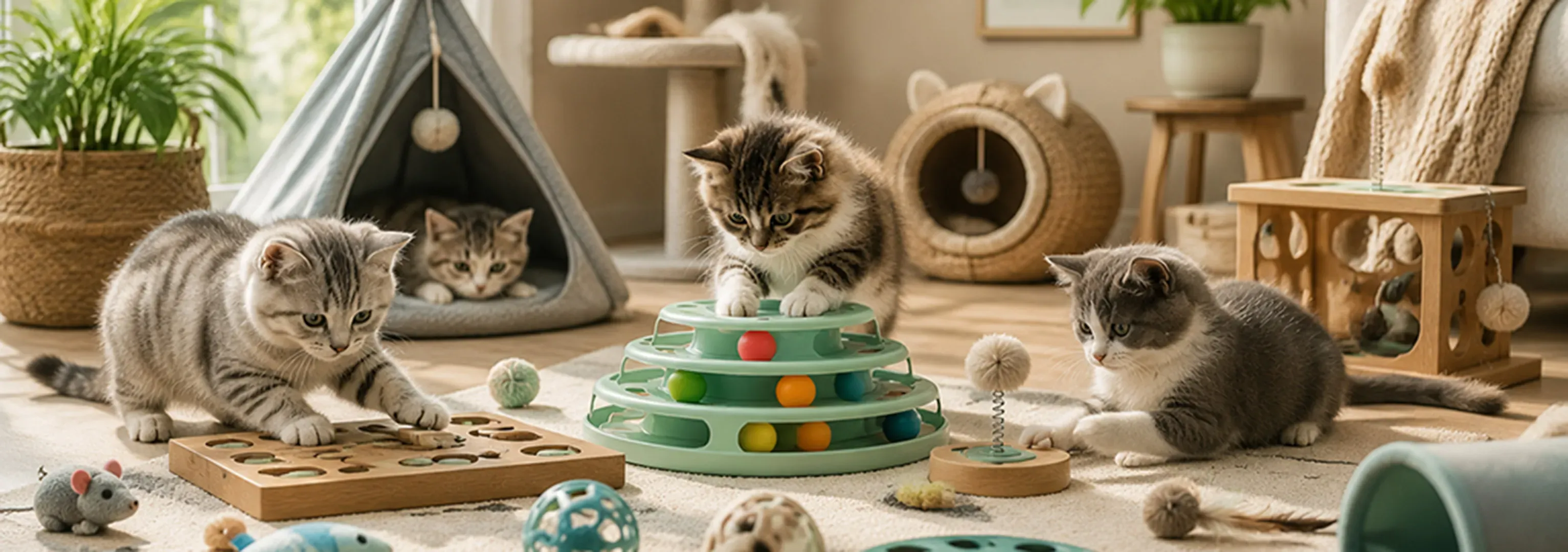
Quick answer: The best mental stimulation toys for cats are toys that let cats search, chase, pounce, catch, bite, scratch, hide, and work for food. For pet stores, groomers, online sellers, subscription box sellers, shelters, and veterinary retail teams, the strongest cat toy assortment should include puzzle feeders, teaser wand toys, kicker toys, catnip or silvervine toys, track balls, tunnels, scratchers, and enrichment furniture.
Mental stimulation toys are not just “cute cat toys.” They are products that help indoor cats express natural behaviors in safe, repeatable ways. The AAFP and ISFM feline environmental needs guidelines state that cats need opportunities for play and predatory behavior, including toys, owner interaction, and feeding devices that require cats to actively acquire food. The same guidelines also note that cats are solitary hunters and may eat 10–20 small prey per day in natural conditions, which explains why many cats benefit from short, repeated play and feeding challenges instead of one large meal and a few passive toys.
For retailers, this topic is commercially important because “cat toys” is no longer only a low-ticket add-on category. Search demand now includes wholesale cat toys, bulk cat toys, cat toys in bulk, cat toy suppliers, interactive cat toys for bored cats, cat puzzle toy, cat teaser toys, cat kicker toys, cat tunnel, cat scratcher, catnip toys, and toys for senior cats. These keywords show that buyers are looking for both bulk supply and problem-solving products.
Petfairs is an online wholesale platform serving small and mid-sized pet businesses, online sellers, social commerce sellers, pet boutiques, grooming salons, veterinary retail teams, subscription box sellers, shelters, and local distributors. For these buyers, the goal is not to stock one “best cat toy.” The goal is to build a balanced cat enrichment collection that covers different play styles, different price points, and different customer problems.
What Makes a Cat Toy Mentally Stimulating?
A mentally stimulating cat toy is a product that makes the cat do something before getting the reward. The action can be chasing a feather wand, rolling a treat ball, digging food out of a puzzle feeder, hiding inside a tunnel, scratching a surface, or grabbing a kicker toy.
The key difference is effort. A basic plush toy may be fun for some cats, but a richer enrichment toy creates a small challenge: the cat must search, stalk, paw, bite, pull, roll, or solve.
A strong mental stimulation toy usually includes at least one of these five elements:
| Enrichment Element | What It Means | Product Examples |
| Search | The cat must find the item or treat | Puzzle feeders, hidden treat toys, snuffle mats |
| Chase | The toy moves like prey | Feather wands, teaser toys, rolling balls |
| Catch | The cat can physically grab the toy | Wand toys, plush mice, kicker toys |
| Work | The cat must solve a small problem | Cat puzzle toys, treat dispensers |
| Scent | The toy triggers smell-based interest | Catnip toys, silvervine toys, crinkle plush toys This matters because cats can lose interest when a toy does not behave like prey. The AAFP/ISFM guidelines recommend moving wand toys in ways that mimic flying prey or ground prey, letting cats catch the toy, using toys cats can manipulate with paws or mouth, hiding toys in puzzle boxes, and rotating toys to prevent boredom. |
Best Mental Stimulation Toys for Cats: Comparison Chart
For wholesale buyers, the best approach is to compare cat toys by play behavior, customer problem, evidence strength, and retail use case.
| Toy Type | Best For | Evidence / Support | Retail Strength |
| Puzzle feeders | Food-driven cats, indoor cats, overweight cats | Strongest support among toy types; food puzzles use cats’ natural instinct to work for food | High-value educational product |
| Wand & teaser toys | Bonding, exercise, active play | Supported by feline environmental guidelines for predatory play | High turnover, low entry price |
| Kicker toys | Biting, grabbing, bunny-kicking | Matches natural grab-and-rake play behavior | Good impulse buy |
| Catnip / silvervine toys | Scent-driven cats | Silvervine and catnip have published response data | Good repeat purchase |
| Track balls / chase toys | Solo play, apartment cats | Matches chase-and-paw behavior | Good for online bundles |
| Cat tunnels | Hiding, stalking, ambush play | Supports safe hiding and predatory play context | Strong for visual merchandising |
| Scratchers | Scratching, scent marking, stress outlet | Scratching is part of key feline environmental resources | Essential category item |
| Automatic toys | Busy owners, cats home alone | Useful, but quality and safety vary | Good upsell product This table should not be treated as medical ranking. It is a retail selection framework based on feline behavior principles, published enrichment guidance, and practical product merchandising. |
Puzzle Feeders and Cat Treat Puzzle Toys
Puzzle feeders are one of the most important mental stimulation toys for cats because they combine food, problem-solving, and movement. A food puzzle is any object that holds food and requires the cat to interact with it before the food comes out. Published veterinary literature describes food puzzles as mobile or stationary products that can hold dry or wet food and require cats to roll, push, paw, lick, or fish food out.
This category should include keywords such as cat puzzle feeder, cat toy puzzle, cat treat puzzle, treat dispensing cat toys, cat food puzzle, cat slow feeder toy, and interactive feeder for cats.
Food puzzle products are especially useful because they match how cats naturally eat. Cats are predators that tend to eat multiple small meals, and food puzzles let retailers explain the product as a way to turn feeding into enrichment. The 2016 Journal of Feline Medicine and Surgery review states that food puzzles take advantage of cats’ natural instinct to work for food and are biologically relevant enrichment devices.
The numbers are useful for content and sales education. In one cited shelter study discussed in the review, 85% of group-housed cats, or 23 out of 27, engaged with a food puzzle without increased aggression. The same review includes case examples where food puzzles were used with other behavior changes, including cats that lost 6.4%, 11%, and 20% of body weight over different timeframes; however, the authors clearly state that more research is needed and that the case examples are not proof that the puzzle alone caused the change.
For pet retailers, puzzle feeders are not just toys. They are educational products. A store can place them near cat food, treats, slow feeders, or weight-management displays. Online sellers can bundle them with cat treats, catnip toys, or starter enrichment kits.
Retail positioning: Best for indoor cats, bored cats, food-motivated cats, apartment cats, and cats that eat too quickly.
Cat Wand Toys and Cat Teaser Toys
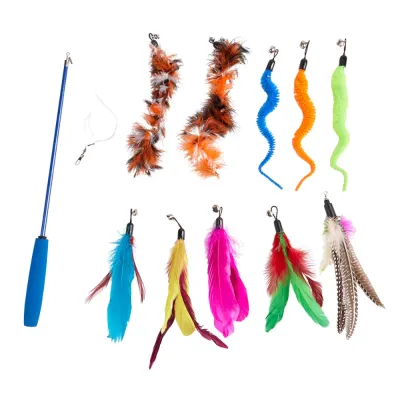
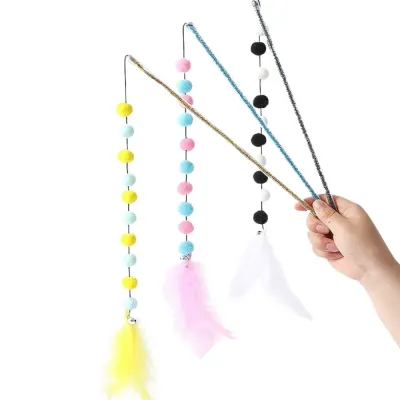
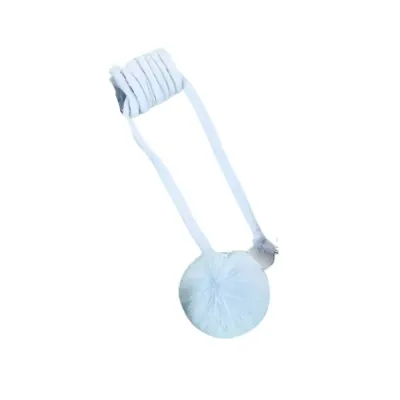
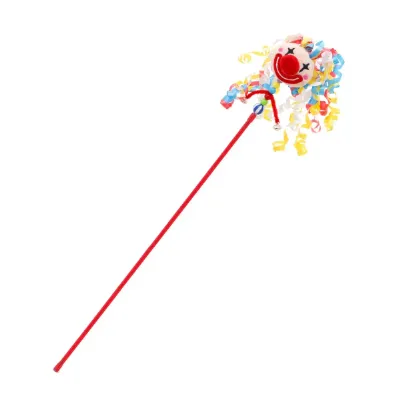
Cat wand toys are among the best interactive cat toys because they let humans control movement. A feather wand, cat toy stick, cat teaser toy, or cat toys wand can mimic birds, insects, mice, or crawling prey.
This category should include keywords such as cat teaser toys, cat toy teaser, cat teaser toy, cat toy stick, cat wand toy, wand toys for cats, cat toys wand, cat toy wands, cat stick toy, feather wand cat, and cat toys wands.
The reason wand toys work is movement. The AAFP/ISFM guidelines recommend moving a rod or wand with a feather or fur toy in ways that mimic flying prey or ground prey. The same guidelines also recommend letting cats catch the toy to simulate capture.
For retailers, this makes wand toys an essential entry-level product. They are affordable, easy to understand, easy to display, and suitable for many customer groups. Pet stores can sell basic feather wand toys, premium wooden cat toy wands, refillable teaser attachments, and multi-pack teaser assortments.
For online sellers and social commerce sellers, wand toys are also highly visual. Short videos showing a cat jumping, stalking, or catching the feather can support conversion better than static product photos.
Retail positioning: Best for bonding, exercise, kitten play, active cats, and customers asking for interactive cat toys for bored cats.
Cat Kicker Toys and Cat Biting Toys
Cat kicker toys are long plush toys that cats can grab with their front paws and kick with their back legs. This makes them different from small plush mice or wool balls.
This category should include keywords such as cat kicker toys, cat kicker toy, kick toys for cats, kicker toys for kittens, cat biting toys, chew toy for cats, durable cat toys, plush catnip toy, and catnip filled toys for cats.
Kicker toys are valuable because they satisfy the “grab and rake” part of play. The AAFP/ISFM guidelines specifically recommend large, soft toys that cats can rake and bite.
For wholesale buyers, kicker toys are a strong assortment item because they can be made in many styles: banana cat toy, pickle cat toy, mushroom cat toy, bug cat toy, duck cat toy, rat toy for cats, rubber cat toys, plush catnip toys, or eco friendly cat toys. These shape-based keywords are not always broad SEO terms, but they work well for product pages, marketplace listings, social media posts, and subscription boxes.
Kicker toys also work well in multi-SKU bundles. A retailer can offer a “catnip kicker pack,” a “large cat toy pack,” or a “cute cat toy pack” with different textures, shapes, and scents.
Retail positioning: Best for cats that bite, wrestle, kick, or lose interest in small toys quickly.
Catnip Toys, Silvervine Toys, and Scent-Based Enrichment
Catnip toys are popular, but not every cat responds to catnip. That is important for retailers because some customers buy a catnip toy, the cat ignores it, and the customer assumes the toy is bad.
The better answer is assortment diversity. Retailers should consider stocking catnip, silvervine, crinkle, and mixed-scent toys so customers have more than one option.
A BMC Veterinary Research study tested catnip, silvervine, Tatarian honeysuckle, and valerian root on 100 domestic cats. In that study, 79% of domestic cats responded positively to silvervine and 68% responded positively to catnip. Of the 31 cats that did not respond to catnip, 22 cats, or 71%, responded positively to silvervine.
This is a strong E-E-A-T point for a product article. Instead of saying “catnip toys are best,” the article should say: catnip works for many cats, but silvervine may be a useful alternative for cats that ignore catnip.
This category should include keywords such as cat nip toys, catnip toys, catnip filled toys for cats, plush catnip toy, silvervine cat toys, eco friendly cat toys, non toxic cat toys, crinkle cat toys, and sensory toys for cats.
Retail positioning: Best for scent-driven cats, gift bundles, subscription boxes, and customers whose cats ignore regular toys.
Cat Ball Toys, Track Toys, and Chase Toys
Ball toys and track toys are useful because they encourage pawing, chasing, and solo play. They are also easy for customers to understand.
This category should include keywords such as cat wool ball, cat toys balls, cat ball toy track, cat chase toy, cat toy mouse, cat hanging toys, cat toys hanging, and interactive cat toys for bored cats.
Track toys are especially good for apartments because they keep the ball contained. This makes them easier to use in small homes, rentals, grooming waiting areas, cat cafés, or adoption spaces.
For wholesale buyers, the key is to stock different difficulty and durability levels. A simple wool ball or plush mouse works as an impulse product. A track ball toy works as a mid-priced interactive product. A motion-based chase toy works as a higher-value upsell.
Retail positioning: Best for solo play, kittens, apartment cats, and buyers looking for affordable cat toys in bulk.
Cat Tunnels, Cat Caves, and Hide-and-Seek Toys
Cat tunnels are not only play products. They also create hiding, stalking, and ambush opportunities.
This category should include keywords such as cat wall tunnel, cat bed tunnel, cat donut tunnel, large cat tunnel, cat donut toy, donut cat toy, cat cave, cat den, and cat tunnel toy.
The AAFP/ISFM guidelines emphasize that cats need safe places and multiple environmental resources, including resting areas, play areas, elevated areas, and hiding spaces. A tunnel, cave, or enclosed bed can therefore serve both mental stimulation and comfort.
For Petfairs buyers, cat tunnels can be sold in several ways. Pet boutiques may prefer aesthetic cat tunnels and donut-style tunnels. Online sellers may prefer large cat tunnels with strong visual photos. Shelters and rescues may use tunnels as low-cost enrichment products. Subscription box sellers may use foldable tunnels as seasonal or premium-box items.
Retail positioning: Best for shy cats, playful cats, multi-cat homes, shelters, cat cafés, and indoor enrichment displays.
Cat Scratchers, Cat Furniture, and Wall Toys
Scratchers are often listed under furniture, but they also support mental stimulation. Scratching gives cats a physical outlet and helps them mark territory through scent and visual marks.
This category should include keywords such as cat scratcher, cat scratch toy, cat scratcher cardboard, cute cat scratcher, wave cat scratcher, cat scratching post carpet, cat furniture scratchers, cat scratching walls, aesthetic cat scratching post, cat wall toys, cat wall furniture, and cat wall shelves.
For retail strategy, scratchers should not be treated as one SKU. A strong assortment should include cardboard scratchers, vertical scratchers, carpet scratchers, sisal scratchers, wave scratchers, cute scratchers, and aesthetic scratching posts.
For online sellers, scratchers also create excellent long-tail SEO opportunities. A product page targeting “aesthetic cat scratching post” will likely attract a different buyer than a page targeting “cat scratcher cardboard” or “cat scratching post carpet.”
Retail positioning: Best for home enrichment, furniture protection, indoor cats, and customers building a full cat activity area.
Automatic Cat Toys and Motion Toys
Automatic cat toys can help busy owners keep cats engaged while they are working, traveling, or away from home. They can include motion balls, moving mice, rotating feathers, or sensor-based toys.
This category should be handled carefully because not every automatic toy is safe for unsupervised play. The AAFP/ISFM guidelines recommend putting away toys with string or parts that could be ingested and avoiding toys with small ingestible parts or bells for free access or unsupervised play.
For wholesale buyers, automatic toys should be selected for durability, battery safety, replaceable parts, and clear usage instructions. This category can create a higher average order value, but it also needs stronger product descriptions and safety notes.
Retail positioning: Best for tech-friendly customers, busy cat owners, online sellers, and higher-ticket enrichment collections.
Best Cat Toy Assortment for Retailers: A Practical Mix
For Petfairs wholesale buyers, the best mental stimulation category should be built as an assortment, not as a single product list.
The following model is a practical starting point for small pet retailers, online sellers, subscription boxes, and local distributors. It is a merchandising recommendation, not a scientific statistic.
| Category | Suggested Share of Cat Toy Assortment | Why It Matters |
| Wand & teaser toys | 25% | Low-cost, high-turnover, easy to demonstrate |
| Catnip & silvervine plush toys | 20% | Strong impulse buy and gift appeal |
| Puzzle feeders & treat toys | 15% | Higher educational value and problem-solving angle |
| Balls, mice & track toys | 15% | Good for bulk packs and entry-level pricing |
| Kicker toys | 10% | Great for biting and wrestling play styles |
| Tunnels & caves | 10% | Strong visual product and enrichment value |
| Scratchers & wall toys | 5% | Larger space need, but strong home-enrichment relevance A new pet store owner may start with small, fast-moving products like teaser toys, plush catnip toys, wool balls, and cat toy packs. A pet boutique may focus on fancy cat toys, cute cat scratchers, aesthetic cat scratching posts, wooden cat toys, and eco friendly cat toys. An online pet seller may prioritize searchable long-tail products such as cat wand toy, large cat tunnel, cat kicker toy, cat puzzle feeder, and cat scratcher cardboard. |
How to Choose Mental Stimulation Toys by Cat Type
Different cats need different toys. A large cat may destroy a small plush toy quickly. A senior cat may need a slower, softer toy. A kitten may need size-appropriate toys and more frequent play.
The AAFP/ISFM guidelines state that older cats still need to play, but the type and intensity may need to be modified. The same guidelines also note that kittens generally have a greater need for higher-intensity play and should have size-appropriate toys and puzzle feeders.
| Cat Type | Best Toy Choices | Retail Keywords |
| Indoor bored cat | Puzzle feeders, wand toys, tunnels, track balls | toys for bored cats, indoor cat enrichment toys |
| Large cat | Large kicker toys, large tunnels, durable plush | cat toys for large cats, large cat tunnel |
| Senior cat | Soft wand toys, easy puzzle feeders, low-entry tunnels | toys for senior cats |
| Kitten | Small teaser toys, soft balls, kitten-safe kickers | kicker toys for kittens, kitten teething toys |
| Food-motivated cat | Puzzle feeders, treat dispensers, foraging toys | cat puzzle feeder, cat treat puzzle |
| Cat that ignores toys | Silvervine, rotating toys, different prey movements | silvervine cat toys, cat toys for bored cats |
| Shy cat | Cat cave, tunnel, soft toys, quiet scratchers | cat cave, cat den, cat bed tunnel This table can also help store staff answer customer questions quickly. Instead of asking “What toy do you want?” staff can ask “What problem are you trying to solve — boredom, biting, scratching, overeating, or solo play?” |
Safety Tips for Cat Toys
Cat toy safety should be part of every product page and buying guide. A toy that is safe during supervised play may not be safe when left out all day.
The most important safety rule is supervision. Wand toys, string toys, hanging toys, toys with small bells, and toys with loose parts should not be treated as always-safe solo toys. The AAFP/ISFM guidelines recommend putting away toys with string or parts that could be ingested and avoiding small ingestible parts or bells for unsupervised access.
Retailers should use clear product labels:
| Label | Meaning |
| Best for supervised play | Wand toys, string toys, feather teasers |
| Good for solo play | Track balls, large plush kickers, some puzzle feeders |
| Check regularly | Plush toys, catnip toys, scratchers |
| Not for aggressive chewers | Small soft toys, toys with loose parts |
| Size matters | Large cats need larger and more durable toys Safety-focused content improves trust. It also supports E-E-A-T because the article is not only pushing products; it is helping customers choose responsibly. |
Why Some Cats Ignore Toys
Many customers search for cat toys after their cat has already ignored several products. This is where content can solve a real problem.
A cat may ignore toys because the toy does not move like prey, the toy is always available, the cat prefers scent-based toys, the cat is older, the cat is stressed, or the play session ends without a catch.
Toy rotation is one of the simplest solutions. AAFP/ISFM recommends using cat toys on a rotating basis to prevent habituation and boredom.
Retailers can turn this into a simple customer tip: keep three to five toys available, store the rest away, and rotate them every few days. For online stores, this supports multi-pack sales such as cat toy pack, bulk cat toys, cat toys in bulk, catnip toy pack, and teaser wand replacement packs.
What About “Calming Cat Toys”?
“Cat calming toys” is a useful keyword, but retailers should be careful with the claim. A toy can provide comfort, scent enrichment, chewing, kneading, or routine, but it should not be marketed as a medical treatment for anxiety unless the claim is supported and compliant.
A safer product description would be:
“Designed for soothing play, gentle kicking, and scent-based enrichment.”
Avoid saying:
“Cures anxiety,” “stops stress,” or “treats behavioral problems.”
This matters for Petfairs because many customers include veterinary clinics, pet groomers, shelters, and professional pet businesses. These buyers need product language that sounds credible, not exaggerated.
Wholesale Buying Guide: What Cat Toys Should Pet Businesses Stock First?
For a small pet store or online seller, the first cat toy order should cover three price levels.
| Price Tier | Product Types | Why Stock It |
| Entry level | Wool balls, toy mice, catnip plush, teaser refills | Easy impulse purchase |
| Mid level | Wand toys, kicker toys, track balls, tunnels | Good margin and visible value |
| Higher value | Puzzle feeders, wall toys, scratchers, automatic toys | Better basket size and category authority For bulk buyers, variety matters more than quantity of one style. A 12-SKU assortment with different play functions is often more useful than 12 versions of the same plush mouse. For subscription box sellers, shape-based novelty is important. Mushroom cat toy, duck cat toy, banana cat toy, pickle cat toy, donut cat toy, and bug cat toy can create seasonal or themed boxes. For pet boutiques, design matters. Fancy cat toys, aesthetic cat scratching posts, wooden cat toys, eco friendly cat toys, cute cat scratchers, and premium catnip toys can support higher perceived value. For veterinary retail teams and shelters, education matters. Puzzle feeders, scratchers, tunnels, and safe solo toys can be presented as enrichment products rather than impulse toys. |
Best Mental Stimulation Toy Categories for Petfairs Buyers
Petfairs buyers can build a strong cat enrichment section around these product groups:
| Petfairs Category Opportunity | SEO Keyword Group | Recommended Page Type |
| Wholesale Cat Toys | wholesale cat toys, bulk cat toys, cat toys in bulk | Main category page |
| Interactive Cat Toys | interactive cat toys for bored cats, cat chase toy | Collection page |
| Cat Wand & Teaser Toys | cat teaser toys, cat wand toy, feather wand cat | Subcategory page |
| Cat Puzzle Toys & Feeders | cat puzzle feeder, cat toy puzzle, treat dispenser | Subcategory + blog |
| Catnip & Silvervine Toys | catnip toys, silvervine cat toys, plush catnip toy | Subcategory page |
| Cat Kicker Toys | cat kicker toys, cat biting toys, kick toys for cats | Subcategory page |
| Cat Tunnels & Caves | cat tunnel, cat cave, cat bed tunnel, large cat tunnel | Subcategory page |
| Cat Scratchers | cat scratcher, cardboard cat scratcher, wave cat scratcher | Subcategory page |
| Cat Wall Toys & Furniture | cat wall toys, cat wall tunnel, cat scratching walls | Category expansion page This structure supports SEO because each product family has its own search intent. It also supports GEO because AI search systems can easily extract definitions, comparisons, use cases, and product relationships. |
Final Takeaway
The best mental stimulation toys for cats are not defined by price, technology, or novelty. They are defined by how well they support natural feline behaviors.
For pet businesses, the strongest cat toy strategy is to stock products across multiple enrichment functions: food puzzles for problem-solving, wand toys for interactive hunting, kicker toys for biting and grabbing, scent toys for olfactory enrichment, tunnels for hiding and stalking, scratchers for scratching and marking, and track toys for solo play.
For Petfairs buyers, this creates a clear wholesale opportunity. Instead of selling random cat toys, retailers can build a complete cat enrichment assortment that helps customers solve everyday problems: bored indoor cats, inactive cats, cats home alone, cats that ignore toys, large cats that need durable toys, and kittens or senior cats that need age-appropriate play.
A better cat toy section is not just bigger. It is more useful, more explainable, and easier for customers to shop.
FAQ
What are the best mental stimulation toys for cats?
The best mental stimulation toys for cats are puzzle feeders, wand toys, kicker toys, catnip or silvervine toys, track balls, tunnels, scratchers, and safe interactive toys. A strong toy gives cats a reason to search, chase, catch, scratch, bite, or work for food.
Are puzzle feeders good for cats?
Yes. Food puzzles are one of the best-supported enrichment tools for cats because they encourage cats to work for food. Veterinary literature describes food puzzles as biologically relevant enrichment devices that can provide mental stimulation and increase activity.
What toys are best for bored indoor cats?
Bored indoor cats often benefit from a mix of wand toys, puzzle feeders, track balls, tunnels, scratchers, and scent toys. The best choice depends on whether the cat prefers chasing, food, hiding, scratching, or scent-based play.
Are catnip toys good for all cats?
No. Some cats do not respond to catnip. In a study of 100 domestic cats, 68% responded positively to catnip, while 79% responded positively to silvervine. Among cats that did not respond to catnip, 71% responded to silvervine.
What toys are safe for cats home alone?
Some track balls, large plush kickers, durable scratchers, and certain puzzle feeders may be suitable for solo play, depending on the product design. String toys, wand toys, toys with loose parts, and toys with small bells should generally be used with supervision.
Why does my cat bring toys to bed?
A cat bringing toys to bed may be carrying a favorite object, showing hunting behavior, seeking attention, or moving the toy to a safe place. This is a useful blog topic, but it should not be over-medicalized unless there are other behavior or health concerns.
How often should cat toys be rotated?
A practical retail recommendation is to rotate toys every few days and keep only a few available at one time. AAFP/ISFM specifically recommends rotating toys to prevent habituation and boredom.
 Popular Blogs