

Factory Price vs Distributor Price for Pet Supplies
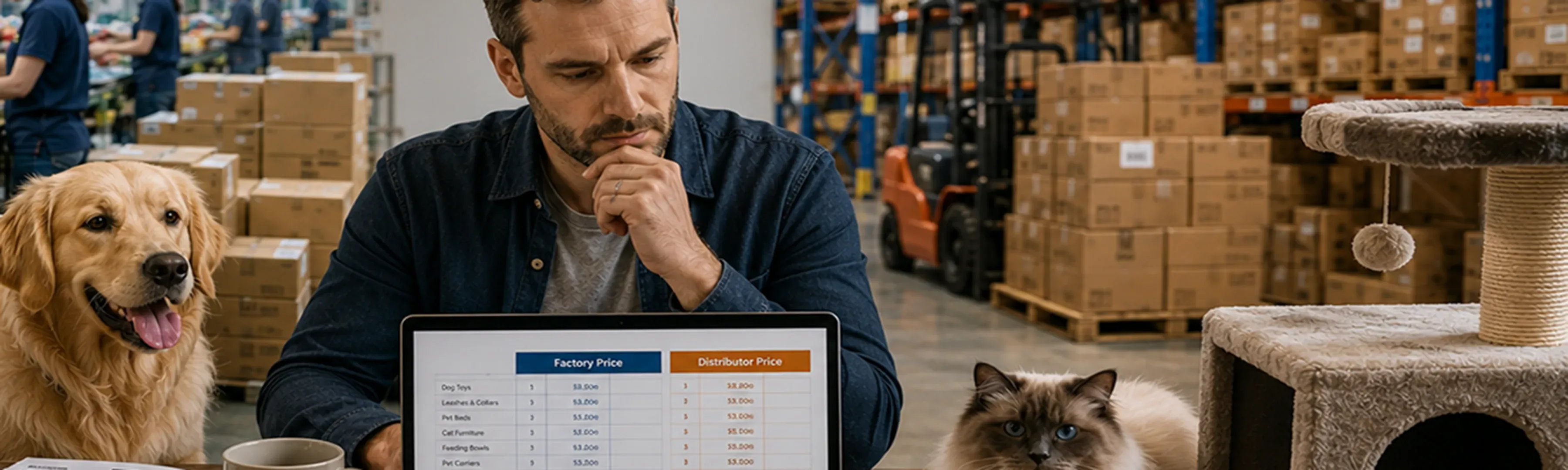
How Smart Pet Businesses Protect Margins with Smarter Sourcing in 2026
The global pet industry continues to grow rapidly, but for many pet retailers, distributors, groomers, online sellers, trainers, and boutique pet shops, profit margins are becoming increasingly difficult to maintain. Rising advertising costs, marketplace fees, warehousing expenses, and logistics costs are forcing small and medium pet businesses to rethink how they source products.
According to the American Pet Products Association (APPA), U.S. pet industry spending reached over $150 billion, while competition across e-commerce, social commerce, Amazon, Etsy, and TikTok Shop continues to intensify. At the same time, platforms like Amazon and Etsy charge increasing seller fees, reducing retailer profitability.
For many pet businesses, the real challenge is no longer simply finding products.
The real challenge is:
How much margin is being lost in the supply chain
This is why more businesses are now comparing:
- Factory direct sourcing vs
- Traditional distributor purchasing
Especially in categories like:
- wholesale dog toys
- wholesale dog clothes
- wholesale dog harness
- dog soccer balls
- white label dog toys
- flower cat bed
- catcave
- dog snuggle bed
- leather dog leash
- squeaky dog ball
- easy on harness for dogs
- raised pet bowl
- foam dog stairs
- travel pet carriers
the pricing gap between factories and distributors can significantly affect profitability.
Why More Pet Retailers Are Comparing Factory and Distributor Pricing
Over the past few years, small pet businesses have experienced growing operational pressure.
Common challenges include:
- Higher marketplace fees
- Increasing customer acquisition costs
- More competition from large retailers
- Rising freight costs
- Lower retail pricing power
- Shorter product trend cycles
For example:
| Expense Type | Estimated Cost Increase |
| Amazon Referral Fees | 8%–15% |
| TikTok Ads | Increasing yearly |
| Domestic Warehousing | Rising |
| International Freight | Volatile |
| Packaging Costs | Rising As margins become tighter, sourcing strategy becomes increasingly important. Many pet businesses now realize: |
Margin is often decided before a product even reaches the shelf
This is especially true for:
- Pet boutiques
- Subscription box sellers
- Groomers
- Pet trainers
- Online pet stores
- Marketplace resellers
- Small chain pet stores
- Social commerce sellers
Because these businesses typically operate with smaller order volumes, distributor markups can have a major impact on profitability.
Factory Price vs Distributor Price: What’s the Real Difference?
Many new buyers assume distributors simply “charge more.”
But the reality is more complex.
Distributors provide convenience, inventory access, local warehousing, and faster delivery. Their pricing reflects these services.
Meanwhile, factory-direct sourcing focuses more heavily on lowering product cost per unit.
Core Differences
| Factory Direct | Distributor |
| Lower unit cost | Faster shipping |
| Better for scaling | Better for testing |
| Often higher MOQ | Smaller order quantities |
| Longer lead times | Local inventory |
| Requires import handling | Easier purchasing |
| Better for private label | Lower operational complexity This is why many small businesses still rely on distributors for urgent inventory or testing new products. However, for proven products with repeat demand, factory-direct sourcing often provides significantly stronger profit margins. |
Why Distributor Prices Are Higher
Distributor pricing includes multiple operational layers beyond the product itself.
These costs may include:
- Warehousing
- Local fulfillment
- Inventory risk
- Sales support
- Domestic shipping
- Product repackaging
- Customer service
- Break-bulk operations
According to research from McKinsey & Company, pricing optimization is one of the primary profit drivers for distributors.
In many industries, distributors commonly operate with markup ranges between 20%–40%, depending on category, inventory complexity, and market conditions.
This explains why products like:
- dog soccer balls
- squeaky dog ball
- leather chew toys for dogs
- tug toys for big dogs
- cat tunnels for walls
- raised pet bowls
- slip leash for dogs
can sometimes cost substantially more through domestic distributors than through factory-direct sourcing channels.
Factory Price Does NOT Equal Final Cost
One of the biggest mistakes new buyers make is focusing only on factory price.
Professional buyers calculate:
Landed Cost
Not simply product cost.
What Is Included in Landed Cost?
| Cost Component | Factory Direct |
| Product Cost | ✓ |
| Ocean Freight | ✓ |
| Customs Duties | ✓ |
| Inspection Fees | ✓ |
| Inland Delivery | ✓ |
| Packaging | ✓ |
| Warehousing | Optional |
| Platform Fees | Optional According to U.S. Customs and Border Protection (CBP) and Trade.gov Incoterms Guide, freight structure and shipping terms significantly affect the true cost of imported products. This is why experienced buyers compare: |
- Distributor price vs
- Factory landed cost
—not simply factory unit price.
Margin Comparison: Real Pet Product Examples
The pricing difference becomes clearer when comparing real pet product categories.
Example 1 — Wholesale Dog Harness
| Product | Distributor Price | Estimated Factory Landed Cost | Suggested Retail Price |
| Easy On Harness for Dogs | $8.90 | $4.80 | $21.99 Estimated additional margin: +31% |
Example 2 — Dog Toys
| Product | Distributor Price | Estimated Factory Landed Cost | Suggested Retail Price |
| Squeaky Dog Ball | $5.20 | $2.30 | $12.99 |
| Dog Soccer Balls | $11.00 | $5.60 | $24.99 |
| Durable Dog Tug Toys | $7.90 | $3.90 | $18.99 |
Example 3 — Cat Furniture
| Product | Distributor Price | Estimated Factory Landed Cost | Suggested Retail Price |
| Flower Cat Bed | $18.00 | $9.80 | $39.99 |
| Catcave | $22.00 | $11.50 | $49.99 |
| Cat Tunnels for Walls | $29.00 | $16.20 | $69.99 |
Example 4 — Leashes & Training Products
| Product | Distributor Price | Estimated Factory Landed Cost | Suggested Retail Price |
| Leather Dog Leash | $14.50 | $7.20 | $32.99 |
| Slip Lead for Dogs | $6.50 | $2.90 | $16.99 |
| Long Lead Dog Leash | $12.00 | $5.80 | $27.99 These examples illustrate why sourcing strategy can dramatically affect profitability. |
Why Pet Product Categories Matter in Factory Direct Sourcing
Not all categories behave the same.
Certain categories are especially suitable for factory-direct sourcing because distributor markup tends to be higher.
Categories Often Suitable for Factory Direct Sourcing
Dog Toys
Including:
- white label dog toys
- dog toy teeth
- durable dog tug toys
- bumper dog toy
- bone toy for dogs
- bunny toy for dogs
- squirrel toy for dog
- soft dog ball
These categories often have:
- repeat purchase behavior
- strong branding opportunities
- high markup potential
- lower regulatory complexity
Pet Apparel & Accessories
Including:
- rolled leather dog collar
- leather dog collars for small dogs
- small dog leash
- cross body leash
- climbing rope dog leash
Fashion-oriented categories often carry larger distributor markups due to branding and merchandising.
Cat Furniture & Beds
Including:
- flower cat bed
- cat hammock
- scratch wall
- dog snuggle bed
- hammock pet
- foam steps
- dog stairs foam
These products benefit heavily from factory sourcing because bulk manufacturing can significantly reduce cost.
When Factory Direct Sourcing Makes Sense
Factory-direct sourcing is typically most effective when:
Products Already Have Proven Demand
For example:
- bestseller dog toys
- successful cat furniture SKUs
- repeat-purchase leash products
Businesses Want Higher Margins
This is especially important for:
- Online pet sellers
- Pet boutiques
- Marketplace resellers
- Subscription box businesses
Private Label Matters
Products like:
- white label dog toys
- custom leash products
- branded harnesses
are especially suitable for factory-direct sourcing.
Businesses Want Better Pricing Stability
Long-term supplier relationships can improve:
- consistency
- pricing
- packaging customization
- inventory planning
When Distributors Still Make More Sense
Factory sourcing is not always the best option.
Distributors remain valuable in several situations.
Better Situations for Distributor Purchasing
Urgent Restocking
Domestic inventory allows faster replenishment.
Trend Testing
Products with uncertain demand may be safer through smaller distributor orders.
Businesses Without Import Experience
Factory-direct sourcing requires:
- freight coordination
- customs understanding
- quality control management
Very Small Order Volumes
For extremely small quantities, distributor pricing may actually reduce operational complexity.
Biggest Risks of Factory Direct Sourcing
Real discussions on Reddit and Quora consistently mention several common concerns.
Common Risks
MOQ Pressure
Many factories prefer larger orders.
Quality Inconsistency
Without inspections, quality can vary.
Freight Delays
International logistics remain unpredictable.
Communication Issues
Time zones and language barriers can slow coordination.
Hidden Costs
Many inexperienced buyers underestimate:
- customs fees
- inland shipping
- packaging costs
Supplier Reliability
Professional supplier verification remains critical.
Why Low MOQ Factory Sourcing Is Becoming More Important
Traditionally, factory-direct sourcing favored large importers.
But modern small businesses increasingly need:
- smaller inventory risk
- faster trend testing
- flexible purchasing
- lower startup costs
This is where platforms like Petfairs create a different sourcing model.
Instead of requiring massive factory orders, buyers can often access:
- low MOQ pet supplies
- consolidated logistics
- wholesale dog toys
- wholesale dog clothes
- cat furniture wholesale
- pet accessories wholesale
- global shipping support
without managing large-scale importing independently.
Factory Pricing Without Massive MOQ
This sourcing model is especially useful for:
- Pet boutiques
- Groomers
- Online pet sellers
- Pet training businesses
- Subscription box companies
- Social commerce sellers
- Small chain stores
because it combines:
| Traditional Factory Sourcing Problems | Modern Low-MOQ Wholesale Platforms |
| High MOQ | Lower order flexibility |
| Complex logistics | Simplified shipping |
| Supplier searching | Curated suppliers |
| Import coordination | Door-to-door options |
| Large inventory pressure | Smaller inventory testing For categories like: |
- dog soccer balls
- slip leash for dogs
- cat donut toy
- raised pet bowl
- squeaky dog ball
- cat litter mat washable
- travel cages
- large pet carrier
this flexibility is especially valuable for smaller businesses testing demand.
A Smarter Sourcing Strategy for Pet Businesses in 2026
The smartest pet businesses are no longer choosing only one sourcing method.
Instead, many are using hybrid sourcing strategies.
Common Smart Sourcing Strategy
| Product Type | Recommended Sourcing Method |
| Proven Bestsellers | Factory Direct |
| Seasonal Trends | Distributor |
| Private Label Products | Factory Direct |
| Emergency Inventory | Distributor |
| Social Media Trend Products | Small Batch Testing |
| Core Long-Term SKUs | Factory Direct This balanced approach helps businesses: |
- reduce inventory risk
- improve margins
- maintain flexibility
- scale more efficiently
Final Thoughts
Factory-direct sourcing is not simply about finding the cheapest supplier.
It is about building a smarter margin strategy.
For many pet businesses, especially smaller retailers and growing online brands, sourcing decisions now directly affect long-term survival and competitiveness.
The real question is no longer:
“Where can I buy pet products?
The real question is:
“How much profit is my supply chain costing me?
As global sourcing becomes more accessible, more businesses are exploring ways to combine:
- factory-level pricing
- lower MOQ
- global logistics
- flexible purchasing
to compete more effectively in the modern pet industry.
For businesses sourcing categories like:
- wholesale dog toys
- cat furniture
- dog harnesses
- pet travel accessories
- pet beds
- training leashes
- private label pet accessories
understanding the difference between factory pricing and distributor pricing may be one of the most important profit decisions they make in 2026.
FAQ
Is factory-direct sourcing always cheaper than buying from distributors?
Not always.
Factory pricing usually lowers the unit cost of products, but the final landed cost may increase after adding:
- ocean freight
- customs duties
- domestic delivery
- inspection fees
- warehousing
- packaging
For small orders or urgent restocking, distributors may sometimes be more cost-effective because they already hold local inventory and simplify logistics.
What is the difference between factory price and distributor price?
Factory price refers to purchasing directly from manufacturers, usually at lower unit costs but with higher MOQ and more operational responsibilities.
Distributor pricing includes additional services such as:
- warehousing
- local inventory
- domestic shipping
- customer support
- inventory risk management
This convenience increases overall product pricing.
Why do distributors charge more for pet products?
Distributors absorb operational costs that factories usually do not handle.
These costs may include:
- local warehousing
- inventory storage
- smaller order fulfillment
- domestic delivery
- sales support
- returns management
- inventory risk
This is why products like wholesale dog toys, leather dog leashes, or cat furniture often cost more through distributors.
What is landed cost in wholesale pet product sourcing?
Landed cost is the total cost of importing products, not just the factory quote.
It may include:
- product cost
- freight charges
- customs duties
- inspection fees
- packaging
- inland transportation
- insurance
Professional buyers compare landed cost rather than only factory pricing.
What are the biggest risks of factory-direct sourcing?
Common factory-direct sourcing risks include:
- high MOQ requirements
- inconsistent quality
- shipping delays
- supplier communication problems
- customs complexity
- fluctuating freight costs
This is why many businesses start with smaller orders before scaling.
Is factory-direct sourcing suitable for small pet businesses?
Yes — especially for:
- online pet sellers
- pet boutiques
- subscription box companies
- marketplace resellers
- growing e-commerce brands
Modern low-MOQ wholesale platforms make factory pricing more accessible to smaller businesses than in the past.
What does low MOQ mean in wholesale pet supplies?
MOQ stands for “Minimum Order Quantity.”
Low MOQ allows buyers to order smaller quantities instead of purchasing massive factory volumes.
This helps businesses:
- reduce inventory risk
- test trending products
- manage cash flow
- explore new categories more safely
Which pet product categories are best for factory-direct sourcing?
Popular factory-direct categories include:
- wholesale dog toys
- dog soccer balls
- squeaky dog balls
- pet harnesses for small dogs
- leather dog leashes
- dog snuggle beds
- flower cat beds
- cat tunnels for walls
- cat hammock products
- raised pet bowls
These products often offer stronger markup potential and repeat purchasing behavior.
When should pet businesses still buy from distributors?
Distributors remain valuable for:
- urgent restocking
- trend testing
- smaller purchases
- retailers without import experience
- products with uncertain demand
Many successful businesses use both sourcing models depending on product type.
Is factory-direct sourcing better for private label pet products?
Yes.
Factory-direct sourcing is often better for:
- private label dog toys
- branded pet accessories
- customized packaging
- exclusive product designs
Factories usually provide greater flexibility for branding and customization.
Why are more pet retailers sourcing directly from factories in 2026?
Several trends are driving this shift:
- rising marketplace fees
- lower retail margins
- increasing advertising costs
- stronger competition
- demand for exclusive products
- growth of social commerce
Retailers are looking for ways to improve profitability through smarter sourcing strategies.
Can small businesses import pet products internationally?
Yes.
Many modern wholesale platforms now support:
- low MOQ ordering
- consolidated shipping
- door-to-door logistics
- customs handling
- global delivery support
This makes international sourcing more accessible to smaller businesses than before.
What are the most profitable wholesale pet product categories?
High-margin categories often include:
- dog toys
- pet apparel
- cat furniture
- pet beds
- dog harnesses
- training leashes
- travel pet accessories
Products with strong emotional appeal and repeat purchase behavior often perform best.
How do online pet sellers improve profit margins?
Many successful online pet sellers improve margins by:
- sourcing directly from factories
- reducing distributor markups
- using low-MOQ purchasing
- testing products in smaller batches
- building private label brands
- focusing on repeat-purchase products
Is Alibaba cheaper than local distributors?
Sometimes, but not always.
Alibaba factory pricing may appear lower initially, but buyers must also calculate:
- shipping
- customs
- duties
- inspections
- freight fluctuations
- communication risks
The cheapest factory quote does not always result in the lowest final landed cost.
 Popular Blogs