

Dog Collar Size Chart by Breed and Neck Measurement
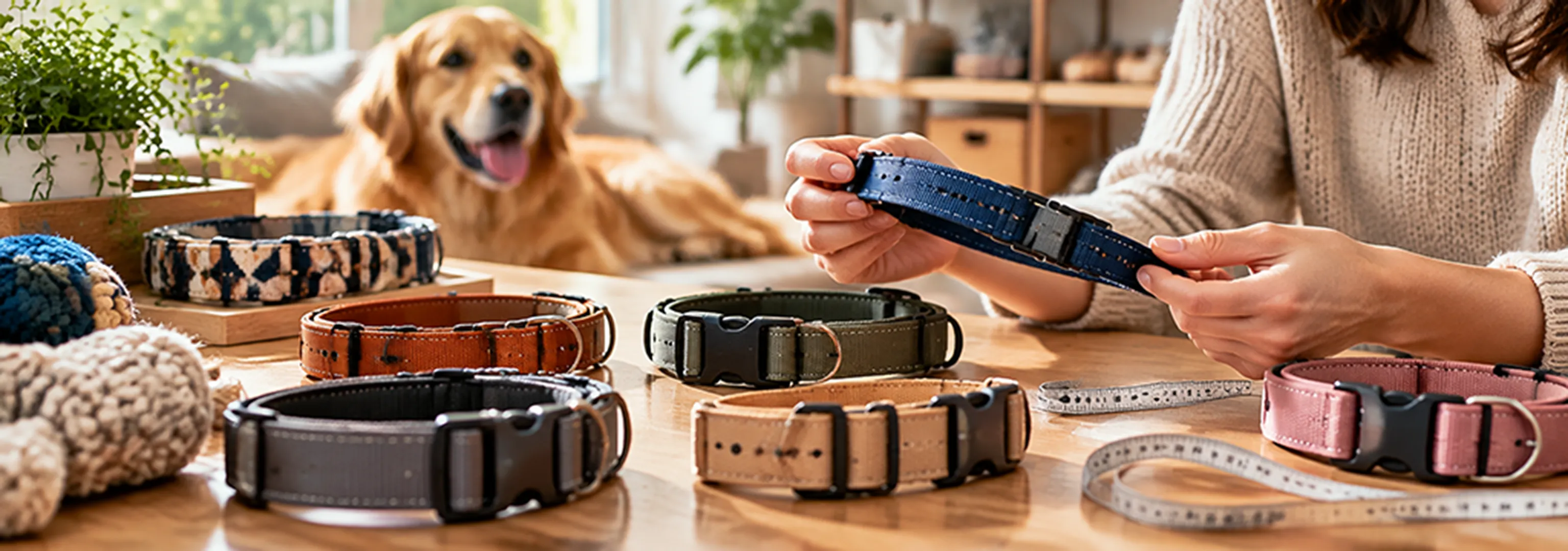
Choosing the right dog collar size starts with one simple step: measure your dog's neck, then compare the measurement with the adjustable range of the specific collar you want to buy. Breed-based size charts are useful for narrowing down the options, but they should never replace an actual measurement. Dogs of the same breed can have different neck circumferences, coat thicknesses, body proportions, and collar-fitting needs.
For dog owners, a properly fitted collar helps keep identification tags secure and supports comfortable everyday wear. For pet retailers, groomers, dog trainers, and online pet sellers, accurate sizing information helps customers make better purchasing decisions and can reduce avoidable size-related returns.
In this guide, you'll find a dog collar size chart by breed, a step-by-step neck measurement method, examples of real collar size ranges, and practical advice for puppies, large breeds, and dogs that fall between sizes. We'll also explain how pet retailers can use accurate product measurements to build a more useful collar assortment.
Dog Collar Size Chart by Breed
A breed-based dog collar size chart provides a starting point for choosing a collar, but the recommended size depends on the actual product. Different manufacturers use different size ranges, so a medium collar from one brand may not fit the same dog as a medium collar from another.
The following chart uses PetSmart's published collar sizing guide as a single-retailer reference. It is not a universal breed standard.
| Collar Size | Neck Circumference | Example Breeds Listed by PetSmart |
| XX Small | 6–8 in (15.2–20.3 cm) | Chihuahua, Teacup Yorkshire Terrier |
| X Small | 8–12 in (20.3–30.5 cm) | Miniature Dachshund, Maltese, Pomeranian, Toy Poodle, Yorkshire Terrier |
| Small | 10–14 in (25.4–35.6 cm) | Cavalier King Charles Spaniel, Pekingese, Miniature Schnauzer, Pug, Scottish Terrier |
| Medium | 14–20 in (35.6–50.8 cm) | Beagle, Border Collie, Boston Terrier, English Bulldog, French Bulldog |
| Large | 16–26 in (40.6–66.0 cm) | Boxer, Dalmatian, Golden Retriever, Labrador Retriever, Weimaraner |
| X Large | 24–30 in (61.0–76.2 cm) | Bernese Mountain Dog, Great Dane, Mastiff, Rottweiler, Saint Bernard Source:PetSmart Dog Collar Sizing Chart. The ranges overlap intentionally. For example, PetSmart's reference chart lists a medium collar for necks of 14–20 inches and a large collar for necks of 16–26 inches. A dog with a 17-inch neck could fall within both ranges, depending on the particular collar's design and adjustment options. That is why the size label alone is not enough. |
What Collar Size Does Your Dog Need?
| Dog or Breed Example | What to Do First |
| Chihuahua | Start by checking the smallest available neck range, then measure the dog's neck |
| Yorkshire Terrier | Compare the measured neck circumference with the specific product chart |
| Beagle | Use a breed chart as a starting point, not a final size recommendation |
| Border Collie | Measure the neck rather than estimating from body weight |
| Labrador Retriever | Check both the neck measurement and the collar's adjustment range |
| Golden Retriever | Compare actual neck size with the manufacturer's large-breed options |
| German Shepherd | Measure the individual dog; adult size and coat thickness can vary |
| Great Dane | Confirm the product's maximum neck circumference and suitable collar width |
| Greyhound or Whippet | Pay particular attention to head-to-neck proportions and escape risk These are starting points for the shopping process, not guaranteed size assignments. A dog may need a different size from other dogs of the same breed. The most reliable sequence is: measure the neck → check the product's adjustable range → fit the collar on the dog. |
How to Measure Your Dog's Neck for a Collar
You only need a flexible measuring tape, a calm dog, and the sizing chart for the collar you intend to purchase.
The American Kennel Club (AKC) recommends measuring the dog's neck where the collar normally sits and checking the fit after putting the collar on. See its guide to choosing the right dog collar.
Step 1: Position Your Dog Naturally
Ask your dog to stand comfortably on a level surface. Avoid measuring while the dog is twisting, stretching its neck, or pulling away, as these positions can make the result less representative of the normal collar fit.
Step 2: Measure Where the Collar Will Sit
Wrap a soft measuring tape around the neck at the intended collar position. For a standard flat collar, this is generally around the lower part of the neck where the collar rests naturally.
Keep the tape close to the coat without pulling it tight. For dogs with thick or long fur, make sure you are measuring consistently rather than allowing loose fur to create an unnecessarily large measurement.
Step 3: Record the Measurement
Write down the measurement in inches or centimeters. If you are using string or ribbon instead of a measuring tape, mark where the ends meet, then lay it flat against a ruler.
For better consistency, repeat the measurement once. If the two readings differ noticeably, check the tape position and measure again.
Step 4: Compare the Measurement With the Product Chart
Find the product's actual adjustable neck circumference, not just its total strap length.
For example, if a collar's adjustable range is 26–32 cm, a dog with a measured neck circumference of 29 cm falls within that range. You still need to confirm that the collar can be fitted comfortably and securely on the dog.
Step 5: Check the Fit After Putting the Collar On
A common fitting guideline is the two-finger check: you should generally be able to place two fingers comfortably between a standard collar and the dog's neck, while ensuring that the collar cannot easily slip over the dog's head.
This is a practical guideline rather than a universal measurement standard. Follow the manufacturer's fitting instructions and assess the actual fit, especially for dogs with thick coats, narrow heads, or unusual body proportions.
Dog Collar Size Chart: How to Read the Measurements
Not all measurements on a collar chart describe the same thing. Understanding the difference can prevent sizing mistakes.
| Measurement | What It Means | How to Use It |
| Neck circumference | The measurement around the dog's neck | Use it to select the appropriate collar range |
| Adjustable neck range | The minimum and maximum neck measurements the collar is designed to fit | Compare this range with your dog's measurement |
| Total collar length | The full length of the strap, which may include the buckle and fastening area | Do not assume it equals the usable neck range |
| Collar width | The width of the strap | Consider the dog's size, comfort, and intended use |
| Buckle or closure dimensions | The dimensions and construction of the fastening hardware | Check durability and ease of adjustment For example, a collar with a total strap length of 44 cm does not necessarily fit a dog with a 44 cm neck. Part of that length may be taken up by the buckle, adjustment holes, or fastening structure. When comparing products, the adjustable neck range is usually the most useful sizing measurement, provided the manufacturer clearly explains how it was measured. |
Real Product Size Examples: Adjustable Dog Collars
The following examples use the size information provided in two product diagrams. They illustrate why actual product measurements are more useful than generic S/M/L labels.
Example 1: Adjustable PU Leather Dog Collar
| Size | Adjustable Neck Range | Collar Width | Total Length |
| XS | 22–28 cm (8.6–11.0 in) | 1.2 cm (0.47 in) | 33 cm (13.0 in) |
| S | 26–32 cm (10.2–12.6 in) | 1.5 cm (0.59 in) | 37 cm (14.6 in) |
| M | 29–38 cm (11.4–14.9 in) | 2.0 cm (0.79 in) | 44 cm (17.3 in) |
| L | 36–46 cm (14.1–18.1 in) | 2.5 cm (0.98 in) | 51 cm (20.1 in) Important measurement note: The original size image appears to label 26 cm as 11.4 inches in one place. The correct conversion is approximately 10.2 inches. The supplier should confirm this discrepancy before the chart is published or used for customer sizing. |
Example 2: Reflective Adjustable Dog Collar
| Adjustable Neck Range | Collar Width |
| 20–30 cm (7.9–11.8 in) | 1.5 cm (0.59 in) |
| 30–40 cm (11.8–15.7 in) | 2.0 cm (0.79 in) |
| 40–60 cm (15.7–23.6 in) | 2.5 cm (0.98 in) The original diagram shows the first range as 8–11.8 inches and the middle range as 11–15.7 inches. The more accurate conversions are approximately 7.9–11.8 inches and 11.8–15.7 inches, respectively. The image also does not identify these three options as S, M, or L. They should therefore be listed by their measurement ranges unless the supplier confirms official size names. These examples demonstrate two important principles: different products can use different adjustment ranges, and unit conversions should be checked before product dimensions are published. |
Why Dog Collar Sizes Vary by Brand
There is no single sizing system that every dog collar manufacturer must follow. Each brand may define its own XS, S, M, L, and XL ranges according to strap length, buckle design, available adjustment holes, product width, and intended fit.
PetSmart's chart, for example, lists a medium collar range of 14–20 inches, while another brand may use a different range for its medium product. A second chart may also use breed labels differently.
This does not necessarily mean one chart is wrong. It means the labels belong to different product systems.
Why a Breed-Only Chart Can Be Misleading
| Factor | Why It Affects Collar Sizing |
| Individual body proportions | Dogs of the same breed may have different neck circumferences |
| Age | Puppies grow, so their current size can change quickly |
| Coat thickness | Dense fur can affect how a collar sits and feels |
| Collar construction | Buckles and adjustment holes affect the usable range |
| Strap width | A wider collar may feel different from a narrow collar |
| Head-to-neck proportions | Some dogs can back out of a collar even if the neck measurement appears correct |
| Brand-specific sizing | S/M/L labels do not represent standardized measurements across manufacturers For consumers, this means checking the size chart for every new product is worthwhile, even when purchasing the same nominal size as before. For retailers, it means product pages should show measurements rather than relying on size labels alone. |
What If Your Dog Is Between Collar Sizes?
If your dog's neck measurement falls close to the boundary between two sizes, do not automatically choose the larger or smaller option without checking the product's construction.
Instead:
- Measure the neck again to confirm the reading.
- Compare the dog's measurement with the full adjustable range of both sizes.
- Check how much adjustment remains at the chosen setting.
- Fit the collar on the dog and confirm that it is comfortable and secure.
- If neither size provides a suitable fit, look for another design or consult the manufacturer.
A collar that is too tight may rub or restrict comfort. A collar that is too loose may slip over the head or become caught on objects.
The correct choice depends on the actual collar and dog, not on a universal rule to always size up.
How to Choose a Collar for a Growing Puppy
Puppies can outgrow collars quickly, particularly during periods of rapid growth. A collar that fits today may become too tight later, so owners should check the fit regularly rather than waiting for visible discomfort.
An adjustable collar can provide room for growth, but it must still fit securely at its current setting. Buying a collar that is much too large in anticipation of adult size can increase the risk of slipping out.
For puppy owners, a practical approach is to:
- Measure the neck before buying.
- Check the fit frequently during growth.
- Re-measure after noticeable growth or weight changes.
- Inspect the strap, buckle, and adjustment holes.
- Choose a new size when the current collar no longer fits comfortably and securely.
This issue appears frequently in dog-owner discussions on Reddit. Owners preparing for a new puppy often ask which collar size to buy before the puppy arrives, while others are unsure how quickly they will need to replace it. These discussions are useful examples of customer questions, but individual Reddit experiences should not be treated as breed-specific sizing standards.
How Tight Should a Dog Collar Fit?
A standard flat collar should be secure without constricting the dog's neck. The two-finger check is a widely used starting point, but it should be combined with a physical fit assessment.
The AKC recommends checking whether two fingers can fit beneath the collar and whether the collar can slip over the dog's head. Its guidance also notes that the appropriate collar depends on the dog's needs and body shape.
VCA Animal Hospitals explains that collars can create pressure on delicate neck structures when a dog pulls hard. It also notes that harnesses may be a more suitable option for some dogs, including those with neck pain or tracheal disease. See VCA's collar and harness guide.
Check for:
- redness, irritation, or rubbing;
- difficulty slipping fingers beneath the collar;
- the collar sliding over the dog's head too easily;
- changes in comfort or behavior when the collar is handled;
- damaged straps, sharp hardware, or worn adjustment holes.
A collar should also be checked after grooming, substantial coat changes, weight changes, and periods of growth.
Dogs should be supervised when wearing collars or harnesses during play because equipment can become caught on another dog's teeth, a crate, or other objects. VCA specifically highlights accidental entanglement as a potential injury risk.
Dog Collar vs. Dog Harness: Which Measurement Matters?
Collars and harnesses serve different purposes and generally require different measurements.
| Feature | Dog Collar | Dog Harness |
| Main sizing measurement | Neck circumference | Usually chest girth; some designs also require neck circumference |
| Common uses | Identification and everyday wear | Walking and managing leash pressure |
| Key fit concern | Secure without constriction or slipping off | Secure fit without rubbing or restricting movement |
| Common sizing mistake | Choosing by breed or weight alone | Using neck size instead of measuring the chest |
| Additional consideration | Head-to-neck proportions | Strap placement and freedom of shoulder movement A harness is not automatically the right choice for every dog, and it must be fitted correctly too. The best option depends on the dog's body shape, behavior, health, and the purpose of the equipment. If a dog pulls hard, coughs when pulling, or has a known neck or airway problem, ask a veterinarian or qualified training professional about suitable walking equipment. |
A Dog Collar Sizing Guide for Pet Retailers
For independent pet stores, pet boutiques, groomers, online sellers, and other pet businesses, collar sizing is not just a product-description detail. It influences which SKUs to stock, how customers compare products, and how often purchases need to be exchanged.
A useful retail assortment should be based on actual customer demand and product specifications rather than assuming that every store needs the same quantity of each size.
What Retailers Should Check Before Buying Dog Collars
| Buying Consideration | Why It Matters |
| Adjustable neck range | Shows which measured neck sizes the collar is designed to accommodate |
| Total strap length | Helps describe the product but should not be confused with usable neck range |
| Strap width | Helps customers compare products and select an appropriate design |
| Material and construction | Affects product characteristics, care, and durability |
| Buckle and adjustment design | Influences ease of use and the available adjustment range |
| Size overlap | Helps identify whether two sizes serve similar measurement ranges |
| Unit and carton quantities | Helps plan purchasing commitments |
| Product measurements in cm and inches | Supports customers using different measurement systems |
| Clear fitting instructions | Reduces confusion when customers compare size charts |
| Actual customer returns and exchanges | Helps identify sizing gaps in the current assortment For example, if sales records show that customers regularly return medium collars because the adjustment range does not fit their dogs, the retailer should examine the actual product measurements and customer feedback before simply buying more medium collars. Similarly, a store serving many large breeds may need more products with wider straps and larger adjustment ranges, while a boutique serving small companion dogs may need greater depth in XS and S. The right assortment should follow the store's customer profile, sales history, and supplier specifications. |
How Pet Businesses Can Reduce Size-Related Returns
Size-related returns are not always caused by customers measuring incorrectly. Sometimes the product page does not explain what the numbers mean.
Retailers can make collar selection easier by showing three separate measurements wherever available:
- Adjustable neck range: the neck circumference the collar is designed to fit.
- Total collar length: the overall strap length, which may include the buckle and fastening area.
- Collar width: the width of the strap.
A clear size chart should also explain where to measure the neck, whether the product has a buckle or another closure, and how to check the fit after putting it on.
When possible, use the same measurement terminology across the category. Consistency makes it easier for shoppers to compare different products and helps customer-service teams answer sizing questions more efficiently.
Frequently Asked Questions About Dog Collar Sizes
What size collar does my dog need by breed?
A breed-based chart can suggest a starting size, but it cannot guarantee the correct fit. Measure your dog's neck and compare the measurement with the specific collar's adjustable range.
How do I measure my dog's neck for a collar?
Use a flexible tape around the neck where the collar naturally sits. Keep the tape comfortably snug, record the measurement, and compare it with the manufacturer's size chart.
Is dog collar size based on neck measurement or weight?
Neck circumference is generally the key measurement for collar sizing. Weight and breed can provide context, but they do not reliably replace an actual neck measurement.
What is the two-finger rule for dog collars?
It is a common fitting guideline: you should generally be able to place two fingers comfortably between a standard collar and the dog's neck. Also check that the collar cannot easily slip over the dog's head, and follow the product's specific fitting instructions.
What should I do if my dog is between collar sizes?
Re-measure the neck and compare the full adjustment ranges of both sizes. Choose the option that can fit comfortably and securely, rather than automatically selecting the larger size.
How often should I check a puppy's collar size?
Check it regularly during growth and whenever the puppy's body size changes noticeably. The collar should never be left to become tight simply because it fitted correctly when first purchased.
Why do dog collar sizes vary by brand?
Manufacturers use different strap lengths, buckle designs, adjustment ranges, and sizing conventions. Always check the specific product's measurements rather than assuming that S, M, or L means the same thing across brands.
Do collars and harnesses use the same size chart?
No. Collars generally use neck circumference, while harnesses usually require chest girth and may also require neck measurements. Always follow the sizing instructions for the specific product.
Final Takeaway: Measure First, Then Choose the Collar
Choosing the right dog collar may look simple, but the details matter. Breed, age, coat thickness, head-to-neck proportions, collar construction, and the manufacturer's sizing system can all affect the final fit.
For dog owners, the most reliable method is to measure the neck, compare the result with the actual adjustable range, and check the collar on the dog.
For pet retailers and wholesale buyers, clear measurements and consistent product information make the shopping experience easier. A well-organized assortment should help customers choose based on their dog's actual size rather than relying on a breed label or a generic S/M/L designation.
A breed chart is a useful starting point. An accurate measurement is the better decision tool.
Sources and Editorial Notes
This guide draws on sizing and fitting guidance from the American Kennel Club, PetSmart's published collar sizing chart, and VCA Animal Hospitals' information about collars and harnesses. Breed examples are presented as retailer references rather than universal standards. The Petfairs product measurements shown above were transcribed from the supplied product diagrams; The indicated inch-conversion discrepancies should be confirmed with the supplier before publication.
 Popular Blogs