

Mobile Dog Grooming Supplies: Essential Equipment & Checklist
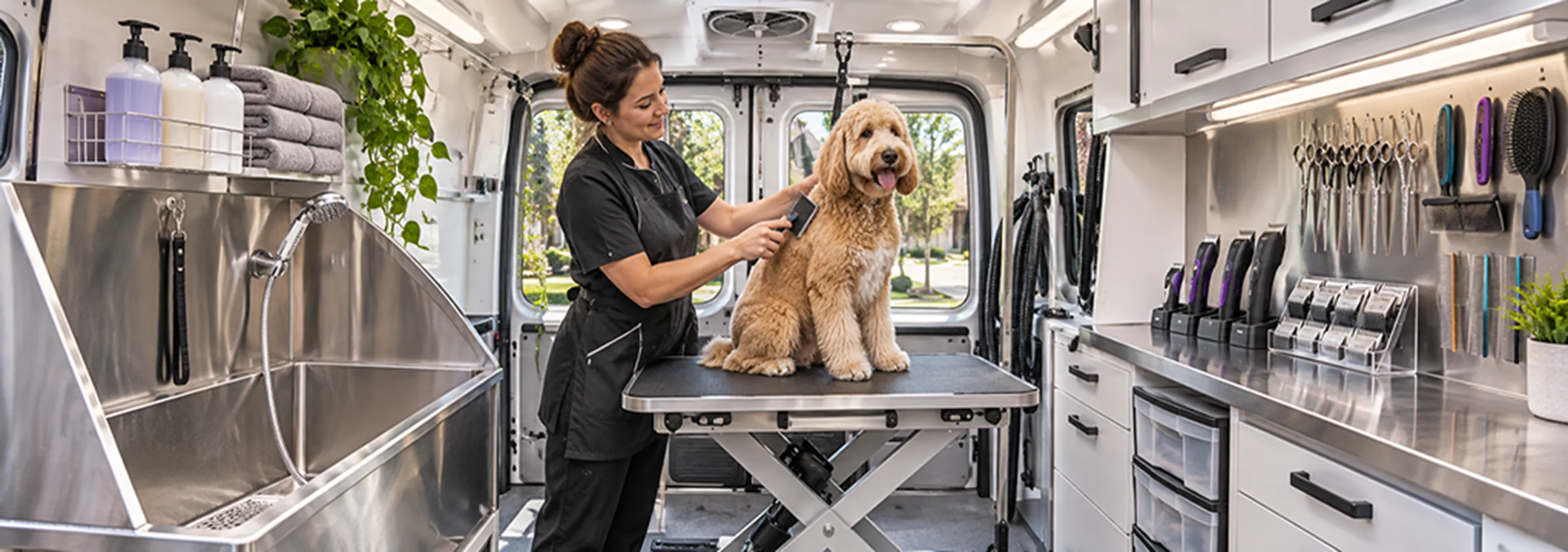
Introduction: What Does a Mobile Dog Grooming Business Really Need?
Starting a mobile dog grooming business requires more than purchasing a grooming table, clippers, and a few bottles of shampoo. Unlike a traditional grooming salon, a mobile operation must fit an entire professional grooming environment into a limited vehicle space while maintaining reliable water, electricity, ventilation, sanitation, and animal safety.
A well-equipped mobile dog grooming business needs six essential categories of supplies: vehicle infrastructure, professional grooming equipment, bathing and drying products, everyday consumables, safety and sanitation supplies, and backup equipment.
Each category serves a different operational purpose. Water tanks and power systems keep the business running independently, grooming tools support different coat types and service requirements, and backup supplies help prevent unexpected equipment failures from disrupting appointments.
For mobile groomers, every item also has to justify the space it occupies. A powerful dryer may improve productivity, but it must fit the vehicle's electrical capacity. A large grooming tub may accommodate bigger dogs, but it also affects storage, water consumption, and vehicle weight.
This is where mobile grooming requires more planning than it initially appears.
In our view, the biggest purchasing challenge is not finding the most expensive or feature-rich equipment. It is choosing products that work together, support different dogs, and remain reliable throughout a busy working day.
This guide explores the essential products, equipment comparisons, operating considerations, and inventory strategies that mobile groomers and pet businesses should understand before investing in a professional setup.
Mobile Grooming vs. Traditional Grooming Salons: What Is Different?
The fundamental difference between mobile grooming and salon grooming is the operating environment.
A traditional salon generally has access to permanent plumbing, electrical outlets, dedicated bathing areas, laundry facilities, and larger storage spaces. A mobile groomer must either carry these resources or arrange access to external utilities.
This changes how equipment should be selected.
Mobile grooming vs. salon grooming
| Consideration | Traditional Grooming Salon | Mobile Grooming Business |
| Water supply | Permanent plumbing | Freshwater tank or external connection |
| Wastewater | Building drainage | Holding tank and approved disposal arrangements |
| Electricity | Building electrical supply | Generator, battery/inverter, or shore power |
| Grooming space | Dedicated workstations | Limited vehicle interior |
| Equipment storage | Cabinets and shelves | Compact, secured storage |
| Climate control | Building HVAC | Vehicle-specific heating and cooling |
| Cleaning | Dedicated cleaning areas | Compact sanitation workflow |
| Equipment replacement | Alternative workstations may be available | A single equipment failure may interrupt the schedule |
| Transportation | Customers bring pets to the salon | Groomer travels to customers |
| Daily maintenance | Facility-based | Vehicle and equipment maintenance A mobile groomer must therefore evaluate the entire working system rather than purchase individual products independently. For example, buying a high-powered dryer without checking the generator's available capacity can create operational problems. Similarly, installing a large freshwater tank without planning wastewater collection can create unnecessary weight and compliance issues. The best mobile setup is a coordinated system, not simply a smaller version of a grooming salon. Industry publication Groomer to Groomer also highlights the importance of separating bathing, drying, and haircutting areas, even within a compact mobile unit. Source: Groomer to Groomer – Better Grooming Through Better Organization |
Essential Mobile Dog Grooming Equipment Checklist
Before purchasing equipment, divide the inventory into operational priorities.
Some products are required to perform standard grooming services, while others improve efficiency, hygiene, and reliability.
Core equipment: What should be stocked first?
| Equipment | Priority | Main Function | What to Evaluate |
| Grooming table | Essential | Supports brushing, clipping, and finishing | Stability, height adjustment, weight capacity |
| Grooming tub | Essential | Bathing and rinsing dogs | Dimensions, drainage, accessibility |
| High-velocity dryer | Essential | Removes water and loosens undercoat | Airflow, speed control, noise, heat |
| Professional clippers | Essential | Haircutting and coat maintenance | Motor performance, ergonomics, battery life |
| Replacement blades | Essential | Supports different coat lengths | Blade compatibility and availability |
| Grooming shears | Essential | Precision cutting and finishing | Blade quality, balance, handle comfort |
| Slicker brushes | Essential | Removes tangles and loose hair | Pin design, size, coat suitability |
| Metal combs | Essential | Checks coat condition and finishing | Tooth spacing and durability |
| Nail clippers | Essential | Nail trimming | Cutting precision and grip |
| Nail grinder | Recommended | Smooths nail edges | Noise, vibration, speed control |
| Grooming restraints | Essential | Helps maintain safe positioning | Fit, strength, adjustment, supervision |
| Storage cabinets | Essential | Organizes equipment | Space efficiency and secure mounting |
| Water system | Essential for self-contained vans | Supplies bathing water | Capacity, pump performance, maintenance |
| Power system | Essential for self-contained vans | Operates electrical equipment | Continuous and peak load capacity |
| Ventilation and HVAC | Essential | Controls temperature, humidity, and air circulation | Capacity and airflow The American Kennel Club's National Core Professional Dog Grooming Educational Standards provides an important reference for equipment selection, sanitation, professional safety, and humane treatment. Source: AKC – National Core Professional Dog Grooming Educational Standards |
Grooming tables: Hydraulic, electric, or portable?
A grooming table is one of the most frequently used pieces of equipment in a mobile grooming unit.
The right choice depends on the dogs being serviced, the available vehicle space, and the groomer's physical working conditions.
| Table Type | Advantages | Limitations | Best Suited For |
| Hydraulic table | Adjustable working height without relying on an electric lifting motor | Requires manual pumping and maintenance | Professional daily grooming |
| Electric table | Convenient height adjustment and reduced manual effort | Requires electrical capacity and additional space | Frequent grooming and varied dog sizes |
| Portable/folding table | Lightweight and easy to store | May offer less stability or lifting convenience | House calls and compact operations What should mobile groomers look for? |
- A stable frame that does not shift during grooming.
- A non-slip tabletop.
- Appropriate weight capacity.
- A grooming arm compatible with the table.
- Secure restraint attachment points.
- Dimensions that fit the vehicle layout.
A low-entry table or lift system may also be useful when working with senior dogs, larger breeds, or dogs with limited mobility.
The most expensive table is not necessarily the best option. Stability, accessibility, and compatibility with the vehicle should take priority.
Grooming tubs: Stainless steel vs. composite materials
A grooming tub needs to withstand frequent water exposure, cleaning chemicals, and repeated use.
| Comparison | Stainless Steel Tub | Composite Tub |
| Durability | Generally excellent | Depends on material and construction |
| Cleaning | Smooth, nonporous surface | Varies by surface finish |
| Weight | Can be relatively heavy | Often lighter |
| Maintenance | Requires routine cleaning and inspection | Requires inspection for scratches and wear |
| Cost | Often higher for professional models | Varies by construction |
| Mobile suitability | Strong option for permanent installations | Useful when weight and installation flexibility matter Important features include: |
- Non-slip flooring.
- Reliable drainage.
- Splash protection.
- Secure restraints.
- Appropriate tub dimensions.
- Easy access for small and large dogs.
- A ramp or lifting solution where appropriate.
For mobile operations, a tub should be evaluated as part of the vehicle's complete water and weight system.
High-velocity dryers: Why are they so important?
A high-velocity dryer is a major productivity tool because it helps remove water from the coat and loosen undercoat before finishing work.
However, airflow is only one part of the purchasing decision.
| Selection Factor | Why It Matters |
| Variable speed | Allows airflow to be adjusted for different dogs |
| Heat control | Helps prevent excessive heat exposure |
| Noise level | Can influence comfort in a confined vehicle |
| Hose length | Affects working flexibility |
| Filter accessibility | Makes cleaning and maintenance easier |
| Motor durability | Important for repeated professional use |
| Replacement parts | Helps reduce downtime Common professional equipment examples include K-9 II, K-9 III, MetroVac Air Force, B-Air, and XPOWER. These are examples of products found in the professional grooming market, not a universal ranking or endorsement. Should a mobile groomer buy two dryers? Not necessarily at the beginning. A primary professional dryer should come first. A secondary dryer becomes worth considering when the appointment volume, workflow, and available electrical capacity justify the additional investment. Drying safety must remain the priority. The AKC grooming standards emphasize monitoring pets during drying, adjusting equipment appropriately, and never leaving animals unattended. |
Clippers, Blades, and Professional Grooming Tools
Clippers and blades directly affect grooming quality, working time, and the range of services a mobile groomer can offer.
What clippers should mobile groomers stock?
A professional clipper should be comfortable to hold, reliable during extended use, and compatible with the blade system the groomer intends to use.
| Clipper Type | Advantages | Considerations |
| Corded clipper | Continuous power without battery replacement | Requires cable management |
| Cordless clipper | Greater mobility and convenience | Battery life and charging arrangements |
| Multi-speed clipper | More flexibility across grooming tasks | Additional features may increase maintenance needs Professional examples include: |
- Andis AGC and Excel 5-Speed.
- Oster A5 Turbo.
- Wahl KM10.
A mobile groomer should consider maintaining at least one backup clipper once regular appointments and revenue depend on the primary tool.
Essential blade sizes
Different blade sizes produce different cutting lengths and serve different grooming requirements.
| Blade Size | Approximate Cutting Length | Typical Application |
| #30 | 0.5 mm | Fine work with appropriate clipper combs |
| #10 | 1.5–1.6 mm | Common sanitary and close clipping |
| #7F | 3.2 mm | Short body clipping |
| #5F | 6.3 mm | Shorter coat styles |
| #4F | 9.5 mm | Longer body clipping Approximate cutting lengths refer to common blade specifications. Actual results depend on the blade manufacturer and blade design. A practical inventory should include: |
- A selection of commonly used blades.
- Compatible attachment combs.
- Multiple high-use replacement blades.
- Blade cleaning products.
- Blade coolant where appropriate.
- A secure blade storage case.
Blade selection should always reflect the requested grooming style, coat condition, and the animal's skin condition.
Grooming shears: Which types are necessary?
A professional grooming kit should cover different finishing tasks.
| Shear Type | Main Purpose |
| Straight shears | General trimming and finishing |
| Curved shears | Rounded shaping and contours |
| Thinning shears | Softening harsh lines |
| Blending/chunking shears | Removing bulk and blending transitions Professional brands mentioned in grooming communities include Kenchii, Geib, and Shark Fin. For mobile groomers, secure storage is especially important. Scissor rolls and hard protective cases can help prevent blades from becoming damaged during vehicle movement. |
Brushes and combs: Match tools to coat types
Not every dog needs the same grooming tools.
A brush that works well for a short-coated dog may be ineffective for a dense double coat or long, curly hair.
| Coat Type | Recommended Tools | Main Grooming Need |
| Short coat | Rubber curry brush, bristle brush | Loose hair and surface grooming |
| Double coat | Undercoat rake, slicker, metal comb | Loose undercoat management |
| Long silky coat | Pin brush, metal comb | Tangle prevention |
| Curly coat | Slicker brush, comb, shears | Mat prevention and shaping |
| Dense or heavily shedding coat | Appropriate deshedding tools | Controlled loose-coat removal Examples of professional grooming tool brands include Chris Christensen and Artero. A well-planned brush and comb inventory should be based on the actual breeds and coat types in the customer base rather than purchasing every available tool. |
Water, Heating, and Power Systems: The Foundation of a Self-Contained Van
This is one of the biggest differences between mobile grooming and traditional salon operations.
A grooming van needs enough water and electrical capacity to support its equipment throughout the working day.
Freshwater tanks: How much capacity is needed?
Freshwater capacity depends on the number of appointments, dog sizes, coat conditions, bathing methods, and equipment efficiency.
The industry research supplied for this article suggests a preliminary planning range of approximately 40–100 gallons, with 50–65 gallons frequently appearing in example mobile setups.
These are configuration references, not a universal industry standard.
A preliminary planning comparison:
| Tank Capacity | Metric Equivalent | Potential Application |
| 40 gallons | 151 liters | Smaller or lower-water-use configurations |
| 50 gallons | 189 liters | Moderate daily water requirements |
| 65 gallons | 246 liters | Larger self-contained configurations |
| 100 gallons | 379 liters | Higher-capacity systems requiring careful weight planning One mobile van conversion example from Curbside Upfitters lists a 65-gallon freshwater tank, a 40-gallon gray-water tank, and a 7 kW generator. This is a real manufacturer configuration example, not a recommended universal specification. Source: Curbside Upfitters – Mobile Pet Grooming Vans |
How much water does one dog require?
Water consumption can vary considerably.
For preliminary planning, the research notes supplied for this article use approximately 4–15 gallons per dog, depending on size, coat, bathing requirements, and operating technique.
This should be treated as an indicative planning estimate, not a measured industry average.
For example:
| Grooming Scenario | Estimated Water Use | Important Variables |
| Small, short-coated dog | 3–6 gallons | Bathing technique and rinsing |
| Medium-coated dog | 5–10 gallons | Coat density and shampoo requirements |
| Large or double-coated dog | 10–15+ gallons | Size, coat density, rinsing time These ranges are illustrative and may overlap. Actual consumption should be measured during normal operations. A useful planning formula is: Daily water requirement = Average water used per dog × Expected daily appointments + Operating reserve For example, if a groomer measures an average consumption of 8 gallons per appointment and plans for 5 appointments: 8 × 5 = 40 gallons. Additional reserve capacity should be considered for unexpected rinsing needs, tank limitations, and changes in the day's schedule. This approach is more reliable than selecting a tank solely because another grooming van uses the same size. |
Freshwater vs. wastewater tanks
Freshwater and wastewater systems should always be planned together.
| System | Function | Important Features |
| Freshwater tank | Stores bathing water | Secure mounting, suitable materials, access for cleaning |
| Gray-water tank | Collects used bathing water | Appropriate capacity, secure fittings, accessible disposal connection |
| Hair trap/filter | Captures loose hair | Easy removal and cleaning |
| Water pump | Moves water through the system | Flow rate, pressure, maintenance |
| Water heater | Supplies warm water | Temperature control and safety |
| Plumbing connections | Connects the system | Leak resistance and winterization The Gork research summary mentions wastewater tanks that may be sized larger than freshwater tanks in some configurations. However, actual tank proportions vary. The 65-gallon fresh/40-gallon gray example demonstrates why a larger gray tank should not be presented as a universal requirement. The correct configuration depends on expected consumption, recovery efficiency, local requirements, and disposal arrangements. |
Wastewater disposal: An important compliance issue
Mobile grooming wastewater can contain shampoo, hair, dirt, cleaning residues, and biological material.
It should never be assumed that wastewater can be released onto a driveway, street, or storm drain.
For example:
- San Diego prohibits polluted water from mobile business activities, including pet grooming, from entering its municipal storm sewer system.
- Claremont requires mobile dog grooming wastewater to be collected in a holding tank and disposed of through approved arrangements.
- Oakland provides guidance on filtering pet hair from wash water before authorized sewer discharge.
These examples demonstrate that disposal rules depend on local jurisdiction.
Before operating, mobile groomers should contact the relevant city or county environmental services department to confirm approved wastewater disposal methods.
Sources:
- City of San Diego – Mobile Business Best Management Practices
- City of Claremont – Mobile Dog Grooming Wastewater Requirements
- City of Oakland – Business Stormwater Inspections
Generator vs. battery/inverter: Which is better?
The power system is another major purchasing decision.
A grooming van may need to operate a dryer, air conditioning, water pump, lighting, and other electrical equipment.
| Comparison | Generator | Battery / Inverter |
| Operating time | Can continue with adequate fuel | Limited by stored battery capacity |
| Noise | Produces engine noise | Generally quieter during operation |
| Exhaust | Produces exhaust emissions | No generator exhaust during battery operation |
| Maintenance | Engine and fuel-system maintenance | Battery and electrical-system maintenance |
| Initial investment | Depends on generator capacity | High-capacity systems can be expensive |
| Recharging | Refueling | External charging or other charging infrastructure |
| Best consideration | Sustained high electrical demand | Noise-sensitive environments and quiet operation Generator examples mentioned by mobile operators include Honda EU2200i inverter generators. However, a 2.2 kW generator is not automatically sufficient for every grooming van. A dryer, air conditioner, and water heater can create substantial combined electrical demand. Before selecting a generator or inverter, calculate: |
- Continuous wattage requirements.
- Starting or surge loads.
- Which appliances operate simultaneously.
- Available electrical capacity.
- Safety and installation requirements.
- Backup power arrangements.
A shore-power connection can also be useful where an appropriate external supply is available.
A quiet power system can be valuable, but electrical capacity and safe installation should come before noise reduction.
Heating, air conditioning, and ventilation
Climate control is not simply a comfort upgrade.
A grooming vehicle is a confined space containing animals, water, electrical equipment, and drying systems.
It needs effective temperature management and air circulation.
Important supplies and systems include:
- Air conditioning.
- Heating.
- Exhaust ventilation.
- Appropriate air circulation.
- Temperature monitoring.
- Secure electrical installations.
The vehicle should be assessed for the combined heat and humidity produced during bathing and drying.
Consumables: What Should Mobile Groomers Restock Regularly?
Equipment is generally a longer-term investment. Consumables, on the other hand, need regular replenishment.
Running out of shampoo, towels, disinfectant, or cleaning products can interrupt an otherwise well-organized grooming schedule.
Shampoo and conditioner inventory
A professional inventory should cover common grooming needs without carrying unnecessary product variations.
| Product Category | Purpose | Stocking Priority |
| General-purpose shampoo | Routine bathing | High |
| Sensitive-skin shampoo | Dogs with sensitive skin | Moderate |
| Puppy shampoo | Appropriate puppy bathing | Moderate |
| De-shedding shampoo | Supports coat-care routines | Based on clientele |
| Whitening shampoo | Specific coat-finishing needs | Optional |
| Conditioner | Coat conditioning and manageability | High |
| Leave-in conditioner | Finishing and brushing support | Optional |
| Medicated shampoo | Specific veterinary-directed needs | Case-specific Concentrated shampoos can reduce storage requirements, but they must be diluted according to the manufacturer's instructions. Medicated products should not be treated as interchangeable with ordinary grooming shampoos. Their use should follow appropriate veterinary guidance and product directions. |
Towels and drying supplies
Towels are among the most frequently used consumables in a grooming operation.
| Product | Application |
| Terry towels | General drying |
| Quick-dry towels | Faster moisture removal |
| Microfiber towels | Additional drying support |
| Absorbent mats | Reducing water on work surfaces |
| Laundry bags | Separating used towels |
| Waterproof storage containers | Protecting clean towels Clean and used towels should be stored separately. For mobile groomers, storage should also protect clean towels from moisture, hair, and cleaning chemicals. |
Cleaning and sanitation products
Sanitation supplies should be treated as operational essentials, not optional accessories.
| Product | Main Purpose |
| Grooming-safe disinfectant | Treating appropriate surfaces and tools |
| Clipper cleaner | Removing hair and residue |
| Blade coolant | Managing blade temperature where appropriate |
| Paper towels | General cleanup |
| Disposable gloves | Appropriate hygiene and chemical handling |
| Cleaning brushes | Removing trapped hair |
| Hair traps | Preventing hair from entering drainage systems |
| Waste bags | Collecting hair and solid waste |
| Hand-cleaning supplies | Personal hygiene One important distinction: cleaning and disinfection are not the same process. Cleaning removes visible dirt and organic material. Disinfection reduces specified microorganisms when the product is used correctly. The AAHA infection-control guidance recommends removing visible debris before applying disinfectant and following the product's required contact time. Source: AAHA – Infection Control, Prevention and Biosecurity Guidelines |
Safety Supplies: Protecting Dogs and Groomers
Safety equipment is essential because mobile grooming combines animal handling, wet surfaces, electricity, heat, and cleaning chemicals in a confined environment.
Essential safety inventory
| Product | Purpose | Priority |
| Pet first-aid kit | Basic emergency supplies | Essential |
| Human first-aid kit | Groomer injuries | Essential |
| Fire extinguisher | Fire response | Essential |
| Eye-wash supplies | Appropriate chemical exposure response | Essential |
| Non-slip mats | Reducing slipping risks | Essential |
| Properly sized grooming loops | Controlled positioning | Essential |
| Muzzles in suitable sizes | Case-specific handling | Recommended |
| Protective gloves | Appropriate chemical and cleaning tasks | Recommended |
| Protective eyewear | Chemical splash protection | Recommended |
| Non-slip footwear | Employee safety | Recommended |
| Emergency veterinary contact list | Quick access to assistance | Essential The AKC National Core Professional Dog Grooming Educational Standards specifically address groomer protection, appropriate restraint, sanitation, and animal supervision. The standards include recommendations for water-resistant clothing, non-slip footwear, gloves, masks, and hearing and eye protection where appropriate. |
Why should dogs never be left unattended?
A grooming table or bathing tub can become dangerous if an animal is left without direct supervision.
A dog may slip, become entangled in a restraint, attempt to jump, or experience distress.
The AKC professional standards specify that pets should not be left unsupervised within arm's reach while on grooming tables or in bathing tubs.
This principle is particularly important in a mobile vehicle, where limited space can make it tempting to multitask.
Chemical safety and OSHA considerations
Grooming businesses use shampoos, ear cleaners, disinfectants, and other chemical products.
These products can expose employees to skin irritation, eye injury, or respiratory hazards depending on their ingredients and handling instructions.
OSHA has documented enforcement cases involving grooming businesses that failed to provide appropriate chemical hazard information, training, or protective equipment.
For example, OSHA cited grooming businesses over missing chemical hazard information and inadequate eye protection when handling certain cleaning and disinfecting products.
Practical measures include:
- Keep original product labels available.
- Maintain Safety Data Sheets (SDS) where required.
- Follow dilution instructions.
- Use appropriate protective equipment.
- Store chemicals securely.
- Never mix cleaning products unless the manufacturer explicitly permits it.
Sources:
- OSHA – Chemical Hazards and Toxic Substances
- OSHA – Happy Tails Pet Grooming Enforcement Record
Storage and Organization: How to Make a Small Grooming Van More Efficient
A mobile grooming van has limited storage, so organization directly affects productivity.
A poorly organized vehicle can create unnecessary movement, increase setup time, and make it difficult to locate essential tools.
Recommended storage products
| Storage Solution | Best Use | Main Advantage |
| Compartmented drawers | Blades and small accessories | Keeps items separated |
| Hard tool cases | Clippers and precision tools | Better protection during transport |
| Scissor rolls | Grooming shears | Protects sharp edges |
| Rolling toolboxes | Frequently used equipment | Easy movement |
| Wall-mounted holders | Brushes and hoses | Saves floor space |
| Labeled containers | Consumables | Faster identification |
| Magnetic strips | Compatible metal tools | Convenient access |
| Separate emergency bag | First aid and repair supplies | Keeps emergency items accessible A useful storage strategy is to organize supplies by working sequence rather than by product brand. For example: |
- Bathing supplies together.
- Drying equipment together.
- Clipping and finishing tools together.
- Cleaning and disinfection products in a separate area.
- Emergency and repair supplies in an easily accessible location.
Separate wet and dry areas
A practical grooming workflow follows this sequence:
Pet assessment → Bathing → Drying → Clipping → Finishing → Cleanup
This is easier to manage when wet and dry supplies have separate storage areas.
| Area | Recommended Supplies |
| Wet zone | Tub, sprayer, shampoo, towels, water-system controls |
| Drying zone | High-velocity dryer, hoses, drying towels |
| Grooming zone | Table, clippers, blades, shears, brushes |
| Cleaning zone | Disinfectant, cleaning tools, waste containers |
| Emergency zone | First aid, fire extinguisher, repair kit Industry publication Groomer to Groomer discusses the importance of separating bathing, drying, and haircutting areas even in smaller grooming spaces. Source: Better Grooming Through Better Organization |
What do real mobile groomers say about organization?
A discussion in Reddit's r/doggrooming highlighted a practical problem: a mobile groomer found it time-consuming to transport, arrange, and pack grooming tools, especially when the vehicle's storage was shared with other groomers.
Suggestions from participants included compartmented trays, scissor holders, and modular tool-storage systems.
Another discussion focused on the quality-of-life features that experienced mobile groomers wished they had included when building their vans.
These discussions illustrate an important operational lesson:
A storage system should reduce repeated handling, not simply provide more places to put equipment.
Community discussions are useful for identifying workflow problems, but individual recommendations should be evaluated against professional safety and equipment requirements.
Community examples:
- Reddit – Mobile Groomers: How Do You Transport and Set Up Your Tools Efficiently?
- Reddit – Must-Haves for a Mobile Grooming Van
Backup Equipment: What Happens When Something Breaks?
For a mobile groomer, equipment reliability directly affects the appointment schedule.
A clipper that stops working, a damaged dryer hose, or a water pump failure can prevent a service from being completed as planned.
Unlike a larger salon, a mobile unit may not have another workstation available.
The three-level inventory strategy
A useful approach is to organize inventory into three levels.
| Inventory Level | Purpose | Examples |
| Primary inventory | Supports daily grooming | Main clipper, dryer, shampoo, towels |
| Backup inventory | Prevents avoidable interruptions | Second clipper, spare blades, replacement hose |
| Emergency inventory | Supports urgent response and repairs | First-aid kit, fire extinguisher, repair tools |
Recommended backup supplies
| Backup Item | Why It Matters |
| Second clipper | Provides an alternative if the primary unit fails |
| Spare blades | Replaces damaged or unsuitable blades |
| Additional grooming loops | Avoids improvising with damaged restraints |
| Spare dryer hose | Supports drying equipment continuity |
| Pump fuses and appropriate spare components | Helps address certain electrical faults |
| Basic plumbing repair supplies | Supports minor approved maintenance |
| Extra towels | Provides additional drying capacity |
| Backup nail clippers | Alternative if the grinder fails |
| Flashlight | Useful during low-light maintenance |
| Multi-tool | General equipment adjustments |
| Emergency contact information | Helps arrange professional repairs Electrical and plumbing repairs should only be undertaken by appropriately qualified individuals when required. A repair kit does not replace safe maintenance practices. |
Preventive maintenance schedule
Rather than waiting for equipment to fail, mobile groomers should follow a regular maintenance routine.
| Frequency | Suggested Checks |
| Before each working day | Check water level, power, dryer, clippers, restraints, and emergency supplies |
| After each dog | Clean and disinfect appropriate tools and work surfaces |
| Weekly | Inspect hoses, filters, storage fittings, and electrical connections |
| Monthly | Review equipment condition, water-system maintenance, and inventory levels |
| According to manufacturer instructions | Service generators, pumps, batteries, heaters, and grooming equipment This schedule is a practical planning framework, not a substitute for manufacturer-specific maintenance intervals. |
How to Choose the Right Supplies for Different Dog Sizes and Coat Types
A mobile groomer should not stock equipment based on a single average dog.
Different breeds and coat types require different tools, bathing arrangements, and drying approaches.
Small dogs vs. large dogs
| Consideration | Small Dogs | Large Dogs |
| Tub access | Easier to accommodate | May require a ramp or lifting solution |
| Grooming table | Smaller working surface may be sufficient | Higher weight capacity and stability needed |
| Restraints | Smaller, appropriately fitted equipment | Stronger, correctly sized restraints |
| Drying | May require lower airflow settings | May require longer drying time |
| Towels | Smaller sizes may be sufficient | Larger and more absorbent towels |
| Storage | Compact accessories | More space for larger tools |
| Water use | Often lower | Can be considerably higher These are operational comparisons, not fixed rules. A small dog with a dense coat may require more work than a larger short-coated dog. |
Match supplies to coat types
| Coat Type | Important Supplies | Grooming Consideration |
| Short-haired | Rubber curry, bristle brush, suitable shampoo | Loose hair and surface cleaning |
| Double-coated | Undercoat rake, slicker, high-velocity dryer | Controlled shedding and coat maintenance |
| Long-haired | Pin brush, metal comb, conditioner | Tangle prevention |
| Curly-haired | Slicker, comb, professional clippers, shears | Mat prevention and finishing |
| Wire-haired | Appropriate stripping and coat tools | Coat-specific technique |
| Senior or mobility-limited dogs | Supportive equipment and suitable access arrangements | Comfort and safe handling The AKC grooming standards emphasize selecting appropriate grooming methods and equipment according to coat type and the individual dog's needs. |
How Much Does It Cost to Equip a Mobile Dog Grooming Business?
The total investment depends on whether the operator is converting an existing vehicle, purchasing a professionally converted van, or starting with a portable house-call setup.
One important distinction is the difference between the cost of grooming tools and the cost of building a self-contained mobile business.
Equipment budget categories
| Investment Category | Examples | Budget Planning Priority |
| Core grooming tools | Clippers, blades, shears, brushes | High |
| Bathing and drying | Tub, sprayer, dryer | High |
| Grooming workstation | Table, arm, restraints | High |
| Water infrastructure | Tank, pump, heater, plumbing | High |
| Electrical infrastructure | Generator, battery, inverter, wiring | High |
| Climate control | AC, heating, ventilation | High |
| Storage and organization | Cabinets, drawers, cases | Medium to high |
| Consumables | Shampoo, conditioner, towels, disinfectant | Ongoing |
| Backup equipment | Second clipper, spare blades, hoses | Medium to high |
| Vehicle conversion | Installation, insulation, flooring, plumbing | Major capital expense The Gork research summary provided for this article suggests an indicative starter range of approximately $1,500–$4,000+ for grooming tools alone, excluding vehicle conversion and major infrastructure. This is a preliminary planning estimate, not a verified 2026 U.S. market average or supplier quotation. A complete self-contained van can require substantially more investment depending on vehicle condition, equipment specifications, installation, and customization. |
Where should new operators invest first?
For a business with a limited initial budget, purchasing priorities should follow operational necessity.
| Priority | Investment | Reason |
| 1 | Safe bathing and grooming setup | Enables core services |
| 2 | Professional clipper and blade system | Supports haircutting |
| 3 | Reliable high-velocity dryer | Supports drying workflow |
| 4 | Brushes, combs, and shears | Covers coat-care requirements |
| 5 | Water and power infrastructure | Enables independent operation |
| 6 | Sanitation and safety products | Supports professional standards |
| 7 | Backup tools and repair supplies | Reduces downtime |
| 8 | Optional upgrades | Improves convenience and service differentiation A low initial purchase price should not be the only selection criterion. A professional tool that lasts longer and can be serviced may offer better long-term value than a cheaper product that needs frequent replacement. |
Business and Compliance Considerations Before Operating
A mobile dog grooming business involves more than equipment purchasing.
Vehicle configuration, local business licensing, wastewater disposal, employee safety, and insurance arrangements should all be reviewed before the business begins operating.
Do mobile dog groomers need a business license?
Requirements vary by state, county, and city.
There is no single universal mobile grooming license that applies identically across the United States.
Depending on the location and business model, operators may need to investigate:
- General business licensing.
- Animal grooming or facility permits.
- Mobile business or vendor requirements.
- Vehicle inspections.
- Zoning and parking restrictions.
- Wastewater disposal approvals.
- Fire and electrical safety requirements.
For example, King County, Washington, explicitly includes mobile grooming units within its pet grooming service guidance.
Los Angeles County also regulates certain grooming facilities and mobile grooming operations, while Beverly Hills has specific requirements involving mobile grooming vehicle inspections.
Sources:
- King County – Resources for Pet Businesses
- LA County Animal Care & Control – Protecting Animals in Grooming Facilities
- Beverly Hills Municipal Code – Animal Grooming Businesses
Before purchasing or converting a vehicle, verify the applicable requirements with the relevant local authorities.
What insurance should mobile groomers investigate?
Insurance needs depend on the business structure, vehicle, employees, services, and policy terms.
Common coverage categories to discuss with a licensed insurance professional include:
| Insurance Category | General Purpose |
| Commercial auto | Business vehicle-related risks |
| General liability | Certain third-party injury or property damage claims |
| Care, custody, and control coverage | Certain risks involving animals in the business's care |
| Equipment or inland marine coverage | Certain business equipment losses |
| Workers' compensation | Employee injury coverage where applicable Coverage exclusions and limits vary. Operators should review actual policy wording rather than assume that one insurance category covers every grooming-related incident. |
How Pet Businesses Can Support Mobile Groomers Through Better Product Selection
The mobile grooming market creates opportunities for more than grooming professionals.
Retailers, distributors, online sellers, and subscription businesses can also benefit from understanding how mobile groomers purchase and use their supplies.
The most useful product recommendations are based on operational needs rather than seasonal promotions or isolated trends.
Product opportunities by business type
| Business Type | Relevant Product Categories | Customer Need |
| Mobile Pet Groomers | Clippers, dryers, tables, tubs, storage | Reliable daily operations |
| Pet Grooming Salons | Shears, brushes, shampoos, sanitation | Professional grooming workflow |
| Veterinary Clinics (Retail) | Cleaning, comfort, and everyday care supplies | Complementary pet care |
| Pet Boutiques | Grooming accessories, brushes, towels | Convenient retail selection |
| Physical Pet Stores | Brushes, combs, nail tools, shampoos | Everyday customer needs |
| Online Pet Sellers | Grooming kits and accessories | Product discovery and convenience |
| Social Commerce Sellers | Grooming accessories and practical kits | Demonstrable product functions |
| Marketplace Resellers | Replacement blades, brushes, tools | Repeat-purchase categories |
| Subscription Box Sellers | Grooming accessories and care essentials | Useful product combinations |
| Local Pet Distributors | Professional grooming equipment and consumables | Supporting business customers |
| Breeders | Coat-care tools and puppy grooming supplies | Early grooming preparation |
| Pet Boarding & Daycare | Brushes, cleaning, and hygiene supplies | Daily care and cleanliness |
| Pet Shelters & Rescues | Brushes, towels, cleaning supplies | Animal care and maintenance |
| Dog Trainers | Brushes, nail-care supplies, cleaning accessories | Complementary everyday care |
Which products are suitable for repeat purchasing?
Not every product category has the same replenishment cycle.
| Product Category | Typical Purchasing Pattern | Inventory Consideration |
| Clippers | Long-term equipment purchase | Replacement and maintenance |
| Blades | Recurring replacement | Maintain compatible stock |
| Shampoo | Recurring consumable | Monitor usage and shelf life |
| Conditioner | Recurring consumable | Match product demand |
| Towels | Replacement and replenishment | Consider washing capacity |
| Disinfectant | Recurring consumable | Follow label instructions |
| Brushes | Periodic replacement | Stock different coat types |
| Shears | Long-term equipment | Maintenance and sharpening |
| Storage accessories | Occasional purchase | Expand as workflow changes For businesses serving professional groomers, understanding the difference between equipment purchases and consumable replenishment helps create more relevant product collections. The goal should be to make it easier for customers to find products that genuinely support their daily work. |
A Complete Mobile Dog Grooming Supplies Checklist
The following checklist brings the main equipment and supplies together into one practical reference.
Vehicle infrastructure
- Freshwater tank
- Wastewater holding tank
- Water pump
- Water heater
- Hair trap or filter
- Generator or battery/inverter system
- Shore-power connection where appropriate
- Air conditioning
- Heating and ventilation
- Secure cabinetry and storage
- Non-slip flooring
- Appropriate tub access and ramp
Grooming equipment
- Grooming table
- Grooming arm and appropriate restraints
- Grooming tub
- High-velocity dryer
- Professional clippers
- Replacement clipper blades
- Attachment combs
- Straight shears
- Curved shears
- Thinning or blending shears
- Slicker brushes
- Pin brushes
- Metal combs
- Undercoat rake
- Nail clippers
- Nail grinder
- Ear-care supplies
Consumables
- General-purpose shampoo
- Appropriate specialty shampoos
- Conditioner
- Towels
- Laundry bags
- Cleaning products
- Disinfectant
- Clipper cleaner
- Blade coolant where appropriate
- Gloves
- Paper towels
- Waste bags
- Hair collection supplies
Safety and emergency supplies
- Pet first-aid kit
- Human first-aid kit
- Fire extinguisher
- Eye-wash supplies
- Protective eyewear
- Appropriate footwear
- Emergency veterinary contacts
- Product labels and SDS information
- Spare grooming restraints
- Secure chemical storage
Backup and maintenance supplies
- Second clipper
- Spare blades
- Spare dryer hose
- Backup nail clippers
- Spare approved electrical components
- Basic maintenance tools
- Flashlight
- Multi-tool
- Extra towels
- Spare cleaning products
Frequently Asked Questions About Mobile Dog Grooming Supplies
What equipment do you need to start a mobile dog grooming business?
A self-contained mobile grooming business needs a grooming table, tub, high-velocity dryer, professional clippers, blades, shears, brushes, nail tools, freshwater and wastewater systems, electrical infrastructure, climate control, storage, sanitation supplies, and safety equipment.
The exact configuration depends on vehicle size, available utilities, service types, and local regulations.
How much water does a mobile dog grooming van need?
A preliminary planning range is approximately 40–100 gallons of freshwater capacity, although actual requirements vary. A 50–65-gallon tank is one configuration range found in the supplied industry research.
The correct size depends on the number of dogs, coat types, bathing methods, and expected daily consumption.
How much water does one dog use during grooming?
Water use varies by dog size, coat density, bathing technique, and rinsing requirements. An indicative planning estimate is approximately 4–15 gallons per dog, but groomers should measure their own usage before choosing tank capacity.
Do mobile dog groomers need a gray-water tank?
A self-contained operation generally needs a way to collect and manage used bathing water. Local wastewater requirements determine approved storage and disposal arrangements.
Operators should confirm local rules before designing the vehicle's plumbing system.
Can mobile dog groomers dump wastewater into a storm drain?
Do not assume this is permitted. Cities such as San Diego prohibit polluted mobile-business wastewater, including pet grooming wash water, from entering municipal storm drains. Disposal requirements vary by jurisdiction.
Is a generator or inverter better for a grooming van?
Generators can support sustained electrical demand when appropriately sized, while battery/inverter systems can offer quieter operation without generator exhaust during battery use. The best option depends on simultaneous equipment loads, operating hours, budget, and charging arrangements.
What backup equipment should mobile groomers carry?
Useful backups include a second clipper, spare blades, an additional nail clipper, replacement dryer hose, suitable electrical spare components, and basic maintenance supplies. Emergency equipment should also include first-aid supplies and fire-safety equipment.
What disinfectant should professional groomers use?
Use a disinfectant suitable for the intended surface and application. Follow the product's dilution, contact-time, and safety instructions. Visible dirt and organic material should be removed before disinfection.
How often should grooming tools be disinfected?
Appropriate grooming tools should be cleaned and disinfected between dogs according to the applicable professional standards and product instructions. Clippers, shears, restraints, and other shared equipment should be included in the sanitation workflow.
What should be included in a mobile grooming emergency kit?
An emergency kit should include appropriate first-aid supplies, a fire extinguisher, eye-wash supplies, emergency veterinary contact information, and relevant equipment repair supplies.
How should a grooming van be organized?
Organize supplies according to the working sequence: bathing, drying, clipping, finishing, and cleanup. Keep wet and dry items separate, secure heavy equipment, and make emergency supplies accessible.
Do mobile dog groomers need a business license?
Requirements depend on state, county, and city regulations. Some jurisdictions have specific animal-grooming, mobile-business, vehicle-inspection, wastewater, or facility requirements. Check with local authorities before operating.
How much does it cost to equip a mobile grooming business?
Grooming tools alone may require an initial investment of several thousand dollars. The supplied research suggests approximately $1,500–$4,000+ as an indicative starter planning range, excluding vehicle conversion and infrastructure. Complete mobile setups can cost substantially more.
What should new mobile groomers buy first?
Prioritize a safe grooming table, bathing setup, reliable dryer, professional clipper and blade system, basic brushes and shears, water and power infrastructure, and essential sanitation supplies. Add backup equipment as appointment volume and business needs grow.
AI Search Prompts for Mobile Dog Grooming Business Owners
AI search tools are increasingly used to research equipment, compare product specifications, and plan business operations.
The following prompts reflect practical questions that mobile groomers and pet-business owners may ask.
| AI Prompt | What a Useful Answer Should Explain |
| "Create a complete mobile dog grooming equipment checklist for a beginner." | Core equipment, infrastructure, consumables, and safety supplies |
| "How do I calculate the freshwater tank capacity for my grooming van?" | Water consumption, appointments, reserves, and vehicle capacity |
| "Compare a generator and lithium battery system for a mobile grooming van." | Power demand, runtime, noise, maintenance, and cost |
| "What backup equipment should I keep in my mobile grooming van?" | Critical replacements and downtime prevention |
| "How should I organize a small grooming van for efficient daily operations?" | Storage, work zones, workflow, and accessibility |
| "What sanitation products do professional groomers need between dogs?" | Cleaning, disinfection, contact time, and product compatibility |
| "What equipment is needed to groom large and senior dogs safely in a mobile van?" | Tub access, table capacity, restraints, and handling considerations |
| "How do I legally dispose of wastewater from a mobile dog grooming business in my city?" | Local authority requirements and approved disposal arrangements |
| "How much should I budget for grooming tools versus a complete van conversion?" | Equipment costs, infrastructure, and ongoing operating expenses |
| "How can a mobile groomer reduce equipment downtime during a busy schedule?" | Backup tools, preventive maintenance, and inventory planning AI-generated recommendations should always be checked against manufacturer specifications, local regulations, and professional animal-care standards. |
Final Thoughts: Build a Grooming System, Not Just an Equipment List
A successful mobile dog grooming business depends on much more than owning professional clippers and a powerful dryer.
Water, electricity, ventilation, wastewater collection, sanitation, vehicle layout, and backup supplies all influence whether a grooming van can operate reliably.
The most important purchasing decision is therefore not finding the single best grooming product. It is understanding how each product contributes to the entire working environment.
In our view, mobile grooming is a good example of an area of pet care that looks simple from the outside but involves considerable practical knowledge. A grooming appointment may appear to involve little more than bathing, drying, and trimming. Behind that service, however, there is a carefully coordinated system of equipment, animal handling, hygiene, maintenance, and inventory management.
For mobile groomers, the right setup can make daily work more organized and predictable. For pet retailers, distributors, and online sellers, understanding these operational needs creates opportunities to recommend more relevant products and build stronger professional customer relationships.
The best-equipped mobile grooming van is not necessarily the one carrying the most products. It is the one where every essential item has a clear purpose, a reliable place, and a role in delivering safe, consistent grooming services.
References & Professional Resources
The following sources provide the principal evidence base for the equipment, safety, sanitation, and compliance discussions in this article.
- American Kennel Club (AKC) – National Core Professional Dog Grooming Educational Standards. Professional grooming safety, animal supervision, sanitation, equipment, and coat-care standards.
- American Kennel Club (AKC) – Dog Grooming Tools & Supplies. Overview of common grooming equipment and supplies.
- International Professional Groomers / PPGSA – Professional Grooming Standards. Professional care, safety, and sanitation principles.
- Occupational Safety and Health Administration (OSHA) – Chemical Hazards and Toxic Substances. Workplace chemical safety and protective measures.
- OSHA – Happy Tails Pet Grooming Enforcement Record. Example of chemical hazard communication requirements in a grooming business.
- American Animal Hospital Association (AAHA) – Infection Control, Prevention and Biosecurity Guidelines. Cleaning and disinfection principles.
- City of San Diego – Mobile Business Best Management Practices. Mobile-business wastewater and stormwater requirements.
- City of Claremont – Mobile Dog Grooming Wastewater Requirements. Wastewater containment and disposal guidance.
- City of Oakland – Business Stormwater Inspections. Mobile-business wastewater guidance.
- King County, Washington – Resources for Pet Businesses. Local pet grooming business requirements.
- Los Angeles County Animal Care & Control – Protecting Animals in Grooming Facilities. Local animal handling and grooming facility requirements.
- Groomer to Groomer – Better Grooming Through Better Organization. Professional grooming workflow and storage organization.
- Groomer to Groomer – What's New in Mobile Grooming?. Mobile grooming vehicle and power-system developments.
- Curbside Upfitters – Mobile Pet Grooming Vans. Example of a commercial mobile grooming van configuration.
- Time To Pet – How to Start a Mobile Dog Grooming Business. Business planning and equipment considerations.
Real-World Groomer Discussions
These discussions are included to illustrate operator experiences and common workflow questions. They are not authoritative evidence for safety, legal, or medical claims.
- Reddit: Mobile Groomers – Transporting and Setting Up Tools Efficiently
- Reddit: Must-Haves for a Mobile Grooming Van
- Reddit: Equipment Failures in Grooming Vans
Editorial and accuracy note: Equipment capacities, consumption estimates, costs, and vehicle configurations are planning references rather than universal industry standards. Verify current manufacturer specifications, local regulations, and professional requirements before purchasing or operating equipment. This article is educational and does not replace veterinary, legal, engineering, or insurance advice.





 Popular Blogs