

What Types of Cat Scratchers Are Most Popular on Amazon in 2026?
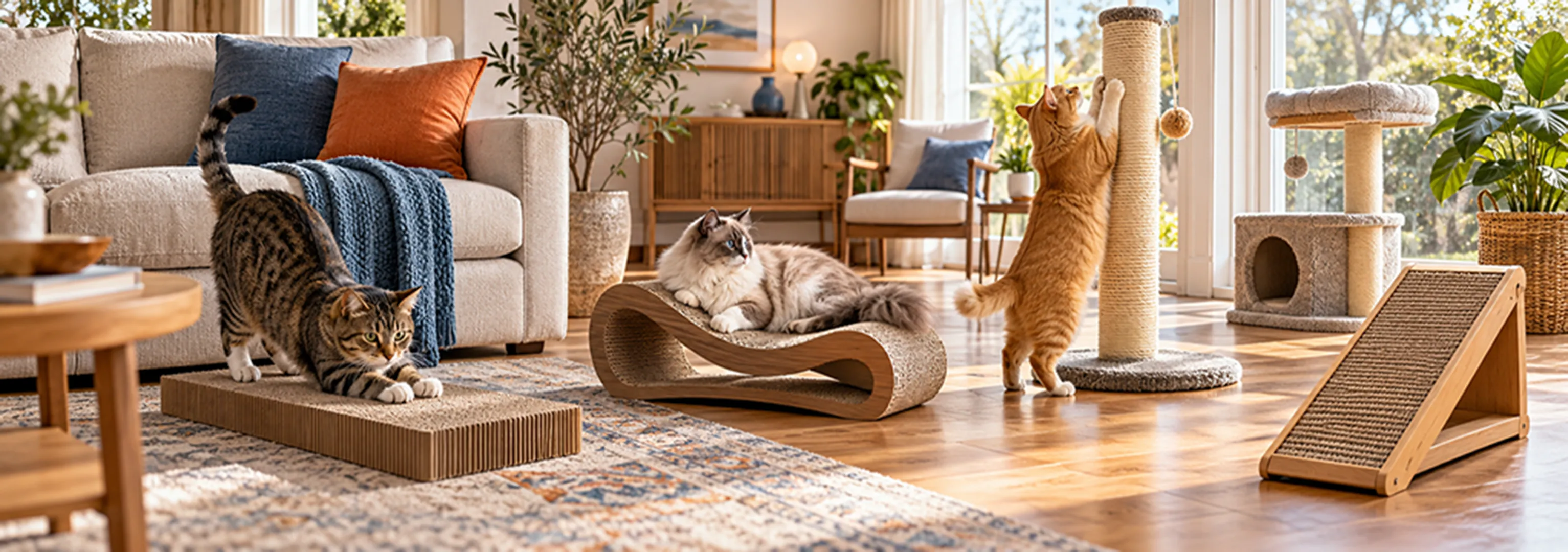
The clearest answer from the Amazon U.S. Scratching Pads dataset supplied for this analysis is corrugated cardboard—but the winning products are no longer just simple flat rectangles.
After grouping 673 ASIN-level records from August 2026 into 108 parent product families to reduce variant duplication, the top of the category shows a strong pattern: all five highest-ranked product families are built around cardboard or corrugated-board scratching surfaces. The top two families feature L-shaped or vertical-supported designs, while the next positions include reversible pads, multipacks and scratcher-lounger formats.
Among the top 20 parent families, 80% contain “cardboard” or “corrugated” in at least one variant title, 45% include an L-shaped variant, 85% use pack/set language, 30% mention reversible use and 40% mention catnip. The median family-level price among those top 20 is $21.12, remarkably close to the $21.46 median across all 108 families.
That tells retailers something more useful than simply “cardboard sells.”
The 2026 Amazon signal is cardboard + usable shape + more usable surface + value.
At the same time, Amazon sales popularity should not be confused with universal feline preference. A large peer-reviewed survey of 4,105 eligible cat-owner responses found that rope/sisal was the most-used scratching substrate when available, while multi-level cat trees and upright posts performed strongly as scratching structures. A controlled kitten study, however, found strong preference for an S-shaped cardboard scratcher over several alternatives. The science therefore supports what good retailers already discover in practice: cats differ, and assortment matters.
For pet stores, boutiques, marketplace sellers and online retailers, the opportunity is not to search for one universal “best cat scratcher.” It is to understand which designs are attracting buyers, what feline behavior those designs serve, and which products are likely to come back onto the shopping list when the first one wears out.
The Answer From Amazon's 2026 Data
The dataset used for this analysis covers the Amazon U.S. Beds & Furniture > Scratching Pads category for August 2026. It contains 673 child ASIN records grouped under 108 parent families.
That distinction matters. Amazon variants frequently share ranking, review or family-level information, so simply adding the totalUnits column across all 673 rows would risk counting the same product family repeatedly. For this article, related variants were grouped by parent ASIN, and the maximum totalUnits value within each family is shown as a conservative comparison signal rather than summing all child variants.
What sits at the top of the supplied Amazon snapshot?
Category rank | Leading product-family format | Family median price | Dataset unit estimate* | Median rating |
1 | L-shaped cardboard / large pad family | $24.99 | 19,132 | 4.5 |
2 | L-shaped wall-supported scratcher | $22.79 | 14,843 | 4.4 |
3 | Corrugated reversible / multipack family | $24.99 | 12,955 | 4.4 |
4 | Wide reversible cardboard pads / multipack | $14.99 | 9,902 | 4.5 |
5 | Corrugated cardboard lounger family | $19.99 | 7,836 | 4.5 |
Product features become even clearer in the top 20
Title-level signal | Top 20 parent families | All 108 parent families |
Cardboard / corrugated appears | 80% | 50.9% |
L-shaped variant appears | 45% | 11.1% |
Pack / set / pieces language appears | 85% | 51.9% |
Reversible appears | 30% | 20.4% |
Catnip appears | 40% | 16.7% |
Refill / replacement appears | 10% | 10.2% |
What the Rankings Reveal About Product Design
Looking past individual ASINs, the Amazon data points to several distinct product formats rather than one winner.
L-shaped scratchers are the strongest visible design trend
The top two parent families both center on an L-shaped or upright-supported format, and nine of the top 20 families include at least one L-shaped variant.
That is notable because the form solves two problems simultaneously.
A conventional flat pad primarily offers horizontal scratching. An L-shaped design can provide a more upright surface while retaining a horizontal base. Depending on construction, a cat may scratch one section vertically, use the bottom section horizontally and sometimes lean or rest against the structure.
From a commercial perspective, the benefit is easy to communicate.
The customer does not have to understand feline-behavior terminology. The product visibly gives the cat more than one way to use it.
Scientific evidence gives the idea some behavioral plausibility, although it does not specifically prove that today's Amazon L-shaped products are superior. In Wilson and colleagues' large international owner survey, cats frequently used simple upright posts and multi-level cat trees; horizontal surfaces were also used, but not by every cat. The researchers emphasized individual variation in scratching preference.
That makes vertical-horizontal hybrids commercially logical.
Instead of forcing a customer to predict a cat's preferred orientation perfectly, one product can cover more than one behavior.
Flat and reversible cardboard remain core products
Simple cardboard boards have not disappeared because newer shapes exist.
The Amazon top group contains reversible pads, mixed flat-and-wavy packs and multi-piece cardboard sets. These products offer a very different value proposition from furniture-like scratchers: they are understandable, relatively low-commitment and easy to replace.
Reversible construction is especially logical in this category.
In the full parent-family dataset, 22 of 108 families, or 20.4%, include reversible language somewhere in their variant titles. Among the top 20, that rises to 30%.
Again, that does not establish that reversibility itself causes higher sales.
It does tell retailers that brands repeatedly use “more usable scratching surface before replacement” as a selling proposition.
I think this is one of the most important lessons for small pet businesses. When a category naturally wears out, product design should not pretend wear does not exist.
It can design around it.
A reversible pad acknowledges the replacement cycle while making the customer feel they receive more use from each purchase.
Scratch-and-lounge designs turn one product into two use cases
Another visible group combines scratching with resting: loungers, beds, couches, bowls and curved designs.
Amazon's fifth-ranked family in the supplied snapshot is a corrugated cardboard lounger family, while bed- and bowl-style products also appear around the upper ranks.
This matches a broader feline-environment principle. Current Feline Veterinary Medical Association and International Cat Care guidance treats scratching, play, resting and sleeping as important environmental resources that owners should make available to cats.
A scratcher bed does not become scientifically better merely because it performs two functions.
But from a household-use perspective, the proposition is obvious:
scratch here, then lie here.
That can be especially attractive in smaller homes, where buyers may hesitate to devote floor space to multiple bulky cat-furniture pieces.
Multipacks are not just a discount story
Multipack language appears unusually frequently in this Amazon snapshot.
The obvious explanation is value: more boards per purchase.
There is another reason retailers should think about.
The 2026 FelineVMA/iCatCare caregiver guidance recommends providing multiple and separated key resources, including scratching areas, especially because cats should be able to access resources without competition or threat. Multi-cat households need separate resources and territories.
The U.S. market is moving in a direction that makes this increasingly relevant. APPA reported that 53 million U.S. households owned a cat in 2025, representing 39% of households. Its 2026 Cat Report also says ownership of two cats increased 7% year over year, while households with three or more cats also rose 7%.
A multipack therefore has more than one possible story.
It can be:
more value for one cat,
multiple placements around the home, or
multiple scratching resources for multiple cats.
That is a much better merchandising story than simply printing “5 PCS” in large type.
Catnip and toy features help with discovery—but should remain secondary
Eight of the top 20 parent families contain catnip language somewhere in their variants, and the dataset also contains products incorporating balls, tracks and hanging toys.
These features make listings visually richer and give sellers additional marketing hooks.
But the scientific picture is more nuanced.
In a controlled study of 40 kittens under eight weeks old, researchers found that an S-shaped cardboard scratcher was consistently preferred over several alternatives, but dried catnip and catnip oil did not increase scratching in those kittens. The authors specifically cautioned that kitten responses should not automatically be generalized to adult cats.
So retailers should avoid implying:
“Contains catnip, therefore every cat will use it.”
A more defensible hierarchy is:
good scratching surface first; useful form second; attraction/play features third.
What Cats Actually Prefer Is More Complicated Than Amazon Rankings
Amazon measures consumer behavior.
Feline-behavior research measures something different.
That distinction is essential.
A product can rank highly because it is affordable, photographable, easy to ship, well reviewed or heavily promoted. None of those factors necessarily proves that every cat prefers the product.
The strongest large-scale scratching study available makes this particularly clear.
Wilson and colleagues analyzed 4,105 eligible owner responses from 36 countries, with 3,021 respondents, or 73.6%, from the United States. Among cats nine years old or younger, rope was the most frequently preferred substrate at 32.5%, followed by carpet at 25.1% and cardboard at 18.2%. Among cats over ten, carpet ranked first at 24.7%, followed by rope at 22.9% and cardboard at 19.6%.
Amazon popularity and feline preference are not the same ranking
Evidence source | Strong signal | What it means |
Amazon U.S. dataset, Aug. 2026 | Corrugated cardboard dominates upper category ranks | Buyers are strongly purchasing/engaging with cardboard-based formats in this category snapshot |
Wilson et al., 4,105 analyzed owners | Rope/sisal most used when offered; carpet and cardboard also used | Cats show material preferences and rope performed strongly |
Wilson et al. | Multi-level trees and upright posts frequently used | Vertical scratching remains behaviorally important |
Zhang et al., 40 kittens | S-shaped cardboard strongly preferred in several tests | Shape + cardboard can be highly attractive to kittens |
Moesta et al., 116 valid pilot-survey responses | Posts used more often than pads; isolated material/orientation effects were not statistically clear | Preference cannot be reduced to one material variable |
Frontiers 2024, 1,211 cats | Placement was significantly associated with scratching behavior | Where the scratcher goes matters as well as what it is |
Vertical and horizontal both have a reason to exist
The Wilson study found strong use of upright posts and multi-level trees, especially among younger cats. In the same research, simple horizontal scratching surfaces were also used, but to a lesser degree in that sample.
A separate University of Georgia pilot study gathered 116 valid responses from cat owners. It found that designated scratching posts were used more frequently than scratch pads, although material, orientation and length considered individually did not significantly explain scratching frequency in that smaller study.
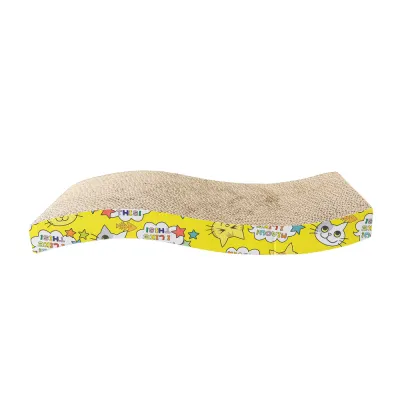
Then the controlled kitten study produced a different result: young kittens showed a strong preference for an S-shaped cardboard scratcher over several tested alternatives, and in one comparison preferred a surface positioned horizontally over the same type positioned vertically.
That is why statements such as “cats prefer vertical scratchers” or “cats prefer cardboard” are too absolute.
The better advice is:
Observe how the individual cat already scratches.
A cat repeatedly scratching the side of a sofa is giving a very different clue from a cat scratching the carpet.
One suggests vertical access.
The other suggests horizontal access.
Placement can make a good product fail
A 2024 Frontiers in Veterinary Science study analyzed data from 1,211 cats with unwanted scratching behavior. The researchers found significant associations between scratching and environmental factors, including scratcher placement. They concluded that placing scratching resources in areas the cat frequents can help redirect behavior toward more appropriate surfaces.
This is one reason a low star rating does not always mean poor product design.
A beautifully constructed scratcher placed in a hidden spare room may lose to the sofa in the living room because the sofa is where the cat wants to scratch.
For retailers, that opens a content opportunity.
Do not sell only the product.
Teach the customer:
where to put it,
how to identify the cat's preferred direction,
how to offer alternative surfaces, and
when to add a second scratching area.
Useful education can reduce the gap between “I bought a scratcher” and “my cat actually uses it.”
Why Replacement Behavior Makes This Category Interesting
Cat scratchers occupy an unusual position between pet furniture and pet consumables.
A large cat tree is a durable good.
A corrugated insert is not.
That distinction matters enormously for a small retailer.
A customer may buy one cat tower and keep it for a long time, while a heavily used cardboard surface gradually becomes shredded and eventually needs to be turned over, refilled or replaced.
The supplied Amazon dataset strongly reflects that product lifecycle.
Across the 108 parent families:
Replacement-oriented listing signal | Parent families | Share |
Pack / set / pieces | 56 | 51.9% |
Reversible | 22 | 20.4% |
Refill / replacement | 11 | 10.2% |
“Wears out” should not automatically mean “poor quality”
This is an important customer-education point.
A cardboard pad is designed to receive repeated claw contact. Comparing it with a permanent piece of wooden furniture solely by longevity misunderstands the product.
The better questions are:
How dense is the cardboard?
How much usable surface does the customer get?
Can both sides be used?
Is the insert replaceable?
Does the structure stay stable as the surface wears?
Can debris be contained?
Those questions can help a boutique or online seller move the conversation away from:
cheapest scratcher per piece
toward:
useful scratching value over the life of the product.
Replacement creates a different inventory opportunity
Repeat-use products can be valuable to small businesses because they create a reason for a customer to return without requiring a completely new pet-care need.
But repeat purchase is only useful when replenishment is simple.
A retailer that successfully introduces a replacement-based scratcher should know whether it can obtain:
- the same size again,
- compatible refill inserts,
- additional packs,
- related shapes,
- and enough stock to avoid disappointing returning customers.
That makes the scratcher aisle not just a product-discovery category but a replenishment category.
For marketplace and e-commerce sellers, the same principle can become lifecycle merchandising:
Buy the frame → replace the insert.
Or:
Try one shape → reorder the multipack.
Or:
Start with horizontal → add vertical if the cat also scratches furniture sides.
In other words, the second purchase does not always have to be an identical product.
It can be the next product that completes the scratching environment.
What Pet Businesses Should Stock
The data does not support telling every retailer to buy the same five Amazon-style products.
A boutique with 50 cat SKUs has different constraints from an online marketplace seller with thousands.
What it does support is an assortment framework.
Start with behaviors, then choose SKUs
Customer need | Core format to consider | Why it belongs in an assortment | Inventory role |
Cat scratches floors/rugs | Horizontal cardboard pad | Low-complexity entry format | Core |
Cat scratches sofa sides | Vertical or L-shaped scratcher | Matches upright behavior | Core |
Customer wants more use per purchase | Reversible / multipack pad | More usable surface | Core / value |
Cat likes resting on scratcher | Lounger / bed shape | Combines scratching and resting | Expansion |
Small home | L-shaped / wall-supported format | Uses vertical space | Expansion |
Customer wants durable texture | Sisal mat/post | Supported by feline-preference research | Core alternative |
Multi-cat household | Multipack / multiple scratching areas | Enables resource distribution | Bundle |
Existing reusable frame | Refill pad | Creates replacement pathway | Replenishment |
Customer wants play value | Ball-track / toy-integrated scratcher | Adds engagement | Test |
Gift/design customer | Sculptural/novelty format | Differentiation | Test |
A practical small-business assortment
For a new pet store or boutique, I would build the category in three layers.
Core products should cover the most obvious needs: a horizontal corrugated pad, a vertical or L-shaped option, a sisal alternative and a reversible or multipack value option.
Expansion products can introduce a cardboard lounger, a larger format and perhaps a refill system.
Test products can cover novelty shapes, interactive functions, wall systems or design-led furniture.
This protects cash while still giving customers meaningful choice.
It also aligns with the scientific evidence. The large owner survey found that inappropriate scratching decreased as households offered a greater variety of scratching styles, although observational survey data cannot prove that adding more styles alone caused the reduction.
Different businesses should read Amazon data differently
A physical pet store benefits from clear good-better-best options and readily replaceable core pads.
A pet boutique can lean further into attractive L-shaped designs, loungers and furniture-friendly products that customers are happy to display in the home.
A marketplace reseller can use multipacks, size variants and clearly differentiated shapes because customers can compare specifications directly.
A social-commerce seller may benefit from products whose function can be demonstrated visually: reversible boards, transformable designs, scratch-and-lounge products or cats actively using vertical/horizontal surfaces.
A subscription-box operator should be more selective because many full-size scratchers are bulky; compact pads, refill products or occasional cat-enrichment themes may fit the model better.
A shelter or rescue retailer can focus on approachable scratching resources and owner education because current feline-welfare guidance treats appropriate scratching areas as part of the cat's environmental resources.
Where Petfairs fits
For Petfairs, the opportunity is not to tell small businesses that one Amazon bestseller should become everyone's inventory.
Petfairs is an online wholesale platform serving independent retailers and professional or high-consumption buyers across dog, cat and other companion-animal categories, with delivery available across much of the global market.
The more useful role is helping buyers build a category architecture.
A retailer can source around:
orientation — horizontal, vertical, mixed;
material — cardboard, sisal, mixed;
lifecycle — durable frame, replaceable surface, multipack;
function — scratch, lounge, play;
space — floor, corner, wall, compact home;
price — entry, core, premium.
That is more resilient than chasing one ASIN.
Amazon rankings change.
The behavior underneath them changes much more slowly.
Quick Answers and Research Methodology
What type of cat scratcher is most popular on Amazon in 2026?
Within the Petfairs-provided August 2026 Amazon U.S. Scratching Pads dataset, corrugated cardboard is the strongest material signal. All five top-ranked parent families are cardboard-based, and 80% of the top 20 families contain cardboard or corrugated language in at least one variant title. L-shaped, reversible, multipack and lounge-style designs are especially visible near the top.
Are L-shaped scratchers popular?
Yes, in this dataset they are a particularly strong format. The first two ranked product families use L-shaped/upright-supported designs, and 45% of the top 20 parent families contain at least one L-shaped variant. That figure is a title-based dataset observation, not an Amazon-wide market-share estimate.
Do cats prefer cardboard or sisal?
There is no universal winner. In a large owner survey with 4,105 analyzed responses, rope/sisal was the most-used substrate when available, particularly among cats nine and younger. In a controlled study of kittens, however, an S-shaped cardboard scratcher performed strongly against several alternatives. Individual preference, age, design and orientation all matter.
Do cats prefer vertical or horizontal scratchers?
Both should be considered. Large owner-survey data showed frequent use of upright posts and multi-level trees, while controlled kitten research found horizontal preference in at least one matched-surface comparison. The safest buying advice is to observe what direction the individual cat already chooses when scratching.
Why does my cat use the sofa instead of the scratching board?
The product may not match the cat's preferred orientation, texture or location. A 2024 study involving 1,211 cats found scratcher placement significantly associated with scratching behavior, supporting the practical value of placing appropriate scratching resources in areas the cat already frequents.
Are cardboard scratchers repeat-purchase products?
They can be. The Amazon dataset cannot establish a universal repurchase interval, so claims such as “owners replace them every X weeks” would be unsupported. However, 51.9% of the analyzed parent families contain pack/set/pieces language, 20.4% include reversible language and 10.2% include refill/replacement wording in at least one variant. Combined with the naturally wearing scratching surface, that makes cardboard scratchers a logical replacement-oriented category.
How often should a cardboard scratcher be replaced?There is no evidence-based universal timetable. Replacement should depend on actual condition: remaining usable surface, structural stability, cleanliness and whether the cat can still scratch it effectively. A heavily used pad may need replacing much sooner than one used occasionally.
Should a pet retailer carry only cardboard because it is popular on Amazon?
No. Amazon commercial popularity and feline behavioral preference are different questions. Scientific research supports sisal/rope, upright posts and multi-level structures as valuable options, while feline-veterinary guidance recommends providing appropriate scratching resources and, particularly in multi-cat homes, multiple separated resources.
What is the best starter assortment for a small store?
A practical starting point is one horizontal cardboard option, one vertical/L-shaped option, one sisal alternative and one reversible or multipack option. Add lounge, refill and interactive designs after observing what customers actually reorder. This is an assortment recommendation derived from the Amazon and behavioral evidence, not a measured industry-wide sales formula.
How this analysis was built
The commercial analysis uses the spreadsheet supplied by Petfairs, containing 673 ASIN-level records from Amazon U.S. source files for August 2026. Those records map to 108 parent product families.
Because child variants can share ranking, review and estimated-sales information, this analysis does not sum totalUnits across all ASINs. Product-family comparisons use parent grouping and the maximum recorded totalUnits value in that family as a comparison indicator. Median prices and ratings are calculated at family level where appropriate.
Keyword analyses—such as cardboard, L-shaped, reversible, catnip, pack/set and refill—use product-title text. A family is counted when at least one of its variants contains the relevant term. These percentages therefore describe listing characteristics, not audited Amazon market shares.
There is another important limitation: the supplied file covers the Scratching Pads category. Large cat trees, traditional standalone sisal posts and other feline furniture may be categorized elsewhere on Amazon and can therefore be underrepresented here. The correct conclusion is that cardboard dominates this 2026 Amazon Scratching Pads snapshot, not that cardboard represents 80% of every cat-scratching product sold on Amazon.
The behavioral interpretation is based primarily on peer-reviewed feline research. Wilson et al. analyzed 4,105 eligible responses, 73.6% from the U.S., and documented substantial variation in substrate and structure use. Zhang et al. experimentally tested scratcher preference in 40 young kittens. Moesta et al. conducted a 116-response pilot survey of scratching behavior. Demirbas et al. analyzed environmental and behavioral correlates of unwanted scratching in 1,211 cats.
Current feline-care context comes from the 2026 Feline Veterinary Medical Association/International Cat Care environmental-needs guidance, which explicitly includes scratching areas among key environmental resources. U.S. market context comes from APPA's 2026 research, which reports 53 million cat-owning U.S. households in 2025 and continuing growth in multi-cat ownership.
The takeaway for pet businesses
The 2026 Amazon data does not say that retailers should fill every shelf with the same corrugated pad.
It says something more useful.
Cardboard has become a strong commercial foundation, but shoppers appear to reward products that give that familiar material a clearer reason to buy: more directions, more pieces, more usable sides, more ways to rest or play, or an obvious replacement path.
The science adds the missing half of the story.
Cats do not all scratch the same way.
Some want vertical resistance. Some use horizontal surfaces. Material preference varies. Age matters. Placement matters. Environment matters. And a product that works beautifully for one cat may be ignored by another.
That is why the strongest retail strategy is not:
Find the single most popular scratcher.
It is:
Stock the major scratching behaviors, then learn which products your customers come back to replace.
For small pet businesses, that final word—replace—is particularly important.
A cat scratcher is not always a one-time furniture sale. In the cardboard segment especially, use gradually creates the need for the next pad, refill or multipack. The Amazon data's heavy presence of reversible surfaces, bundles and replacement products reinforces that lifecycle.
In my view, that makes cat scratchers one of the more interesting feline accessory categories for independent retailers: part enrichment product, part furniture-protection solution, and part repeat-purchase opportunity.
The first scratcher gets the cat started.
The better assortment gives the owner a reason to come back.
 Popular Blogs