


Pet Industry Trends 2026: Growth, Products & E-commerce
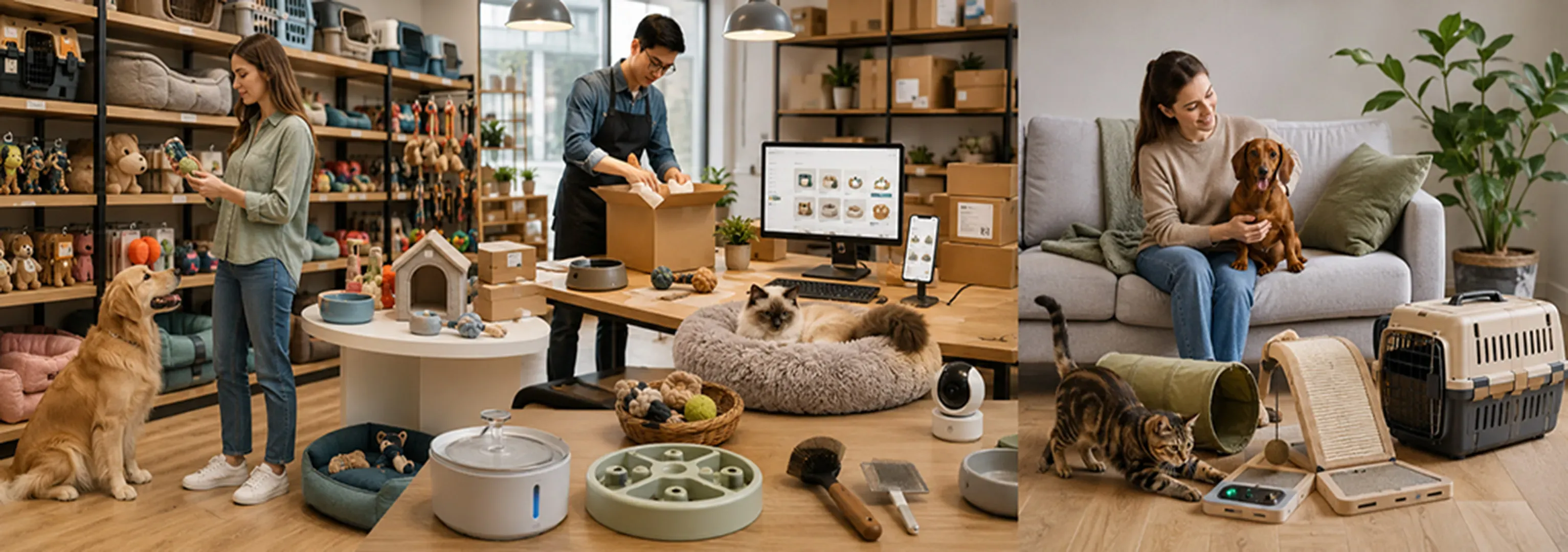
Quick Answer:The pet industry continued to grow in the first half of 2026, but growth became more selective. U.S. pet industry spending reached $158 billion in 2025 and is projected to rise to $165 billion in 2026. Pet owners remain willing to spend on products that improve comfort, enrichment, convenience and daily care, while becoming more price-conscious and selective about non-essential purchases.
For independent pet retailers, the strongest opportunities are in cat toys and enrichment, interactive dog toys, pet beds, travel accessories, grooming tools, smart pet hardware and selected exotic-pet supplies. E-commerce continues to gain share, but physical stores remain important for product advice, immediate availability and local trust. The most practical strategy for smaller businesses is to test focused product ranges in manageable quantities, monitor sell-through and reorder proven products.
The pet industry entered the first half of 2026 with continued growth, but the market is becoming more selective. Pet ownership remains resilient, consumers continue to protect spending connected to their animals, and online purchasing continues to gain share. At the same time, shoppers are comparing prices more carefully, delaying lower-priority purchases and expecting clearer reasons to choose one product over another.
For independent pet retailers, ecommerce sellers, groomers, trainers, boarding businesses, subscription-box operators and local distributors, the main opportunity is therefore not to stock every product associated with a passing trend. The opportunity is to identify durable consumer needs, test focused product ranges and reorder the products that prove their value.
This report focuses on the non-consumable pet-products market, including pet toys, enrichment products, beds, travel accessories, feeding hardware, grooming tools, collars, harnesses and selected smart products. It excludes pet food, edible treats, supplements, medicines, shampoos and pharmaceutical products.
Key Takeaways
The U.S. pet industry reached $158 billion in expenditures in 2025, an increase of 3.7%, and the American Pet Products Association projects that it will reach $165 billion in 2026. Approximately two percentage points of the projected 4.4% growth are expected to come from inflation, meaning retailers should distinguish between nominal market growth and real unit demand.
Consumer demand remains resilient, but value is being redefined. Pet owners are seeking promotions, buying selected products in larger quantities and delaying non-essential purchases, while continuing to favor products and retailers they trust. Convenience, clarity and reliability are increasingly part of the value proposition rather than optional service features.
Cat ownership is an important growth signal. APPA reports that U.S. cat ownership increased 5% year over year in 2025 to 53 million households, while product purchases remained the largest expense category for cat owners. This supports continued opportunities in indoor enrichment, cat toys, scratchers, beds and other non-consumable cat products.
E-commerce continues to take share from physical retail, but the market is not becoming online-only. NIQ reports that omnichannel shoppers represent the majority of pet buyers and the overwhelming majority of spending, while physical stores remain important for immediate purchases, reassurance, specialist advice and service-led relationships.
For smaller businesses, the most practical response is a test-and-reorder model: source focused assortments in manageable quantities, measure sell-through, collect customer feedback and increase inventory only after demand has been demonstrated.
About This Report and Methodology
This report reviews pet industry information published or available through July 2026. Priority was given to primary and high-authority sources, including the American Pet Products Association, FEDIAF, NielsenIQ and publicly reported financial results from major pet retailers.
Market definitions differ between sources. APPA’s U.S. expenditure estimate covers the broader pet industry, while NIQ’s measured pet-care figure reflects the products and retail channels included in its market measurement. These figures should not be added together or treated as competing estimates of exactly the same market.
Regional comparisons also require caution. FEDIAF’s report published in June 2026 uses 2024 European population data and now covers 41 of the 48 Council of Europe member states. FEDIAF specifically advises against simple year-over-year comparisons because its country coverage has changed.
Social-media discussions can reveal questions, frustrations and emerging shopping language, but they are not treated as population-level evidence in this report. Comments on Reddit, Quora, TikTok, Instagram and Facebook may help businesses understand customer scenarios, but market conclusions should be verified using representative research, company filings or recognized industry sources.
Pet Industry Market Growth in 2026
Is the pet industry still growing in 2026?
Yes. The pet industry is still growing in 2026, but the clearest description is resilient and selective growth, not unrestricted expansion across every category.
APPA reports that U.S. pet industry expenditures rose 3.7% to $158 billion in 2025 and are projected to reach $165 billion in 2026. The association expects full-year nominal growth of approximately 4.4%, with about two percentage points driven by inflation. The distinction matters because higher revenue does not automatically mean consumers are buying proportionally more units.
NIQ uses a narrower measured pet-care definition and reports a market of $91.8 billion, with a projection of $95.3 billion for 2026. NIQ similarly describes the outlook as positive but measured, with growth concentrating in particular species, price tiers, channels and product needs rather than spreading evenly across the entire market.
For a retailer, selective growth means category-level decisions are more important than headline market size. A growing total market can still contain weak products, slow-moving designs and oversupplied subcategories. Inventory should therefore be planned around customer problems, reorder behavior, acceptable margins and sell-through speed.
2026 U.S. pet industry snapshot
| Indicator | Latest reported figure | Why it matters to retailers |
| 2025 U.S. pet industry expenditure | $158 billion | Confirms continued market resilience |
| Projected 2026 expenditure | $165 billion | Indicates positive but measured growth |
| Projected nominal growth | About 4.4% | Revenue growth includes an inflation effect |
| U.S. pet-owning households | 95 million | Maintains a broad addressable customer base |
| Dog-owning households | 71 million | Dogs remain the largest U.S. ownership segment |
| Cat-owning households | 53 million | Cat ownership is growing faster year over year |
| Owners spending less in 2025 | 22% | Shows greater price and value sensitivity All figures in this table are based on APPA’s March 2026 State of the Industry announcement. |
Pet ownership continues to support demand
The United States had approximately 95 million pet-owning households in 2025, according to APPA. Dog ownership increased from 51% of U.S. households in 2024 to 53% in 2025, representing approximately 71 million households and four million additional dog-owning households.
Cat ownership reached 39% of U.S. households, or approximately 53 million households, after increasing 5% year over year. APPA identifies Gen Z and Millennials as important contributors to that increase and reports that products remain the largest expense category among cat owners.
Ownership is also expanding beyond cats and dogs. APPA reported year-over-year Gen X ownership increases across birds, reptiles and freshwater fish, supporting opportunities for retailers that can serve selected exotic-pet and small-animal niches instead of treating the pet market as a dog-and-cat-only industry.
For a broad wholesale platform, this creates two complementary strategies. The first is to maintain depth in high-volume dog and cat categories. The second is to offer carefully selected accessories for birds, reptiles, fish and small animals, where a specialist retailer may need fewer units but a more relevant assortment.
Regional Outlook: United States, Europe and Australia
United States: scale, convenience and category specialization
The United States remains a large, mature and highly competitive pet market. Scale creates room for mass retailers, specialist chains, ecommerce platforms, independent boutiques and service-led businesses, but it also makes generic products easy to compare.
A U.S. pet retailer therefore needs a reason for customers to choose its assortment. That reason may be specialist advice, a local community, curated designs, faster availability, products for a defined breed or lifestyle, or a product bundle that solves a specific problem.
For example, “dog accessories” is too broad to represent a defensible retail position. “Reflective walking accessories for urban dogs,” “enrichment products for dogs left alone during the working day” or “compact cat furniture for apartments” give the customer a clearer reason to engage.
Europe: a large pet population with meaningful local differences
FEDIAF reports that Europe has approximately 306 million pets and that 140 million households, or 49% of households in the countries covered, own at least one pet. The report was published in June 2026 and uses 2024 data collected across 41 Council of Europe countries.
Europe should not be treated as one uniform retail market. Product-language requirements, packaging rules, safety expectations, environmental claims, consumer preferences and logistics costs can differ significantly by country.
European retailers may place particular emphasis on materials, product durability, repairability, packaging efficiency and the evidence behind environmental claims. A general claim such as “eco-friendly” is less persuasive than a precise description of the material used, the product’s expected life, how packaging has been reduced or which component can be recycled.
The large European cat population also makes indoor cat enrichment, scratchers, compact beds, hideaways and apartment-friendly furniture important areas for product development. Retailers should nevertheless validate demand at the country and customer level rather than assuming a product that succeeds in one European market will automatically perform in another.
Australia: high pet ownership and strict import considerations
Australia combines high pet ownership with long transport distances and strict biosecurity requirements. Recent reporting based on Animal Medicines Australia’s 2025 national survey states that approximately 73% of Australian households own a pet and that the country has an estimated 31.6 million pets.
For non-consumable accessories, Australian buyers should pay attention to product materials, natural untreated components, wood, seeds, animal-derived materials and packaging contents. Import requirements depend on the exact product and material, so buyers should verify applicable requirements before ordering rather than assuming that every ordinary-looking pet accessory can enter under the same conditions.
Shipping economics also affect product selection. Lightweight, compressible, nested or efficiently packaged products may be commercially easier to import than bulky products with low retail value per cubic meter.
This favors practical packaging decisions such as vacuum-compressed textile beds, foldable carriers, nested bowls, compact grooming tools and toys that deliver clear retail value without excessive dimensional shipping cost.
Regional comparison
| Market | Latest ownership signal | Main retail opportunity | Main operating consideration |
| United States | 95 million pet-owning households | Large category depth and omnichannel demand | Strong price comparison and fulfillment expectations |
| Europe | 140 million pet-owning households across covered countries | Cats, compact living and specialist assortments | Country-level regulation, language and environmental claims |
| Australia | 73% of households reported as pet-owning | High engagement and premium accessory potential | Biosecurity, distance and dimensional shipping costs These figures come from different studies, definitions and reporting periods and should be used as regional indicators rather than as directly comparable measures. |
Consumer Behavior: Pet Owners Are Redefining Value
How is pet consumer behavior changing in 2026?
Pet owners are not abandoning the category, but many are becoming more intentional. They are protecting important pet-related spending while asking harder questions about price, durability, usefulness and convenience.
APPA reports that about half of pet owners said their spending remained unchanged, while 22% said they spent less in 2025. The share reporting reduced expenditure was 10% higher than in 2024, and spending shifted away from discretionary purchases toward essential care.
NIQ describes a similar pattern: consumers are buying in bulk, delaying non-essential purchases, looking for deals and selectively reducing services, yet remaining loyal to trusted brands. NIQ also identifies price-checking fatigue and time pressure as important factors, meaning simplicity and reliability now contribute directly to perceived value.
For accessories and toys, value should therefore be defined as:
The combination of an appropriate price, useful function, credible quality, low purchasing friction and a product life that matches customer expectations.
A low price alone does not create value if the product breaks quickly, arrives in an unsuitable size or fails to solve the reason it was purchased.
Customers want products tied to a recognizable use case
A product becomes easier to evaluate when its purpose is immediately clear. A reflective harness solves low-light visibility. A slow-feeding bowl addresses fast eating. A washable bed supports easier maintenance. A puzzle toy creates a structured enrichment activity. A collapsible travel bowl reduces the difficulty of carrying feeding equipment outside the home.
This does not mean marketing should make medical or guaranteed behavioral claims. It means that merchants should connect product design features to realistic usage scenarios.
Instead of saying:
“The ultimate revolutionary pet product.”
A stronger description is:
“A foldable silicone bowl designed for walks, road trips and other situations where carrying a rigid bowl is inconvenient.”
The second version gives the customer a definition, an intended situation and an understandable benefit in the same paragraph.
Safety information is part of conversion
Pet owners cannot judge every product material, component or construction detail from a product photograph. Clear specifications reduce uncertainty and help retailers answer customer questions.
Useful product information may include:
- Product dimensions and weight.
- Recommended pet size or use.
- Primary materials.
- Cleaning method.
- Whether the item contains a squeaker, rope, bell or small removable component.
- Whether supervision is recommended.
- Intended activity, such as chewing, cuddling, fetching or scratching.
- Warnings that the product is not indestructible where applicable.
Retailers should avoid presenting every toy as suitable for every animal. A soft plush toy designed for cuddling serves a different use case from a dense rubber chew product. Clear positioning helps reduce mismatched expectations, negative reviews and avoidable returns.
Durability is relative, not absolute
“Durable” should describe performance under an intended use rather than promise that a product cannot be damaged. Pet size, jaw strength, play style, supervision and product material all influence lifespan.
For dog toys, a useful merchandising system can separate:
- Soft comfort toys.
- Interactive tug toys.
- Fetch toys.
- Treat-dispensing enrichment toys.
- Moderate-chew products.
- Products designed for stronger chewers.
This structure helps customers make a more informed decision and gives online sellers better language for category filters, product comparisons and buying guides.
Convenience affects both product and channel choice
Convenience includes more than delivery speed. It also includes how easily the customer can understand the product, select the correct size, clean it, store it and reorder it.
A compact cat tunnel that folds away may fit an apartment better than a rigid structure. A removable bed cover may be easier to maintain than a fully enclosed bed. A self-cleaning grooming brush may reduce the inconvenience of removing collected hair. A harness with clear measurement guidance may reduce sizing uncertainty.
For retailers, convenience should therefore be designed into product selection, product content and fulfillment.
Trending Pet Product Categories in 2026
Which pet product categories offer the strongest opportunities?
The strongest opportunities are not necessarily the products receiving the most social-media views. More defensible opportunities are categories linked to durable needs: indoor enrichment, comfort, walking and travel, grooming tools, waste management, selected smart hardware and products adapted to specific species or living environments.
The following opportunity ratings are editorial assessments based on ownership trends, channel behavior, problem frequency, suitability for repeat assortment updates and relevance to independent retailers. They are not published market-growth forecasts.
| Product category | 2026 outlook | Retail opportunity | Main demand driver |
| Cat toys and indoor enrichment | High | ●●●●● | Rising cat ownership and indoor lifestyles |
| Interactive dog toys | High | ●●●●● | Mental stimulation and shared play |
| Beds and comfort products | High | ●●●●● | Daily use, aging pets and home integration |
| Walking, travel and outdoor accessories | High | ●●●●○ | Mobility, safety and pet-inclusive lifestyles |
| Grooming tools | Medium–High | ●●●●○ | At-home maintenance and professional use |
| Smart pet hardware | Medium | ●●●●○ | Monitoring and convenience |
| Sustainable and material-led accessories | Medium | ●●●○○ | Environmental interest and product differentiation |
| Exotic-pet accessories | Niche–High | ●●●●○ | Specialist demand and less direct competition Cat toys and indoor enrichment Cat products represent one of the clearest non-consumable opportunities in 2026. APPA reports that U.S. cat ownership increased 5% year over year to 53 million households in 2025 and that products remained the largest expense category for cat owners. Indoor cats need opportunities to scratch, stalk, chase, climb, hide and explore. The retail opportunity is therefore broader than selling isolated toys. It includes creating a connected enrichment assortment. Relevant product groups include: |
- Catnip-filled plush toys where permitted and appropriate to the retailer’s range.
- Teaser wands.
- Ball-track and chase toys.
- Motion-activated toys.
- Scratching boards and scratching posts.
- Tunnels and hideaways.
- Window perches.
- Compact cat trees.
- Puzzle toys.
- Multi-texture toys with crinkle, feathers or ribbons.
- Cat furniture designed for smaller homes.
Retailers can improve conversion by organizing these products around behavior rather than only product format. Useful collections include “solo-play cat toys,” “interactive toys for cats and owners,” “scratching products for apartments” and “indoor enrichment for multi-cat homes.”
Product rotation is also relevant. Cats may lose interest when the same toy remains available continuously, so bundles or seasonal toy rotations can create a practical reason for repeat purchasing without making unsupported claims.
Interactive dog toys and behavioral enrichment
Interactive dog toys are designed to create an activity rather than simply remain available for passive chewing. They may involve fetching, tugging, searching, manipulating compartments or working to release dry food supplied separately by the pet owner.
The main customer need is mental and physical engagement. Owners may look for these products when a dog spends time alone, eats too quickly, needs more structured indoor activity or benefits from owner-led play.
Retailers can divide the category into clear use cases:
| Use case | Suitable product types | Main merchandising message | Main demand driver |
| Owner-and-dog play | Tug ropes, fetch toys, flying discs | Shared activity and exercise | Rising cat ownership and indoor lifestyles |
| Solo supervised enrichment | Puzzle toys, rolling dispensers | Extends activity beyond simple chewing | Mental stimulation and shared play |
| Slow feeding | Maze bowls, licking mats, feeder puzzles | Makes feeding activity more structured | Daily use, aging pets and home integration |
| Comfort | Soft plush and cuddle toys | Soft texture for rest and carrying | Mobility, safety and pet-inclusive lifestyles |
| Water play | Floating toys | Visible and suitable for supervised water use | At-home maintenance and professional use |
| Stronger chewing | Dense rubber or reinforced designs | Match material and size to chewing style | Monitoring and convenience |
| Sustainable and material-led accessories | Medium | ★★★☆☆ | Environmental interest and product differentiation |
| Exotic-pet accessories | Niche–High | ★★★★☆ | Specialist demand and less direct competition “Anxiety relief” should be used cautiously. A toy may provide an activity or comfort, but it should not be presented as a guaranteed treatment for separation anxiety or another behavioral condition. |
Beds, mats and comfort products
Beds and mats serve a daily-use function and can also act as visible home products, making design and practicality equally important.
Demand can be segmented by need:
- Orthopedic-style and supportive beds for older or larger pets.
- Washable mats for everyday use.
- Self-warming mats that reflect body heat without electricity.
- Cooling mats for seasonal use.
- Raised beds for ventilation.
- Travel mats for cars, crates and temporary accommodation.
- Enclosed or cave beds for pets that prefer a sheltered space.
- Sofa covers and blankets that protect furniture.
Retailers should state what makes a product supportive rather than relying on the word “orthopedic” alone. Foam thickness, material density, construction, removable covers and weight distribution are more useful than an unsupported premium label.
Washability is particularly important. Product pages should distinguish between a removable machine-washable cover, a fully machine-washable bed and a product that only supports spot cleaning.
Bulky beds also require commercial discipline. Retailers and importers should compare landed cost with packaged volume, because a low factory price can still result in an unattractive final cost when the product occupies substantial shipping space.
Walking, travel and outdoor accessories
Pet-inclusive travel and outdoor activity support demand for harnesses, leads, carriers, portable bowls, car-protection products and visibility accessories.
The category should be merchandised around actual journeys:
- Daily neighborhood walks.
- Running or hands-free walking.
- Car journeys.
- Public transport.
- Hiking and camping.
- Air or rail travel where permitted.
- Visits to groomers, trainers or veterinary clinics.
- Temporary stays at boarding facilities.
Harness pages should provide measurement instructions and explain adjustability. Reflective details should be described as supporting visibility rather than guaranteeing safety. Car restraints and carriers should clearly identify their intended use and should not be presented as independently crash-tested unless the relevant product has actually completed a recognized test.
Portable accessories can be particularly suitable for small retailers because many are lightweight, giftable and easy to demonstrate in short-form video.
Grooming tools
Grooming tools support both professional and at-home use. The category includes brushes, combs, de-shedding tools, nail grinders, clippers, bath accessories, drying tools and grooming organizers, while excluding shampoos and medicinal treatments under the scope of this report.
Different customers require different assortments. A mobile groomer values tool portability, organization and reliability. A salon may prioritize durability and repeated daily use. A pet owner may prioritize easy handling, safety information and a simple cleaning mechanism.
Retailers should avoid positioning one brush as appropriate for every coat. Product content should identify the intended coat type, such as short, long, curly, double-coated or fine hair, and explain the difference between detangling, removing loose undercoat and smoothing the top coat.
For wholesale buyers, grooming tools can offer a practical mix of professional and consumer demand. They are generally compact, easy to display and suitable for educational product content.
Smart pet hardware
Smart pet hardware includes automatic feeders, water fountains, cameras, location trackers, activity devices, sensor-enabled doors and automated litter equipment.
The category is driven by convenience and monitoring. Customers may want to manage routines while away from home, check whether a pet has accessed food or water, observe behavior remotely or simplify repetitive household tasks.
However, smart products create additional risk compared with simple accessories. Buyers should assess:
- Electrical certifications required in the destination market.
- Plug types and voltage.
- Battery safety.
- App compatibility.
- Wi-Fi requirements.
- Subscription fees.
- Replacement filters or parts.
- Data-privacy practices.
- Cleaning difficulty.
- Warranty and technical support.
- Whether the product still performs basic functions during an internet outage.
A 2026 engineering study on a low-cost GSM-enabled pet feeder illustrates the broader product-design goal: reliable remote control, consistent dispensing and accessible automation. It should not be treated as proof that all commercial feeders achieve the same performance.
Smart hardware is therefore best treated as a curated category. Independent retailers may be better served by a small number of supportable products than a wide assortment of devices with inconsistent apps, documentation or replacement parts.
Sustainable and material-led accessories
Sustainability can influence purchasing, but vague environmental language creates credibility and regulatory risk. Retailers should prioritize measurable attributes over general claims.
More precise descriptions include:
- Made with a stated percentage of recycled polyester.
- Packed without an individual plastic bag.
- Replaceable component extends usable product life.
- Natural rubber rather than unspecified “eco rubber.”
- Recycled paper packaging.
- Concentrated or flat-packed shipping design.
- Durable construction intended to reduce frequent replacement.
A sustainable product must still meet its primary function. A recycled-material dog bed that loses shape quickly or a natural-material toy that is unsuitable for the intended activity does not create strong customer value.
Environmental positioning is therefore strongest when material information, durability and packaging efficiency are presented together.
Accessories for reptiles, birds, fish and small animals
Exotic-pet and small-animal products are smaller categories than dog and cat products, but specialist demand may be less exposed to direct competition from general retailers.
APPA reported strong year-over-year Gen X ownership growth in birds, reptiles and freshwater fish in 2025. These figures refer to ownership growth within a demographic group rather than total market growth, but they signal that non-dog-and-cat species should not be ignored.
Potential non-consumable categories include:
- Reptile hides, décor and habitat accessories.
- Feeding tongs and maintenance tools.
- Bird perches, swings, ladders and enrichment toys.
- Small-animal tunnels, houses and exercise accessories.
- Aquarium décor, maintenance tools and selected hardware.
- Species-appropriate carriers and temporary enclosures.
These categories require more technical discipline than generic decorative products. Dimensions, material safety, species suitability, temperature exposure and ease of cleaning may be critical.
For a specialist retailer, a smaller but credible assortment can be more valuable than a large catalog of poorly explained products.
E-commerce Growth Is Reshaping Pet Retail
Is pet e-commerce still growing in 2026?
Yes. Online pet-care growth continues to outpace in-store performance, but the winning model is increasingly omnichannel rather than online-only.
NIQ reports that online growth is taking share across pet food, supplies and treatments. It also states that omnichannel pet owners account for the majority of buyers and an overwhelming share of category spending. Online purchasing is supported by ease of ordering and free or low-cost shipping, while stores remain important for immediate need and reassurance.
Chewy provides a company-level example of ecommerce strength. For the fiscal quarter ending May 3, 2026, Chewy reported net sales of $3.36 billion, up 7.7% year over year, and approximately 21.5 million active customers.
Chewy’s Autoship customer sales reached approximately $2.83 billion, increased 10.5% year over year and represented 84.4% of quarterly net sales. This figure reflects Chewy’s own business model rather than the entire pet market, but it demonstrates the power of convenience and recurring customer relationships in pet ecommerce.
What online buyers expect
Online buyers expect more than a low product price. They also evaluate:
- Delivery cost.
- Delivery speed.
- Product images.
- Size accuracy.
- Reviews.
- Returns.
- Customer support.
- Stock availability.
- Product comparison.
- Reorder convenience.
- Trust in the seller.
For online pet accessories, visual information is especially important because the customer cannot physically inspect the item. Product listings should include:
- A clean main image.
- Scale or dimensions.
- Product-in-use imagery.
- Material and construction details.
- Cleaning information.
- The intended pet size or activity.
- Clear warnings where necessary.
- Packaging contents.
- Multiple angles.
- A short answer to the most common purchasing objection.
A visually attractive listing without accurate specifications may generate clicks but also create returns and negative reviews.
Social commerce is a discovery channel, not a complete retail strategy
TikTok, Instagram, Facebook, YouTube and creator content can expose a product to a large audience quickly. Demonstrable products such as self-cleaning brushes, puzzle toys, collapsible bowls and motion-based cat toys are particularly suited to short video because their function can be shown within seconds.
However, social reach does not automatically prove stable demand. A product may attract views because it is humorous, unusual or visually satisfying without producing repeatable sales.
Social-commerce sellers should therefore track:
- Click-through rate.
- Product-page conversion.
- Customer acquisition cost.
- Refund rate.
- Return reasons.
- Contribution margin after shipping.
- Repeat purchase.
- Sales after the content trend declines.
- Organic sales without creator promotion.
A product should be treated as commercially validated only after its economics remain acceptable beyond the initial spike in attention.
Physical stores still have a defined role
NIQ reports that neighborhood pet retail serves a smaller, more service-oriented customer base centered on trust and community, although price perceptions can constrain performance.
Independent physical stores can compete through:
- Immediate availability.
- Product demonstration.
- Harness and apparel sizing help.
- Staff recommendations.
- Local delivery or pickup.
- Grooming, training or boarding connections.
- Community events.
- Curated products not available everywhere.
- Faster resolution of product questions.
- Local knowledge of breeds and customer lifestyles.
The strongest physical stores do not attempt to recreate the full assortment of a large marketplace. They make a smaller number of decisions easier for the customer.
Omnichannel is now an operating requirement
Omnichannel retail means that customers can discover, evaluate, buy, receive and return products through connected online and offline touchpoints.
For a small pet retailer, omnichannel does not require an enterprise technology system. A practical version may include:
- Accurate online inventory.
- Local pickup.
- Messaging-based customer support.
- Social product demonstrations.
- Email reorder reminders.
- Online booking for grooming or training.
- QR codes linking store displays to product guidance.
- Consistent prices and product information.
- Easy returns across the available channels.
The objective is to remove friction between the customer’s first question and the final purchase.
What Different Pet Businesses Should Prioritize
New pet store owners
New store owners should begin with a focused assortment rather than attempting to represent every pet category immediately.
A starting assortment can be built around:
- High-frequency customer problems.
- Products with clear demonstrations.
- Several price points.
- Lightweight add-on products.
- A smaller number of visually distinctive hero products.
- Products that support future bundles and seasonal updates.
The first goal is not maximum catalog size. It is learning which customers visit the store, what problems they want to solve and which products they are willing to reorder or recommend.
Pet boutiques
Pet boutiques can compete through design, curation, gifting and customer experience.
Suitable categories may include:
- Coordinated collars and leads.
- Decorative beds and blankets.
- Seasonal toys.
- Travel accessories.
- Pet apparel.
- Gift sets.
- Lifestyle-led cat products.
- Products with distinctive materials or design themes.
A boutique should still balance visual products with functional items. A catalog made entirely of seasonal novelty products can create unstable demand and markdown risk.
Online pet sellers and marketplace resellers
Online sellers should prioritize products that can be understood quickly, photographed clearly and shipped economically.
Important selection criteria include:
- Low dimensional shipping weight.
- Low breakage risk.
- Clear differentiation.
- Limited sizing complexity.
- Strong image potential.
- Sufficient margin after marketplace fees.
- Packaging that protects the product.
- Compliance with marketplace restrictions.
- Low expected return rate.
Online sellers should calculate contribution margin rather than comparing factory price with retail price. Advertising, transaction fees, storage, fulfillment, returns and customer service all affect the actual result.
Social-commerce sellers
Social sellers benefit from products with visible movement, transformation or interaction.
Examples include:
- Self-cleaning grooming brushes.
- Puzzle toys.
- Treat-dispensing hardware.
- Motion cat toys.
- Foldable travel products.
- Reflective walking accessories.
- Reversible beds or blankets.
- Before-and-after fur-removal tools.
The product must still work after the video stops being interesting. Demonstration potential should support product value, not replace it.
Subscription-box sellers
Subscription-box operators require products that are compact, safe to ship, seasonally adaptable and sufficiently varied to avoid repetition.
Useful product groups include:
- Small plush toys.
- Themed cat toys.
- Rope toys.
- Grooming accessories.
- Travel accessories.
- Seasonal apparel accessories.
- Lightweight enrichment products.
Box economics should be calculated from total landed cost, assembly, packaging and fulfillment rather than unit purchase price alone.
Groomers and mobile grooming businesses
Groomers can retail products connected to problems they observe during appointments.
Suitable non-consumable categories include:
- Brushes and combs.
- De-shedding tools.
- Nail-care tools.
- Drying accessories.
- Grooming loops and restraints intended for professional use.
- Towels.
- Protective apparel.
- Home-maintenance tools.
The recommendation becomes more credible when the groomer can explain which coat or maintenance routine the tool supports.
Pet trainers
Trainers may use or retail products connected to structured activity and handling.
Relevant categories include:
- Training leads.
- Treat pouches without included consumables.
- Clickers.
- Target sticks.
- Long lines.
- Portable bowls.
- Interactive toys.
- Reward-dispensing hardware.
- Vehicle and travel accessories.
Products should be presented as training aids, not as guaranteed solutions to aggression, anxiety or other serious behavioral problems.
Boarding and daycare businesses
Boarding and daycare operators need products that are durable, washable, easy to identify and practical for repeated use.
Potential categories include:
- Raised beds.
- Washable mats.
- Slip leads.
- Storage and organization products.
- Slow-feeding bowls.
- Enrichment toys.
- Cleaning hardware.
- Travel and handover bags.
- Identification accessories.
Retail can also extend the service relationship. A daycare may sell the same enrichment product a dog enjoys during supervised sessions, provided the product is suitable for the customer’s home use.
Veterinary clinics with a retail area
Veterinary clinics may retail selected non-medical products that support routine handling, comfort and post-visit convenience, while staying within professional and regulatory boundaries.
Examples include:
- Recovery collars.
- Carriers.
- Supportive beds.
- Slow-feeding bowls.
- Nail-care tools.
- Grooming brushes.
- Non-slip mats.
- Harnesses.
- Pet steps or ramps.
- Protective covers.
Medical claims, rehabilitation recommendations and post-operative use should remain under veterinary direction.
Breeders, shelters and rescues
Breeders, shelters and rescues often need practical products in repeatable quantities rather than trend-led individual items.
Potential needs include:
- Washable bedding.
- Leads and collars.
- Carriers.
- Bowls.
- Grooming tools.
- Enrichment toys.
- Identification accessories.
- Starter kits for adopters.
- Cleaning and storage hardware.
Durability, ease of cleaning and predictable availability may matter more than novelty design.
Local distributors
Local pet distributors need products that can serve multiple downstream customer types.
A suitable wholesale assortment may combine:
- Stable core products.
- A limited number of seasonal ranges.
- Compact add-on products.
- Selected specialist items.
- Several retail price points.
- Clear reorder availability.
- Packaging that supports both ecommerce and store display.
The distributor should evaluate not only retail popularity but also carton efficiency, documentation, labeling, quality consistency and the supplier’s ability to replenish successful products.
A Lower-Risk Product-Sourcing Model for Small Businesses
Why large opening orders create unnecessary risk
A large order may reduce unit cost, but it also increases exposure to uncertain demand, seasonal changes, product defects, cash-flow pressure and storage costs.
The lowest unit price is not always the lowest-risk commercial decision.
A simple inventory-risk formula is:
Inventory exposure = landed unit cost × units ordered × probability of slow sell-throug
The probability cannot be known precisely before launch, but it can be reduced through smaller tests, customer research, preorders, waitlists and comparable-product data.
Use a test-and-reorder process
A practical sourcing process has five stages.
Stage 1: Define the customer problem.
State why the product should exist in the assortment. “It is trending” is not enough. “Apartment cat owners need compact scratching and enrichment products” is more useful.
Stage 2: Select a small test range.
Test a few products or variations rather than many near-identical SKUs.
Stage 3: Set a measurement window.
Choose a period appropriate to the sales channel and product seasonality.
Stage 4: Measure real outcomes.
Track units sold, gross margin, return rate, customer questions, reviews and reorder requests.
Stage 5: Reorder winners and remove weak items.
Do not allow sunk cost or personal preference to keep an underperforming product in the range.
Metrics that matter
| Metric | Definition | What it tells the retailer |
| Sell-through rate | Units sold divided by units received | How quickly inventory converts into sales |
| Gross margin | Revenue minus product cost | Basic product profitability |
| Contribution margin | Revenue minus variable selling costs | More realistic commercial value |
| Return rate | Returned units divided by sold units | Product, quality or expectation problems |
| Reorder rate | Buyers or businesses ordering again | Whether demand is repeatable |
| Days of inventory | Current stock divided by average daily sales | How long cash may remain tied up |
| Defect rate | Defective units divided by received units | Supplier and quality-control performance |
| Attach rate | Orders containing the add-on product | Bundle and cross-selling potential A product with strong revenue but high returns may be less attractive than a smaller product with a stable margin, low support burden and predictable reorder behavior. |
How Petfairs Fits the Independent Retail Market
Petfairs is an online wholesale platform serving small business buyers and high-intent commercial customers across pet retail, grooming, training, ecommerce, social commerce, boarding, distribution and related pet-service sectors.
The platform focuses on common pet-supply categories for dogs, cats and selected exotic pets, including toys, beds, apparel, walking accessories, carriers, grooming tools, feeding hardware and other non-consumable products. Delivery is available to most global destinations, subject to product, carrier, customs and destination requirements.
For a smaller buyer, the role of a wholesale platform should not be to encourage the largest possible first order. Its more useful role is to make product discovery, comparison, trial ordering and reordering more manageable.
A flexible sourcing model is particularly relevant to:
- New pet store owners building their first assortment.
- Pet boutiques testing seasonal products.
- Ecommerce sellers validating a new category.
- Social sellers responding to a content trend.
- Groomers adding a small retail selection.
- Subscription-box businesses planning future themes.
- Local distributors testing products before wider placement.
- Shelters or rescues sourcing practical products in repeatable quantities.
Buyers should still conduct their own commercial and compliance review. Product suitability, labeling, certifications, import requirements and resale rules may vary by destination and use.
Practical Actions for Pet Retailers in the Second Half of 2026
Build around customer problems
Replace broad category planning with use-case planning.
Instead of ordering “more dog toys,” identify whether customers need strong-chewer products, indoor enrichment, fetch toys, water toys or comfort toys.
Instead of ordering “more cat products,” determine whether demand relates to scratching, solo play, small-space furniture or interactive owner-led play.
Give cat products more space
U.S. cat ownership grew faster than dog ownership in percentage terms in 2025, while Europe has a large established pet population and strong cat relevance. Retailers that historically built most of their assortment around dogs should review whether their cat range adequately covers play, scratching, hiding, climbing and rest.
Reduce unnecessary product overlap
Ten products that solve the same problem in nearly the same way can divide sales without improving customer choice.
A better assortment may contain:
- One entry product.
- One best-value product.
- One premium product.
- One specialist variation.
- One visually distinctive option.
Each item should have a clear reason to remain in the range.
Improve product information before increasing advertising
Online growth rewards retailers that reduce uncertainty. Before spending more on traffic, improve dimensions, materials, intended use, cleaning guidance, comparison images and answers to common objections.
A conversion problem caused by incomplete content will not necessarily be solved by additional visitors.
Measure landed cost
Landed cost includes more than the supplier’s unit price. Depending on the order, it may include freight, customs charges, duties, brokerage, insurance, packaging, inspection and domestic delivery.
Retailers should compare products using landed cost per sellable unit and contribution margin after channel expenses.
Plan separate core and trend inventories
Core inventory contains products with stable demand, such as leads, bowls, brushes, beds and basic toys.
Trend inventory contains seasonal designs, viral products, novelty shapes and temporary content-led opportunities.
The two groups should not receive the same order depth. Core products can justify more consistent replenishment, while trend products usually require smaller tests and faster evaluation.
Design for omnichannel use
A product should be able to move between store shelves, ecommerce listings, social videos and local pickup without requiring completely different merchandising.
Use consistent names, SKU codes, images and specifications across channels.
Review suppliers beyond price
A supplier or wholesale platform should be assessed on:
- Product consistency.
- Documentation.
- Communication.
- Packaging.
- Defect handling.
- Reorder availability.
- Lead times.
- Shipping options.
- Compliance support.
- Whether product claims are adequately supported.
A cheaper product can become expensive when defects, delays or missing documentation interrupt sales.
Final Thoughts
The first half of 2026 confirms that the pet industry remains resilient, but the market is rewarding precision rather than indiscriminate expansion.
Pet ownership continues to support a broad customer base. Cat ownership is producing meaningful opportunities. Ecommerce is gaining share. Physical retail remains relevant where it provides trust, immediacy and expertise. Consumers continue to spend, but they expect clearer value and lower purchasing friction.
For independent pet retailers and other small commercial buyers, the practical strategy is straightforward:
Stock around real customer needs, test products in manageable quantities, measure actual performance and reorder proven winners.
Businesses do not need the largest catalog to compete. They need an assortment their customers understand, products that perform as expected, reliable sourcing and enough inventory flexibility to respond when demand changes.
Frequently Asked Questions
Is the pet industry still growing in 2026?
Yes. APPA projects U.S. pet industry expenditures will increase from $158 billion in 2025 to $165 billion in 2026. Growth is positive but partly inflation-driven, so retailers should evaluate individual categories and unit demand rather than relying only on the headline market figure.
What are the most important pet industry trends in 2026?
The most important trends are resilient pet ownership, more intentional consumer spending, stronger cat-category opportunities, continued demand for enrichment and convenience, ecommerce growth and the normalization of omnichannel shopping.
Which non-consumable pet products are trending in 2026?
Relevant categories include cat enrichment products, interactive dog toys, washable and supportive beds, walking accessories, travel products, grooming tools, selected smart hardware and species-specific accessories for reptiles, birds, fish and small animals.
Are consumers cutting back on pet products?
Some are. APPA reports that 22% of pet owners spent less in 2025, while approximately half said spending was unchanged. Consumers are more likely to compare value and delay lower-priority purchases than to abandon pet spending entirely.
Why are cat products an important opportunity?
U.S. cat ownership increased 5% year over year to 53 million households in 2025, and APPA reports that products remained the largest expense category for cat owners. Indoor lifestyles also create multiple needs related to play, scratching, climbing, hiding and rest.
Is pet ecommerce still growing?
Yes. NIQ reports that online pet-care growth is outpacing in-store performance and continues to gain share. Chewy also reported 7.7% year-over-year net-sales growth in its fiscal first quarter of 2026.
Does ecommerce growth mean physical pet stores are declining?
Not necessarily. Physical stores retain advantages in immediate availability, product demonstration, specialist advice, community relationships and service integration. The broader trend is toward connected omnichannel shopping rather than the elimination of stores.
What should a new pet store stock first?
A new store should begin with a focused range that addresses common customer problems, includes several price points and can be replenished without excessive inventory exposure. Core walking accessories, selected toys, grooming tools, beds and compact add-on products may provide a practical starting structure.
How can retailers test trending pet products with less risk?
Retailers can place smaller trial orders, limit the number of initial variations, set a defined evaluation period and measure sell-through, return rate, contribution margin and customer feedback before reordering.
What does low MOQ mean?
MOQ means minimum order quantity, which is the smallest quantity a supplier will accept for a product or order. A lower MOQ can reduce initial inventory exposure, but buyers should still compare landed cost, shipping efficiency and margin.
Are smart pet products suitable for small retailers?
They can be, but they require more due diligence than simple accessories. Retailers should verify electrical requirements, app support, data practices, warranties, replacement parts, cleaning requirements and destination-market compliance.
What should online pet sellers include on a product page?
A strong product page should include accurate dimensions, materials, intended use, pet-size guidance, multiple images, cleaning instructions, package contents, relevant warnings and a direct answer to the customer’s main purchasing concern.
Can social-media popularity predict pet-product sales?
Social engagement can identify potential demand, but views do not prove sustainable sales. Retailers should validate products using conversion, margin, returns and performance after the initial content trend declines.
Where can independent retailers source pet products in smaller quantities?
Independent retailers can use wholesale marketplaces and supplier platforms that support trial ordering, transparent product specifications and practical reorder options. Buyers should compare MOQ, landed cost, quality controls, shipping terms and destination requirements before purchasing.
 Popular Blogs