

What Types of Cat Dental Care Products Are Most Popular on Amazon in 2026?
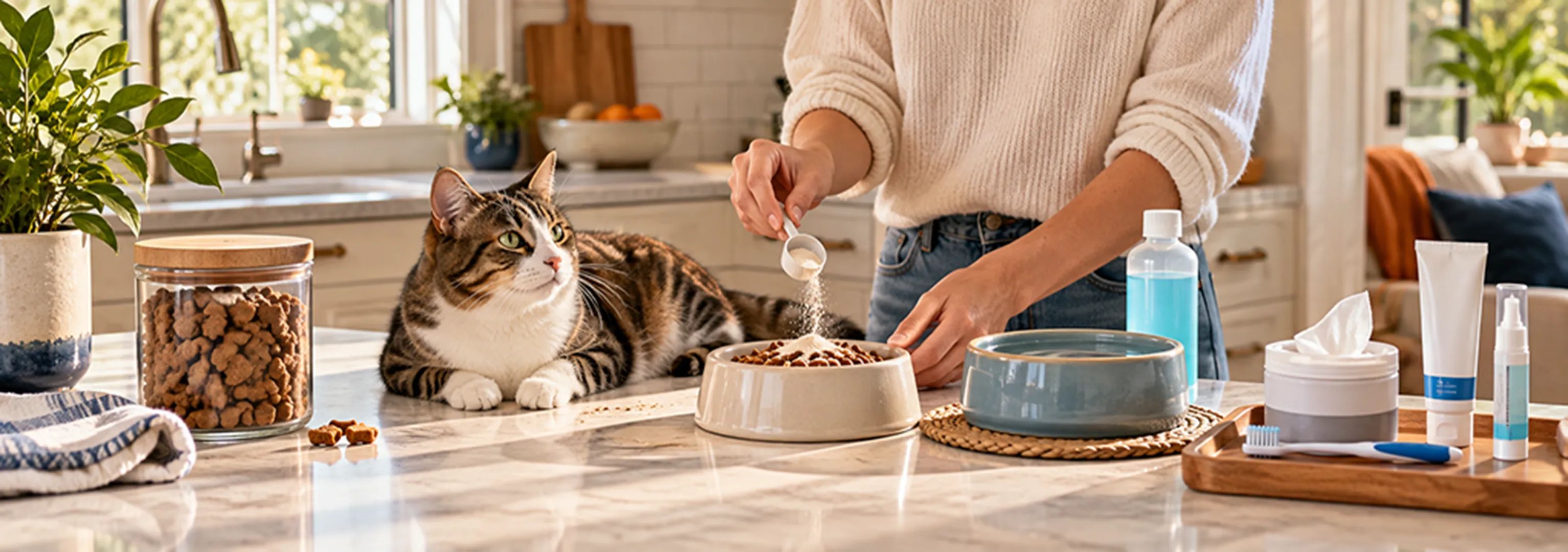
Cat dental treats, water additives, and dental powders are the three strongest product formats in the Amazon U.S. dental-care dataset analyzed for this article. Together, they account for roughly 75% of parent-level unit volume in the August 2026 sample, while toothbrush-and-toothpaste kits, wipes, sprays, and gels make up smaller shares.
That does not mean treats, additives, and powders are automatically the most effective choices for every cat.
Amazon tells us what shoppers are buying. Veterinary research tells us what different forms of oral care may actually do. Those are related questions, but they are not the same question.
That distinction matters because feline dental care sits at the intersection of two very different realities. On one side, veterinarians continue to emphasize plaque control, professional dental examinations, and—when a cat will tolerate it—regular brushing. On the other side, cat owners repeatedly look for something easier: a treat their cat will willingly eat, a powder that can be added to food, or a liquid that goes into the water bowl.
In my view, that gap between ideal dental care and care owners can realistically maintain is one of the biggest reasons this category has become commercially interesting.
Dental problems have also become a familiar concern for cat owners rather than a niche veterinary topic. Cornell University's Feline Health Center notes that studies report dental disease in 50%–90% of cats older than four years, although prevalence varies by condition, population, and study. That does not mean every cat needs the same dental product, but it does explain why oral care has become an increasingly important part of routine feline care.
For retailers, online sellers, veterinary retail counters, and pet boutiques, the opportunity is therefore not simply to stock "dental products." It is to understand the different problems customers are trying to solve.
What Does "Most Popular" Mean on Amazon?
Before ranking product types, we need to define popularity.
A product can be popular because it sells many units, because it receives thousands of reviews, because it ranks highly in its category, or because shoppers rate it well. Those signals should not be treated as interchangeable.
For this article, sales volume is the primary commercial popularity signal where available. Product-family prevalence, price, review count, and ratings are supporting signals. Ratings are especially important to separate from popularity: a 4.7-star product may satisfy a small group of buyers without being a large-volume seller.
The Amazon data analyzed here comes from the U.S. Cats → Health Supplies → Dental Care category for August 2026. The raw file contains 179 listing or variation rows representing approximately 80 parent product families. Because different flavors, sizes, and packages can belong to the same parent product and may repeat parent-level sales figures, product families were consolidated when estimating category share.
That methodology matters. Without parent-level consolidation, one successful product with many variations could appear several times and artificially inflate its importance.
Amazon Cat Dental Care Snapshot
| Metric | August 2026 Dataset |
| Listing / variation rows | 179 |
| Approx. parent product families | 80 |
| Leading format by unit volume | Dental treats / chews |
| No. 2 format | Water additives |
| No. 3 format | Dental powders |
| Top three formats combined | ~75.4% of parent-level units |
| Highest median rating among major formats | Toothpaste / brush kits |
| Highest median price among leading formats | Dental powders Data source: Petfairs analysis of supplied Amazon U.S. Cats → Health Supplies → Dental Care dataset, August 2026. This is a snapshot of one Amazon category and time period. It is not the total U.S. feline dental-care market and should not be presented as national market share. |
Dental Treats and Chews Lead the Amazon Sample
Dental treats and chews were the largest format in the dataset, generating approximately 33.4% of parent-level unit volume.
That makes intuitive sense from a pet-owner perspective. A dental treat asks very little from either the cat or the owner. The owner opens the package; the cat eats something that feels like a reward. There is no toothbrush, no finger inside the mouth, no liquid sprayed toward the gums, and usually no training period.
Amazon Performance by Major Product Format
| Product Type | Parent Families | Parent-Level Units | Unit Share | Median Price | Median Rating |
| Dental treats / chews | 14 | 100,117 | 33.40% | $12.99 | 4.4 |
| Water additives | 15 | 67,614 | 22.60% | $18.49 | 4.3 |
| Dental powders | 10 | 58,188 | 19.40% | $30.34 | 4.2 |
| Dental wipes | 8 | 21,269 | 7.10% | $9.78 | 4.3 |
| Toothpaste / brush kits | 8 | 19,665 | 6.60% | $16.99 | 4.5 |
| Dental sprays | 10 | 13,396 | 4.50% | $16.11 | 4.2 |
| Dental gels | 6 | 7,832 | 2.60% | $13.99 | 4.45 |
| Other formats | 9 | 11,500 | 3.80% | $19.99 | 4.2 The commercial strength of treats does not mean every dental treat has clinically demonstrated benefits. The Veterinary Oral Health Council, or VOHC, evaluates specific products rather than declaring an entire product category effective. Its current list of accepted feline products includes dental treats such as Feline Greenies, Whiskas Dentabites, Purina DentaLife Daily Oral Care, and Purina Pro Plan Veterinary Diet Dental Bites, with approved plaque and/or tartar claims depending on the individual product. Clinical research also supports the basic idea that some specifically designed feline dental chews can reduce plaque or calculus accumulation. That evidence belongs to the tested formulation, however—not to every crunchy treat marketed with a dental label. For shoppers, the lesson is simple: "Dental treat" describes a format, not a guarantee. For retailers, that distinction is equally important. A familiar format may drive trial, but evidence, ingredient positioning, size, palatability, caloric contribution, and the intended dental claim determine how credible the product actually is. |
Water Additives Are the Second-Largest Format
Water additives account for approximately 22.6% of parent-level units in the Amazon sample, making them the second-largest category.
Their appeal is easy to understand.
The product turns an existing behavior—drinking—into a possible oral-care step. The owner does not have to convince the cat to sit still for brushing, and there is no treat that adds another feeding occasion.
This is exactly the type of product that answers a very common owner question:
How can I care for my cat's teeth if my cat will not let me brush them?
That question appears repeatedly in online cat communities.
Recent 2026 Reddit discussions include owners asking whether water additives, powders, treats, or wipes are reasonable options because their cats refuse toothbrushes. Reddit is not medical evidence, but it is useful evidence of consumer friction: brushing compliance is a real problem.
Water additives also have some product-specific clinical evidence behind them. A controlled crossover study published in the Journal of Veterinary Dentistry evaluated a drinking-water additive over two 56-day periods and reported reduced plaque and calculus accumulation in the cats studied.
The current VOHC feline list also includes accepted water-additive products.
The correct conclusion is therefore not:
Water additives work.
It is:
Certain tested water additives have evidence for plaque or tartar control, while evidence must be evaluated product by product
That difference is essential for responsible pet-health content.
Dental Powders Have Become a High-Value Format
Dental powders represent approximately 19.4% of parent-level unit volume, placing them third in the Amazon sample.
What makes this category especially interesting is price.
The median price in the dataset was approximately $30.34, significantly higher than the median for dental treats at $12.99 or wipes at $9.78.
Yet powders still represented nearly one-fifth of analyzed volume.
Median Price Comparison
| Format | Median Price |
| Dental wipes | $9.78 |
| Dental treats / chews | $12.99 |
| Dental gel | $13.99 |
| Dental spray | $16.11 |
| Toothpaste / brush kit | $16.99 |
| Water additive | $18.49 |
| Dental powder | $30.34 This suggests something commercially important. Convenience may be valuable enough that shoppers will pay more for it. That is an editorial inference rather than a measured reason for purchase, but it is consistent with the product's use case: sprinkle a measured quantity onto food rather than physically cleaning the cat's teeth. ProDen PlaqueOff powder also appears in VOHC's accepted feline product list with plaque and tartar claims, demonstrating again why retailers should evaluate specific products rather than making claims based solely on the word "powder." For small pet retailers, powders are interesting because they occupy a different position from inexpensive treats. They can support a higher price point while still addressing the same core consumer problem: "I want to do something for my cat's teeth, but brushing is difficult." |
Toothbrush and Toothpaste Kits Sell Less—but Receive Strong Ratings
Traditional toothpaste-and-brush products account for only about 6.6% of parent-level units in the Amazon sample.
Their median rating, however, is approximately 4.5 stars, the highest among the major formats in the dataset.
That contrast may be more meaningful than a simple sales ranking.
A lower-volume but highly rated product can indicate that the solution works well for customers who can actually use it, even if fewer customers choose the format in the first place.
AAHA states that daily brushing is the best way to help reduce plaque accumulation at home and recommends a pet-specific soft-bristled toothbrush and veterinary-safe toothpaste. Human toothpaste should not be substituted.
The 2025 FelineVMA oral-health guidelines similarly discuss brushing as part of at-home dental care while emphasizing cooperative care and the practical realities of working with cats.
In other words:
Clinical usefulness and consumer convenience do not necessarily rank in the same order
That is one of the most important lessons in this Amazon dataset.
A dental treat may be easier to sell because it is easy to use.
A toothbrush may demand more effort but provide direct mechanical plaque removal.
Both products can belong in the same category because they solve different versions of the same problem.
Dental Wipes Sit Between Brushing and Hands-Off Care
Dental wipes account for about 7.1% of parent-level units in the analyzed sample.
That puts them above sprays, gels, and traditional brushing kits in unit share, but well below treats, additives, and powders.
Their position makes sense.
A wipe still requires the owner to touch the cat's mouth and teeth, but it does not require the same precision as a toothbrush. For a cat that accepts handling but dislikes brushing motions, wipes can represent an intermediate level of interaction.
The FelineVMA guidelines include dental wipes among available home-care approaches, while the current VOHC feline list also includes accepted wipe products.
For a retailer, this creates a useful way to organize an assortment by owner effort rather than only by product type.
Dental Care by Owner Effort
| Effort Level | Typical Formats |
| Very low | Water additive, food powder |
| Low | Dental treats |
| Moderate | Spray, gel |
| Moderate–high | Dental wipes |
| High | Toothbrush + toothpaste This is not an efficacy ranking. It is a behavioral merchandising framework: How much cooperation does the product require from the cat? That question may be more useful to shoppers than simply asking which format is "best." |
Sprays and Gels Fill Smaller, More Targeted Niches
Dental sprays represented approximately 4.5% of parent-level unit volume, while gels represented around 2.6%.
Those smaller numbers should not be interpreted as evidence that either format is ineffective.
Randomized research on a specific barrier gel in cats found significantly lower plaque deposition after 56 days compared with controls, while no statistically significant differences were observed for calculus, gingivitis, or gingival bleeding in that particular study.
That nuance matters.
One dental product can improve one measured outcome without improving every oral-health outcome.
Consumers frequently see packaging that combines terms such as:
Plaque. Tartar. Fresh breath. Gum care.
These should not automatically be treated as interchangeable benefits.
For Petfairs buyers and other retailers, a better product-evaluation question is:
What exact outcome does the product have evidence for
That is much more meaningful than asking whether the bottle says "advanced dental care."
Plaque and Tartar Are Not the Same Thing
Understanding the difference between plaque and tartar makes the entire dental-care category easier to evaluate.
Plaque is a bacterial biofilm that forms on the tooth surface. Cornell University's Feline Health Center explains that if plaque is not regularly removed, it can migrate toward and below the gumline and contribute to gingival inflammation.
When plaque absorbs minerals and hardens, it becomes calculus, commonly called tartar.
Once significant calculus is already present, adding a powder or water additive should not be viewed as a substitute for veterinary dental evaluation.
That distinction explains why VOHC separately identifies products with:
- Plaque claims
- Tartar claims
- Plaque & tartar claims
For shoppers, this is an important safeguard against expecting too much from an over-the-counter oral-care product.
Why Is Feline Dental Care Becoming Such a Common Owner Concern?
Dental disease is common enough in cats that the category should not be treated as a cosmetic niche.
Cornell reports that studies estimate 50%–90% of cats older than four years have some form of dental disease. Gingivitis, periodontitis, and tooth resorption are among the most common feline dental disorders.
That number does not mean 50%–90% of cats need an Amazon dental product.
It means owners should take oral health seriously and work with a veterinarian when disease is suspected.
Common warning signs include:
- persistent bad breath;
- red, swollen, or bleeding gums;
- excessive drooling;
- difficulty chewing;
- dropping food;
- eating on one side;
- decreased appetite;
- pawing at the mouth;
- facial swelling;
- visible dental damage.
A cat can also continue eating despite significant oral discomfort.
That is why "my cat still eats normally" is not a reliable dental exam.
Is Bad Breath a Reason to Buy a Dental Product?
Sometimes it prompts the purchase, but persistent bad breath should not simply be covered up.
Many Amazon dental listings emphasize "fresh breath" because odor is an easy problem for owners to notice.
The medical question is more important:
Why does the breath smell different?
AAHA includes bad breath among signs that should prompt dental evaluation, especially when accompanied by red gums, drooling, or difficulty eating.
A fresh-breath additive may make a product attractive, but a retailer should avoid presenting odor control as a substitute for professional assessment.
For responsible pet retail, the message should be:
Home dental products can support routine oral care. They do not diagnose or treat existing dental disease.
Why Don't More Cat Owners Brush Their Cats' Teeth?
The answer is probably not lack of awareness alone.
The practical challenge is cooperation.
In recent Reddit discussions, cat owners repeatedly describe similar situations:
- the cat refuses the toothbrush;
- the cat tolerates treats but not oral handling;
- the owner cannot maintain a daily routine;
- the owner tries powder or water additives instead;
- the owner is uncertain whether dental treats are enough;
- the cat accepts a wipe but not a brush.
These discussions are anecdotal and cannot establish medical effectiveness.
But they reveal a very real product-selection problem:
A theoretically excellent dental routine has little practical value if the owner cannot perform it consistently.
The 2025 FelineVMA guidelines address this reality through a broader spectrum-of-care approach. Appropriate recommendations should consider the individual cat, caregiver, ability to provide home care, finances, stress, and health status.
That makes feline dentistry particularly suitable for a choice-based product assortment rather than a one-product-fits-all approach.
Popularity Does Not Equal Clinical Evidence
This is the most important distinction in the entire article.
What Amazon Can Tell Us
Amazon data can show:
- what formats generate high unit volume;
- what price levels shoppers accept;
- which products accumulate reviews;
- which categories attract many competing listings;
- which formats appear commercially mature.
What Amazon Cannot Tell Us
Amazon sales alone cannot prove:
- that a product reduces plaque;
- that it prevents periodontal disease;
- that one format is medically superior;
- that a highly rated product is suitable for every cat;
- that a dental product can replace veterinary care.
Scientific and veterinary evidence must answer those questions.
That is why a useful buying framework combines commercial demand + verified evidence + practical usability.
What Should Shoppers Look for in a Cat Dental Product?
A practical evaluation can start with five questions.
What problem are you trying to address?
Routine plaque management is different from visible tartar, gum inflammation, mouth pain, or persistent bad breath.
Products designed for home maintenance should not be expected to correct advanced disease.
Will the cat actually accept the format?
A cat that rejects oral handling may be a poor candidate for a toothbrush routine unless gradual cooperative training is possible.
A food powder or water additive may be easier to integrate, while treats can work well for cats motivated by food.
Is there evidence for the specific product?
The VOHC Seal is one useful indicator because it applies to specific products that meet the council's standards for plaque and/or tartar claims.
The word "dental" on a package is not evidence by itself.
Can the owner maintain the routine?
Consistency matters.
A complicated system used twice and abandoned may provide less practical value than an evidence-supported routine the owner can actually maintain.
Does the cat need a veterinary dental exam instead?
Pain, bleeding gums, significant tartar, facial swelling, difficulty eating, or persistent odor should shift the conversation from shopping to veterinary care.
Choosing Between Treats, Powders, Water Additives, Wipes and Toothpaste
There is no single best format for every cat.
Practical Comparison
| Format | Main Advantage | Main Limitation | Best-Fit Scenario |
| Dental treats | Easy, rewarding, familiar | Adds calories; evidence varies by product | Food-motivated cat |
| Water additive | Minimal handling | Cat must continue drinking normally; evidence product-specific | Cat refuses oral handling |
| Dental powder | Easy to add to food | Usually higher price; must be accepted with food | Wet-food or meal-based routine |
| Dental wipes | Mechanical contact without brush | Still requires mouth handling | Cat tolerates brief touching |
| Toothbrush + toothpaste | Direct mechanical plaque removal | Highest cooperation requirement | Cat trained for oral handling |
| Gel | Targeted application | Requires some mouth access | Cat tolerates brief application |
| Spray | Fast application | Some cats dislike spraying | Owner wants low-duration application The best answer is therefore not: Which product is strongest? It is: Which evidence-supported product can this particular cat and owner use consistently? |
What Does Amazon Demand Tell Pet Retailers?
For small pet stores and online sellers, the 2026 Amazon sample suggests that convenience-oriented formats deserve serious shelf space.
Treats, water additives, and powders together generated approximately three-quarters of analyzed parent-level units.
That is not an argument to stock only those three formats.
It is an argument to build an assortment around the different levels of owner effort.
A strong dental section might therefore provide:
Easy daily options: treats, powders, water additives.
Hands-on alternatives: wipes, gels, sprays.
Mechanical-care options: toothbrushes and pet toothpaste.
That gives shoppers a pathway rather than a wall of similar packages.
Dental Care Is Also a Natural Replenishment Category
There is another commercial reason this category deserves attention.
Most feline dental-care products are consumables.
Treats are eaten.
Powders are measured into food.
Water additives are poured into drinking water.
Wipes are discarded.
Toothpaste is used up.
Sprays and gels eventually need replacing.
That creates a different retail dynamic from durable products such as carriers, beds, or cat trees.
Use creates depletion, and depletion creates a natural reason to reorder.
We should not invent a universal replenishment interval—one package may last weeks while another lasts months depending on product size, dosage, number of cats, and frequency of use.
But structurally, dental care is a repeat-purchase category.
For pet boutiques, marketplace sellers, subscription businesses, veterinary retail, and independent stores, that makes customer education particularly valuable. Helping a buyer find a routine that works can potentially create a longer-term purchasing relationship than a one-time accessory sale.
A Practical Assortment Framework for Small Pet Retailers
Based on the Amazon data and the range of evidence-supported product formats, I would organize the category into three tiers.
| Assortment Tier | Suggested Formats | Why | Best-Fit Scenario | Median Price | Median Rating |
| Core | Dental treats, water additives, dental powders | Strongest demand in supplied Amazon sample | Food-motivated cat | $12.99 | 4.4 |
| Support | Wipes, toothpaste/brush kits | Cover owners who want more direct cleaning | Cat refuses oral handling | $18.49 | 4.3 |
| Test / Differentiation | Gels, sprays, specialized combinations | Useful for specific customer needs and assortment differentiation | Wet-food or meal-based routine | $30.34 | 4.2 |
| Dental wipes | Mechanical contact without brush | Still requires mouth handling | Cat tolerates brief touching | $9.78 | 4.3 |
| Toothbrush + toothpaste | Direct mechanical plaque removal | Highest cooperation requirement | Cat trained for oral handling | $16.99 | 4.5 |
| Gel | Targeted application | Requires some mouth access | Cat tolerates brief application | $16.11 | 4.2 |
| Spray | Fast application | Some cats dislike spraying | Owner wants low-duration application | $13.99 | 4.45 |
| Other formats | 9 | 11,500 | 3.80% | $19.99 | 4.2 This is a merchandising framework, not a veterinary ranking. For a physical pet store, the core question might be: Can a customer understand the difference between these products within 30 seconds? For an e-commerce seller, it might be: Does the product page explain whether the item targets plaque, tartar, breath, or general home care? For marketplace resellers, another question matters: Is the listing differentiated by real product evidence or only by increasingly aggressive claims? Those questions are often more commercially useful than simply chasing the next "best seller." |
Where Petfairs Fits Into This Category
Petfairs is an online wholesale pet-supplies platform serving independent retailers, e-commerce sellers, boutiques, veterinary retail operations, marketplace resellers, and other professional buyers across many markets.
For a category such as feline dental care, a wholesale platform has a different job from a veterinary clinic.
The clinic diagnoses and treats disease.
The retailer helps owners access appropriate everyday care products.
The sourcing platform helps retailers build the assortment.
Those roles should remain distinct.
From a buying perspective, the Amazon data suggests that assortment breadth matters because customers are not all looking for the same routine. Some want treats. Some specifically want a no-brush solution. Others are willing to use wipes or toothbrushes.
For professional buyers, the opportunity is therefore less about finding one "winning dental product" and more about covering the main care behaviors behind demand.
Frequently Asked Questions
What is the most popular type of cat dental-care product on Amazon in 2026?
In the supplied August 2026 Amazon U.S. dataset, dental treats and chews were the largest product format, representing approximately 33.4% of parent-level unit volume. Water additives ranked second at about 22.6%, followed by dental powders at roughly 19.4%.
These figures describe the supplied Amazon sample, not total U.S. market share.
Are dental treats enough for a cat's teeth?
Not necessarily.
Specific dental treats can help reduce plaque or tartar, and several feline treats carry VOHC acceptance. However, veterinary dental care includes regular oral examinations, professional treatment when necessary, and home plaque-control strategies appropriate for the individual cat.
What can I use if my cat will not let me brush its teeth?
Depending on the cat and veterinary advice, options may include VOHC-accepted dental treats, water additives, powders, wipes, gels, or dental diets.
The important point is to choose a product with evidence for its claimed benefit rather than assuming all products in a format perform equally.
Are cat dental water additives effective?
Some specific water additives have clinical evidence for reducing plaque and/or calculus, and certain feline water additives have received VOHC acceptance.
That does not prove all water additives are effective.
Do dental powders for cats work?
Some specific powders have evidence or VOHC acceptance for plaque and tartar control. The effectiveness of one tested formulation should not be generalized to all powders.
Is brushing still the best way to clean a cat's teeth?
AAHA recommends daily brushing as the best at-home method for helping reduce plaque accumulation when the cat tolerates it.
Pet-specific toothpaste should be used, not human toothpaste.
Can dental products remove existing tartar?
Home-care products are primarily used to help manage plaque and tartar accumulation. Significant existing calculus or suspected dental disease requires veterinary assessment and may require professional dental treatment.
Why does my cat have bad breath?
Persistent bad breath can be associated with oral or dental disease. If odor is ongoing—especially with red gums, drooling, appetite changes, difficulty eating, or visible dental problems—a veterinary dental examination is appropriate.
How often should I clean my cat's teeth?
Veterinary sources generally favor frequent plaque control, with daily brushing considered ideal when feasible. The correct routine depends on the product, the cat's oral health, and veterinary guidance.
Product label directions should also be followed.
What should pet stores stock for cat dental care?
A balanced assortment can include treats, water additives, powders, wipes, toothpaste/brush kits, and selected gels or sprays.
Amazon's 2026 sample suggests the strongest commercial demand currently sits in treats, water additives, and powders.
Sources and Methodology
Amazon commercial data
Petfairs analysis of the supplied Amazon U.S. Cats → Health Supplies → Dental Care dataset, August 2026. Parent products were consolidated where variants appeared to share parent-level sales metrics. Amazon results represent a marketplace snapshot and should not be interpreted as total U.S. market share or veterinary evidence.
FelineVMA — 2025 Feline Oral Health and Dental Care GuidelinesJournal of Feline Medicine and Surgery, first published November 29, 2025.
https://journals.sagepub.com/doi/10.1177/1098612X251398793
Used for current feline dental-care guidance, home care, cooperative care, oral-health assessment, and evidence-based product considerations.
Cornell Feline Health Center — Feline Dental Diseasehttps://www.vet.cornell.edu/departments-centers-and-institutes/cornell-feline-health-center/health-information/feline-health-topics/feline-dental-disease
Used for dental-disease prevalence, plaque and calculus definitions, gingivitis, periodontitis, and feline oral-health background.
American Animal Hospital Association — Dental Carehttps://www.aaha.org/resources/your-pets-dental-care/
Used for at-home brushing guidance, plaque management, water additives, dental chews, professional care, and warning signs.
Veterinary Oral Health Council — Accepted Products for Catshttps://vohc.org/accepted-products/
Used to distinguish product-format popularity from evidence evaluated at the individual-product level.
Clarke DE. Drinking water additive decreases plaque and calculus accumulation in cats. Journal of Veterinary Dentistry. 2006.https://pubmed.ncbi.nlm.nih.gov/16878759/
Controlled clinical trial used as evidence that a specific tested drinking-water additive reduced plaque and calculus accumulation.
Efficacy of a barrier gel for reducing the development of plaque, calculus, and gingivitis in cats.https://pubmed.ncbi.nlm.nih.gov/23008857/
Randomized controlled trial used to illustrate why individual outcomes and formulations must be evaluated separately.
Reddit / CatAdvice discussions, 2026
Reddit discussions were reviewed only to identify recurring owner questions such as difficulty brushing, uncertainty about dental treats, and interest in powders and water additives. Reddit anecdotes were not used as veterinary or efficacy evidence.
Final Takeaway
If we look only at Amazon, the answer seems straightforward: dental treats, water additives, and powders are the strongest product formats in the supplied 2026 dataset.
But the more useful answer goes deeper.
Cat owners are not simply shopping for dental products. They are trying to find a routine they can realistically maintain with an animal that may not cooperate with direct oral care.
That helps explain why low-friction formats perform so strongly.
At the same time, convenience should not be confused with clinical superiority. Veterinary guidance still emphasizes plaque control, regular oral examinations, professional dental care when needed, and brushing when a cat can be trained to tolerate it.
For retailers, this means the winning strategy is unlikely to be "stock the most popular product."
It is to offer different evidence-supported ways to solve the same care problem.
And because treats, powders, additives, wipes, gels, and toothpaste are consumed through regular use, feline dental care also has something many durable pet categories do not: a natural replenishment cycle.
That combination—common owner concern, multiple usage scenarios, and recurring consumption—is what makes feline dental care a particularly important category to understand in 2026.
 Popular Blogs