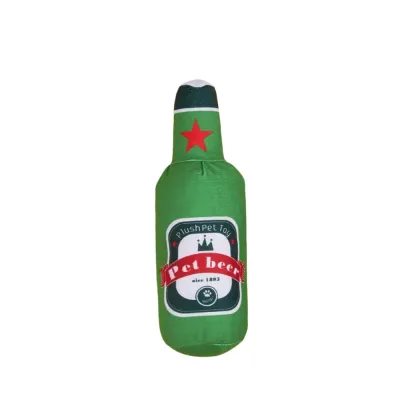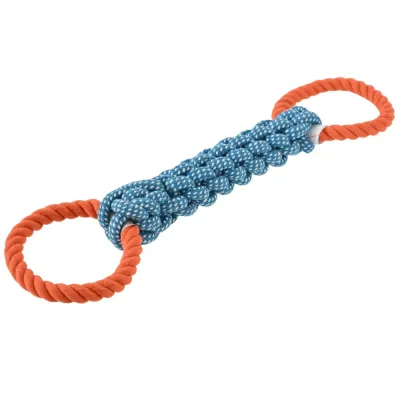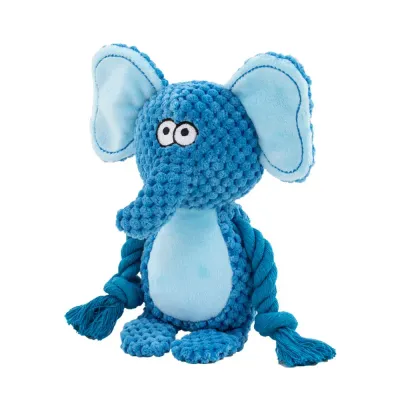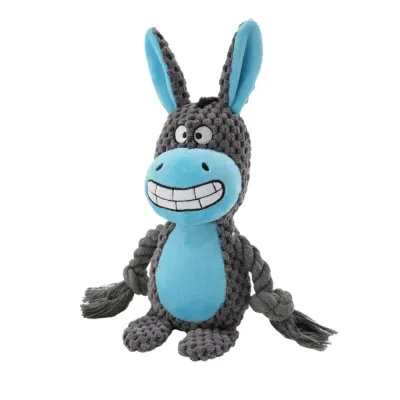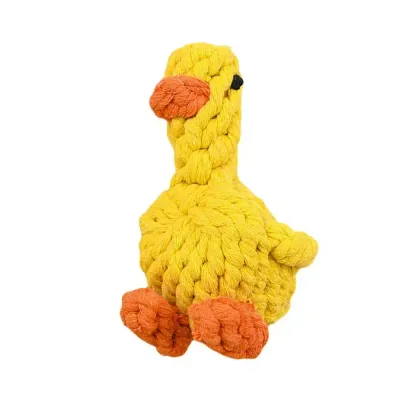

Wholesale Dog Toys in Bulk for New Pet Store Owners
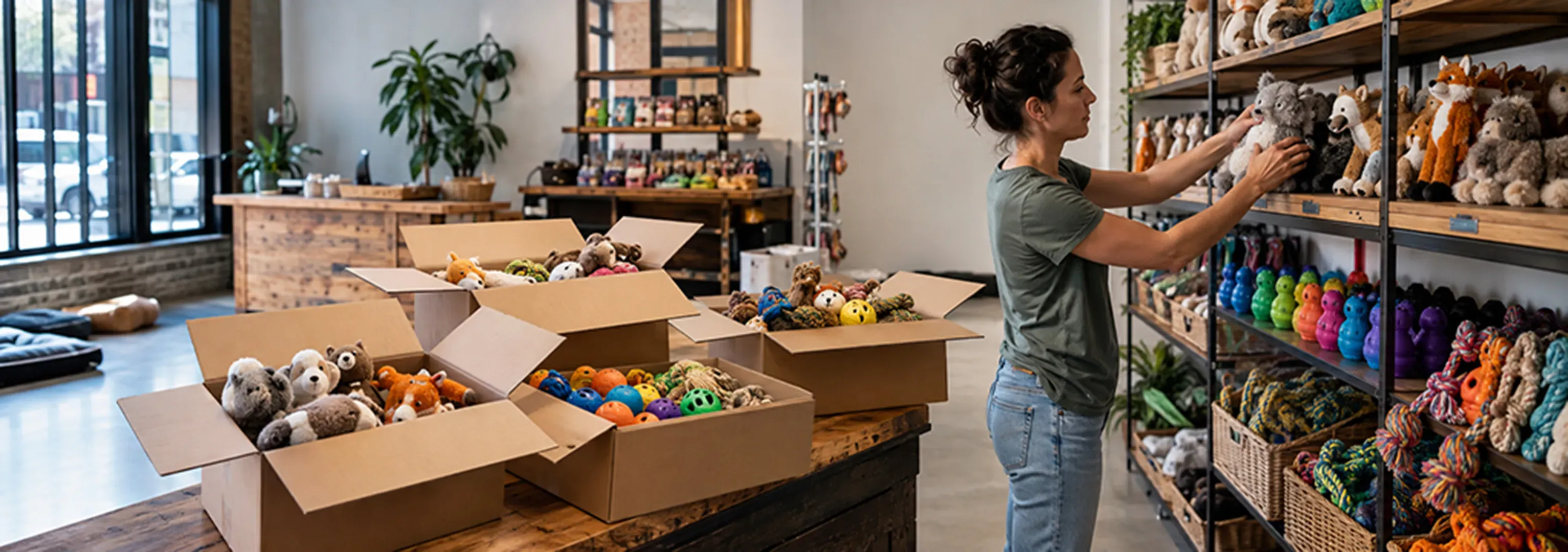
Small pet stores can buy dog toys in bulk from four main sources: domestic pet distributors, B2B wholesale marketplaces, trade shows, and direct manufacturers. The best choice depends less on finding the lowest unit price and more on balancing minimum order quantity, product variety, landed cost, restocking speed, sales-channel restrictions, and inventory risk.
For a new pet boutique or independent retailer, buying smaller quantities across several toy types usually makes more sense than committing heavily to one design. More established retailers with proven sales volume may benefit from larger manufacturer orders or private-label sourcing.
That distinction matters because the U.S. dog market is large, but dog owners are also becoming more deliberate about their spending. APPA reported that 71 million U.S. households owned dogs in 2025, representing 53% of households, while describing owners as increasingly value-conscious rather than simply cutting pet spending. (American Pet Products Association)
For retailers, that changes the sourcing question from:
“Where can I buy cheap dog toys?”
to:
“Where can I source toys customers will actually buy, at an inventory level my business can afford to carry?”
That is the question this guide answers.
Quick Answer: Where Should a Small Pet Store Buy Dog Toys?
There is no single sourcing channel that works best for every retailer.
A neighborhood pet store that needs products next week has very different needs from an online seller planning a private-label collection six months in advance. A dog trainer may want durable tug and reward toys, while a boutique may sell more novelty plush designs. Grooming salons and veterinary clinics with retail shelves generally need a tighter selection of easy-to-understand products rather than hundreds of SKUs.
Here is the practical comparison.
| Sourcing option | Typical strength | Main limitation | Best suited for |
| Domestic distributor | Fast replenishment and established brands | Higher unit cost than direct factory sourcing | Physical pet stores, groomers, clinics |
| B2B wholesale marketplace | Broad selection and relatively low entry commitment | Terms vary between platforms and suppliers | New stores, boutiques, online sellers |
| Trade show | Product discovery and supplier relationships | Travel, time and ordering complexity | Retail buyers expanding assortment |
| Direct manufacturer | Strong price control at larger volume | Higher MOQ, logistics and quality-control responsibility | Established retailers and private-label brands |
| Carton-based factory marketplace | Factory-linked pricing with lower commitment than traditional manufacturing | Carton quantity still varies by SKU | Small businesses testing products before scaling A small retailer should therefore treat sourcing as a portfolio decision, not as a hunt for one perfect dog toy supplier. |
Why Dog Toys Remain an Important Retail Category
Dog toys occupy an interesting position in pet retail. They are not protected household essentials in the same way food may be, but play, enrichment and interaction are strongly connected to how owners care for their dogs.
APPA's 2026 dog-owner research suggests pet owners are becoming more intentional about value. The organization found that owners continued prioritizing products that serve practical, recurring purposes even under economic pressure. (American Pet Products Association)
That is important for toy merchandising.
A toy that simply looks cute competes primarily on design and price.
A product that combines play + enrichment, chewing + treat dispensing, or fetch + water play gives customers more reasons to justify the purchase.
Pet Age identified interactive, durable and mentally stimulating products—including puzzle-feeding and enrichment concepts—as, as notable toy directions for pet retailers in 2026. (Pet Age)
This is why I would not build a small-store assortment entirely around novelty plush.
Visual products attract attention, but functional products give the assortment staying power.
The U.S. Dog Market in Numbers
The size of the dog-owning population explains why even specialized retailers can build meaningful categories around toys, training, walking and enrichment.
U.S. Dog Ownership Snapshot
| Metric | Latest cited figure | Source |
| U.S. dog-owning households in 2025 | 71 million | APPA |
| Share of U.S. households owning dogs | 53% | APPA |
| YoY growth in dog-owning households | 4% | APPA |
| Dog owners purchasing chews in 2025 | 65% | APPA |
| Dog owners grooming at home | 51% | APPA APPA also reported that 65% of dog owners purchased chews in 2025, up 5% year over year, interpreting that growth partly through owners' preference for products that can deliver several forms of value at once. (American Pet Products Association) |
Simple Market Context
For a retailer, this does not mean every dog toy will sell.
It means the addressable customer base is broad enough to support segmentation by play style, dog size, price point and shopping occasion.
Where Can Small Pet Stores Buy Wholesale Dog Toys?
Domestic Pet Distributors
A domestic distributor buys from manufacturers or brands and resells to retailers, usually with inventory already positioned inside the target market.
For small physical stores, this can be one of the simplest ways to source.
The biggest advantage is replenishment speed. If a plush toy sells out unexpectedly, a retailer may be able to replace it without waiting for an international production and freight cycle.
Domestic distributors may also combine products from several brands into one purchasing relationship.
The trade-off is cost. Every additional layer in the supply chain needs a margin, so the wholesale unit price may be higher than buying directly from a factory.
Still, the lowest unit price does not automatically create the highest retail profit.
A $3 toy that requires buying 500 units can represent more business risk than a $4 toy available in quantities of 20 or 30.
That makes distributors particularly useful for:
- independent physical pet stores;
- grooming salons with retail shelves;
- veterinary clinics selling accessories;
- boarding and daycare operators;
- stores that need frequent replenishment.
Online B2B Wholesale Marketplaces
For many smaller businesses, online marketplaces offer the most accessible middle ground between traditional distribution and direct manufacturing.
They allow a buyer to compare many products without opening separate accounts with dozens of manufacturers.
However, marketplaces themselves can follow very different models.
Faire
Faire focuses heavily on independent retail brands.
Its August 2026 dog toys and training guide lists more than 1,000 brands and 26,000 products in that category. Faire states that wholesale prices on its platform commonly span roughly $3.50 to $18, although the number varies by product type.
Its platform data also provides useful insight into the way smaller retailers buy.
Faire reports that many products can have MOQs as low as one unit, while opening-order requirements frequently fall around $100–$200. Pet specialty stores on Faire typically order around three units of an individual product per order.
That does not mean three units is the correct industry-wide purchasing quantity.
It does show that a major B2B marketplace sees significant demand for broad assortments purchased at relatively shallow SKU depth.
Faire Marketplace Snapshot
| Marketplace indicator | Faire dog toys & training |
| Brands | 1,000+ |
| Products | 26,000+ |
| Reported wholesale price span | About $3.50–$18 |
| Typical plush wholesale price | Around $9 |
| Typical squeaky toy price | Around $12.50 |
| MOQ | Can start at 1 unit |
| Frequently cited opening order | About $100–$200 These figures describe Faire's platform and should not be interpreted as universal industry averages. |
WholesalePet
WholesalePet represents another model: an industry-focused pet wholesale marketplace connecting professional retailers with brands.
What is especially useful about browsing platforms like this is seeing how much supplier terms vary.
For example, current WholesalePet listings show:
- Outward Hound with a $100 minimum and restrictions on online resellers; (Wholesale Pet)
- Jax & Bones with a $150 opening order, a $150 reorder minimum for brick-and-mortar stores and approval requirements for online vendors; (Wholesale Pet)
- Play Pet Brands with a $200 minimum order and restrictions on selling through marketplaces such as Amazon and eBay; (Wholesale Pet)
- VIP Products/Tuffy with no stated order minimum on the cited listing, while still applying MAP and third-party reseller rules. (Wholesale Pet)
Marketplace sellers, social-commerce merchants and pet-industry e-commerce operators also need to confirm where they are legally or contractually allowed to resell the products.
Factory-Linked Online Wholesale Platforms
Another model has emerged between a traditional marketplace and full direct importing.
These platforms connect smaller businesses with factory-level supply while reducing some of the operational complexity normally associated with sourcing overseas.
Petfairs is one example of this model.
Petfairs describes itself as an online wholesale marketplace designed for independent pet shops, boutiques, groomers, clinics and online stores. Its catalog extends beyond dog products into cat supplies and categories for birds, fish, small animals, reptiles and other pets. (Petfairs)
Rather than requiring a traditional high-volume factory commitment, the platform structures purchases around a one-carton minimum per product, allowing retailers to test merchandise before making a deeper inventory investment. (Petfairs)
Its current dog-toy catalog illustrates what that looks like in practice.
At the time of research, the category displayed 696 dog-toy results. Of those filters, 48 listings fell at 10 pieces or fewer per MOQ, 579 fell between 11 and 50 pieces, 65 between 51 and 100, and four above 100. (Petfairs)
Petfairs Dog Toy MOQ Snapshot
These numbers are a live catalog snapshot, not a statement about the entire wholesale market.
But they illustrate why carton-based sourcing can appeal to smaller operations: many products sit in a quantity range that is substantially easier to test than a traditional production run.
Petfairs also publishes dog toys across chew, plush, rope and interactive categories, which allows a retailer to assemble several play concepts instead of making its entire toy investment around one style. (Petfairs)
For buyers outside the United States, shipping availability and delivery methods should always be checked for the destination and specific product. Petfairs states that its international service supports air and sea door-to-door options for many destinations, with checkout or support providing applicable freight information. (Petfairs)
For U.S. buyers who prioritize replenishment speed, Petfairs also operates separate U.S. warehouse inventory. Its U.S. shipping information states that warehouse orders are processed domestically and generally reach customers within a matter of business days. (Petfairs USA)
This makes the model particularly relevant to smaller retailers that sit between two extremes:
too large for consumer purchasing, but too small for container-scale factory orders.
Buying Directly From Dog Toy Manufacturers
Direct manufacturing can become attractive once demand is predictable.
It may provide:
- better volume pricing;
- custom colors;
- custom packaging;
- exclusive designs;
- private labeling;
- more control over materials.
But these benefits come with additional responsibilities.
A manufacturer quote of $1.80 EXW and a distributor quote of $3.20 delivered cannot be compared by looking at those two numbers alone.
The U.S. International Trade Administration defines landed cost as the total cost after the product reaches the buyer, including the product itself, freight, insurance, tariffs, taxes and other relevant fees. (Trade.gov)
So retailers should compare:
Landed Cost
Factory price
- packaging
- inland transportation
- international freight
- insurance
- duties and tariffs
- brokerage or customs costs
- inspection/testing
- final delivery**
A direct factory order becomes attractive only when the savings on unit cost exceed the additional logistics, compliance and inventory costs.
For a small store, that often happens after, not before, a product has demonstrated demand.
Pet Industry Trade Shows
A search for dog toy suppliers does not need to remain entirely online.
Trade shows remain an important sourcing channel because buyers can touch products, compare construction, discuss terms and meet manufacturers directly.
Global Pet Expo's 2026 buyer program listed more than 1,200 exhibiting companies, 3,500 booths and over 1,000 new products. (Global Pet Expo)
The event defines qualified buyers as businesses purchasing pet products wholesale for resale and requires commercial evidence when approving buyer registrations. (Global Pet Expo)
For serious retailers, trade shows are particularly useful for:
supplier discovery → product inspection → negotiation → relationship building.
The disadvantage is obvious: travel and time.
An online marketplace may be better for a first-time boutique owner testing 10 products. A trade show may be far more valuable to a distributor or multi-location store searching for long-term supplier relationships.
Which Wholesale Option Is Best?
The answer depends on what the buyer is optimizing.
| Buyer priority | Best starting channel |
| Lowest inventory risk | Low‑MOQ marketplace |
| Fast domestic replenishment | U.S. distributor or warehouse |
| Unique boutique designs | Brand marketplace |
| Broad factory assortment | Factory‑linked B2B platform |
| Custom/private‑label toys | Direct manufacturer |
| New product discovery | Trade show |
| Marketplace resale | Supplier that explicitly permits the intended channel |
| Subscription boxes | Low‑cost, repeatable bulk assortment |
| Dog trainers | Functional tug, reward and interactive suppliers |
| Groomers/salons | Compact retail‑ready assortments A retailer can—and often should—use more than one. For example, a pet boutique might source design-driven plush toys from independent brands, functional enrichment toys from a wholesale platform and high-volume best sellers from a manufacturer once demand becomes predictable. |
What Is a Good MOQ for a Small Pet Store?
A good MOQ is not the smallest possible number.
It is the quantity that lets the retailer generate useful sales data without trapping too much working capital.
Imagine two suppliers.
| Supplier A | Supplier B | |
| Unit cost | $2.40 | $3.10 |
| MOQ | 500 | 24 |
| Initial merchandise spend | $1,200 | $74.40 |
| Product tested before large commitment? | No | Yes |
| Inventory exposure | High | Low Supplier A offers a 23% lower unit cost. But Supplier B exposes the store to only a fraction of the inventory risk. If the product proves successful, the retailer can reorder or negotiate better economics later. That is why I recommend small pet stores think in terms of inventory learning cost, not just product cost. Every opening order should answer a question: Will my customers buy this? |
How Should Retailers Test Dog Toys?
A practical opening assortment should test different customer needs rather than 10 variations of the same plush animal.
For example:
| Play need | Suggested test category | Retail purpose |
| Chewing | Rubber or TPR toy | Durability-driven shopper |
| Fetch | Ball or flying disc | Active outdoor customer |
| Tug | Rope or reinforced toy | Interactive play |
| Mental stimulation | Puzzle or snuffle toy | Enrichment |
| Sound | Squeaky toy | Engagement |
| Soft play | Plush toy | Comfort/novelty |
| Food motivation | Treat-dispensing toy | Play + reward |
| Gifting | Novelty animal/food design | Impulse purchase |
| Dog trainers | Functional tug, reward and interactive suppliers | |
| Groomers/salons | Compact retail-ready assortments | From there, track four numbers: units sold, gross margin dollars, sell-through time and reorder rate. A toy does not become a winner because 70% gross margin looks attractive on paper. It becomes a winner when customers repeatedly turn inventory into cash. |
Which Dog Toys Are Best for Resale?
There is no universally best product, but several categories serve distinct retail jobs.
Plush and Squeaky Toys
Plush toys are visually merchandisable and work well in boutiques, gift displays and seasonal collections.
Faire's current marketplace data shows plush as its largest dog-toy product type, with more than 9,000 listings from over 400 brands within the toys and training category. (Faire)
This depth suggests a competitive category, so stores need differentiation through design, theme, size or construction rather than simply adding another generic plush toy.
That is where searches such as:
duck dog toy, piggy dog toy, burger dog toy, tiger dog toy or pheasant plush dog toy
become commercially useful.
They are not merely random long-tail keywords.
They represent a consumer tendency to search by visual theme + toy format + dog need.
Chew Toys
Chew toys should be segmented by dog size and chewing intensity.
Retailers should avoid making absolute claims such as “indestructible” unless those claims can be supported.
A customer searching for a toy for an aggressive chewer has a fundamentally different expectation from someone buying a small puppy's first squeaky toy.
The merchandising should make that difference obvious.
Fetch and Foam Balls
Balls have the advantage of being easy for shoppers to understand immediately.
But a buyer evaluating foam dog balls in bulk should consider more than whether the ball feels soft.
Questions include:
- Is the size appropriate for the target dog?
- Does the surface tear easily?
- Does it float?
- Is it suitable for launchers?
- Can the material tolerate repeated compression?
- Does the packaging clearly explain intended use?
These details reduce the gap between a cheap product and a commercially useful one.
Enrichment and Treat-Dispensing Toys
This is one of the categories I would give increasing shelf space.
Pet Age's 2026 coverage highlights mentally stimulating and interactive toys as areas retailers should pay attention to. (Pet Age)
They also create stronger merchandising stories.
Instead of:
“Rubber ball — $9.99.”
a store can explain:
“Treat-dispensing toy for slower rewards and interactive play.”
The second product gives the customer a reason to buy.
Think in Evergreen Needs, Not Only Trends
This is where my own experience as a pet-industry observer matters.
Pet owners increasingly think about their animals as part of everyday life rather than as an occasional hobby. APPA's recent research similarly describes a deeper human-animal bond and increasingly intentional care decisions. (American Pet Products Association)
A portable dog water bottle is a good example.
Water itself is not a seasonal need. Walking, road trips, training sessions, parks and outdoor activities create a year-round need for a product that is portable, practical and easy to use.
For someone operating a pet business, that makes feeding, hydration, walking and basic care products useful inventory anchors even when fashion or holiday trends change.
I would apply the same logic to toys.
Seasonal Christmas ducks and novelty burger toys can drive attention, but a store should build its core assortment around recurring needs:
chew, fetch, tug, reward, enrichment and training.
Then use themed designs to refresh those functions.
That produces a healthier assortment than chasing novelty alone.
Do Not Compare Wholesale Price Without Calculating Margin
Wholesale buyers frequently look at unit price first.
Retail buyers should start one step later.
Gross Margin Percentage
[Gross\ Margin = \frac{Retail\ Price - Landed\ Cost}{Retail\ Price}\times100]
Suppose a toy sells for $12.99.
Example
| Cost component | Amount |
| Product | $3.20 |
| Freight allocation | $0.65 |
| Duty/brokerage allocation | $0.20 |
| Packaging/handling | $0.15 |
| Landed cost | $4.20 |
| Retail price | $12.99 |
| Gross margin dollars | $8.79 |
| Gross margin | 67.70% This is an illustrative model, not an industry benchmark. The important lesson is that a retailer buying dog toys in bulk should compare landed cost, not merely supplier price. |
How Do You Know Whether a Dog Toy Supplier Is Reliable?
A legitimate website alone is not sufficient.
Before making a meaningful wholesale order, ask:
| Supplier check | Why it matters |
| Registered business identity | Confirms who you are buying from |
| Physical/contact information | Creates accountability |
| Product specifications | Clarifies materials and intended use |
| MOQ and carton quantity | Determines real inventory exposure |
| Sample/testing option | Allows quality evaluation |
| Lead time | Determines replenishment risk |
| Incoterm | Clarifies freight responsibility |
| Defect policy | Defines what happens when products fail |
| Product test reports | Supports safety and material claims |
| Channel restrictions | Prevents resale-policy conflicts |
| Packaging information | Confirms retail readiness |
| Country of origin | Important for importing and labeling |
| Repeat-order capacity | Matters after a product becomes successful The most important question is not: “Is this supplier verified?” It is: “Can this supplier consistently deliver this particular product at the quality, cost and timeline my store requires?” |
Are Dog Toys Regulated in the United States?
This is an area where retailers should be careful with SEO content because inaccurate claims are common.
The American Pet Products Association states that there are few U.S. federal or state rules written specifically and exclusively for ordinary pet toys. That does not mean pet toys are outside consumer-product considerations or that retailers should ignore safety testing. (American Pet Products Association)
APPA specifically notes that some retailers voluntarily use standards related to children's products when setting internal specifications for pet toys, but those children's standards are not automatically legal requirements for every pet toy. (American Pet Products Association)
Therefore, a blanket statement such as:
“Every dog toy sold in America must be ASTM F963 certified”
would be misleading.
Product-specific components can nevertheless trigger regulatory requirements.
A useful real-world example comes from the U.S. Consumer Product Safety Commission.
In August 2025, CPSC announced a recall covering roughly 15,400 Pet Zone laser pointer and LED ball pet toys because accessible button batteries created an ingestion hazard and violated the applicable mandatory button-cell battery requirements. (U.S. Consumer Product Safety Commission)
A second pet laser-toy recall announced in April 2026 involved about 51,160 units for similar button-battery safety problems. (U.S. Consumer Product Safety Commission)
That provides a practical lesson for buyers:
Evaluate the actual construction and components of the product—not merely the fact that it is categorized as a pet toy.
Electronic components, batteries, coatings, detachable pieces and material claims deserve additional scrutiny.
Manufacturers vs. Wholesale Platforms: When Should You Switch?
I recommend a simple framework:
Test → Track → Reorder → Scale
Test
Buy a manageable quantity across several product concepts.
Do not predict a bestseller using personal taste alone.
Track
Measure actual sell-through.
For online sellers, also track conversion, returns and review sentiment.
For physical stores, ask staff which products customers touch, ask questions about and buy repeatedly.
Reorder
Put more money behind confirmed winners.
A rapid second order is usually a better signal than a strong opening week driven by a promotion.
Scale
Once a product has predictable demand, explore deeper buying, better pricing or private-label manufacturing.
This is when manufacturers become more attractive.
The buyer is no longer gambling on 500 unknown units.
They are scaling a known product.
What About Cheap Bulk Dog Toys?
There is nothing inherently wrong with inexpensive toys.
Price is part of retail.
But bulk dog toys cheap should be interpreted as a cost-control search, not as permission to sacrifice quality.
The cheapest item can become expensive when:
- customers return it;
- it breaks immediately;
- reviews damage the store;
- packaging looks unprofessional;
- replacement costs rise;
- freight is inefficient;
- the store cannot reorder it consistently.
A better procurement goal is:
lowest sustainable landed cost for an acceptable product, not simply lowest factory quote.
What Should Different Pet Businesses Stock?
Not every Petfairs customer—or every independent pet business—needs the same toy wall.
Pet Boutique
Focus on strong visual design, giftability, novelty plush, enrichment and differentiated premium products.
Physical Pet Store
Build a balanced core around chew, fetch, plush, rope and interactive play.
Groomer or Mobile Groomer
Use a smaller retail assortment. Reward toys, compact plush, dental-related play and easy impulse purchases can complement service revenue.
Dog Trainer
Prioritize function: tug toys, reward toys, balls, treat dispensers and training-related products.
Veterinary Clinic Retail Area
Keep the assortment edited and easy to explain. Avoid turning the reception area into a general toy warehouse.
Subscription Box Seller
Look for repeatable themes, predictable carton quantities and products that fit shipping dimensions.
Online Pet Seller or Social-Commerce Seller
Visual differentiation matters, but resale rights matter just as much. As current WholesalePet supplier terms demonstrate, some brands restrict Amazon, eBay or third-party marketplace sales. (Wholesale Pet)
New Pet Store Owner
Prioritize learning.
You do not yet need the cheapest 1,000 units.
You need enough products to discover what your local customers want.
A Practical First-Order Dog Toy Mix
For a small store testing eight product concepts, I would start with something like this:
| Category | Share of toy buying budget | Purpose |
|---|---|---|
| Plush/squeaky | 20% | Visual appeal and gifting |
| Durable chew | 20% | Functional year-round demand |
| Interactive/enrichment | 20% | Higher perceived value |
| Fetch/balls | 15% | Familiar core product |
| Rope/tug | 10% | Interactive play |
| Treat dispensing | 10% | Multi-purpose product |
| Seasonal/novelty | 5% | Trend testing These percentages are my suggested test allocation, not published industry averages. The mix should change after the store has its own sales data. That is exactly what good small-business buying should do: replace assumptions with evidence. |
So, Where Should Small Pet Stores Start?
For most new or independent retailers, I would not begin with a large direct-manufacturer order.
Start with a supplier or platform that makes it easy to test several products without putting too much cash into each SKU.
Domestic wholesalers may be preferable when speed and recognizable brands matter most.
Faire can be useful for discovering independent brands and carrying shallow quantities across a wide assortment. Its own platform data reflects this small-batch buying behavior. (Faire)
WholesalePet is useful for established pet-industry brands and transparent supplier-specific terms, although buyers need to check minimums and channel restrictions individually. (Wholesale Pet)
Trade shows such as Global Pet Expo are especially useful when the goal shifts from simply placing an order to discovering suppliers and building relationships. (Global Pet Expo)
And platforms such as Petfairs can make sense when a small pet business wants broader factory-linked sourcing without immediately moving to traditional large-volume factory purchasing. The current platform combines one-carton ordering with categories covering dog, cat and other pet supplies, while offering both international sourcing options and U.S.-warehouse inventory for applicable products. (Petfairs)
The right choice depends on what the business needs next.
Final Buying Checklist
Before placing an order for dog toys for resale, answer these questions:
- Who is the customer for this product?
- What play need does the toy solve?
- What is the real MOQ?
- How many pieces are inside one carton?
- What is the landed cost per sellable unit?
- What retail price can my customer reasonably accept?
- How much cash will this SKU tie up?
- How quickly can I reorder it?
- What happens if the product arrives defective?
- Have I checked materials, construction and relevant safety documentation?
- Am I allowed to resell it through my intended sales channel?
- Do I have evidence that my customers want this product—or am I guessing?
If the answer to the last question is “guessing,” buy less.
Learn first.
Scale second.
FAQ
Where can I buy wholesale dog toys for a small pet store?
Small pet stores can source through pet-product distributors, B2B marketplaces, factory-linked wholesale platforms, industry trade shows and direct manufacturers. The best option depends on MOQ, landed cost, product range, delivery speed and how much inventory the business can safely hold.
What is the best wholesale dog toy supplier for small stores?
There is no universal best supplier. A new boutique may benefit more from low minimums and assortment flexibility, while an established retailer may prioritize direct manufacturing, private labeling or lower volume pricing.
Can I buy dog toys in bulk without ordering hundreds of units?
Yes. Current B2B marketplace data shows that some suppliers support very small unit quantities, while carton-based wholesalers can provide product-specific quantities in the tens rather than hundreds. Faire reports MOQs as low as one unit for some brands, while Petfairs' current dog-toy catalog contains many products with carton quantities between 11 and 50 pieces.
What dog toys are good for resale?
A balanced retail assortment can include plush and squeaky toys, chew toys, balls, rope and tug toys, interactive products, puzzle toys, snuffle products and treat-dispensing toys. The best combination depends on the store's customer base.
Where can I buy durable foam dog balls in bulk?
Look for specialized pet wholesalers, B2B marketplaces or manufacturers offering fetch and ball categories. Instead of comparing price alone, check size, compression, tear resistance, intended dog size, packaging, MOQ and replacement terms.
Are squeaky burger dog toys good for aggressive chewers?
A food-shaped design does not determine durability. Retailers should evaluate the underlying material, seams, squeaker construction and intended chewing level. Products should not be marketed as universally indestructible without evidence supporting that claim.
Are duck, pig, tiger or pheasant dog toys worth stocking?
They can be useful as novelty or giftable products when the visual design matches the store's audience. The animal theme should ideally sit on top of a useful play format—such as squeak, tug, crinkle, fetch or treat hiding—rather than relying on appearance alone.
Is it cheaper to buy directly from a manufacturer?
The factory unit price may be lower, but the buyer should calculate total landed cost, including freight, insurance, duties, taxes, testing, packaging and final delivery. Direct sourcing tends to become more attractive after demand is proven and the retailer can justify larger quantities.
Can online sellers buy wholesale pet toys?
Yes, but sellers must check each supplier's resale policy. Some brands permit independent online stores while restricting third-party marketplaces such as Amazon or eBay. Current WholesalePet supplier listings show that these restrictions vary significantly by brand.
Small pet stores do not need to buy dog toys the same way large chains do.
Their advantage is flexibility.
Instead of making one large bet, they can test several play styles, learn what their own customers prefer, reorder the winners and increase purchasing volume only when the numbers justify it.
That makes MOQ, landed cost, product safety, replenishment speed and supplier reliability more important than chasing the lowest quoted unit price.
The strongest sourcing strategy is therefore not simply:
buy cheap → mark up → sell.
It is:
Find → Compare → Test → Track → Reorder → Scale
That approach works whether the buyer runs a neighborhood pet shop, grooming salon, online pet business, subscription box, training service or growing multi-channel retail operation.
And in a market where dog owners are becoming increasingly deliberate about what delivers real value for their pets, retailers should make their buying decisions just as deliberately. (American Pet Products Association)
 Popular Blogs